
Vertiv Holdings Expands Backlog on AI-Driven Data Center Demand but Faces Contractual and Market Volatility Risks
Vertiv’s latest quarter shows growing order backlog fueled by AI infrastructure growth amid persistent sales cycle unpredictability and pricing pressures.
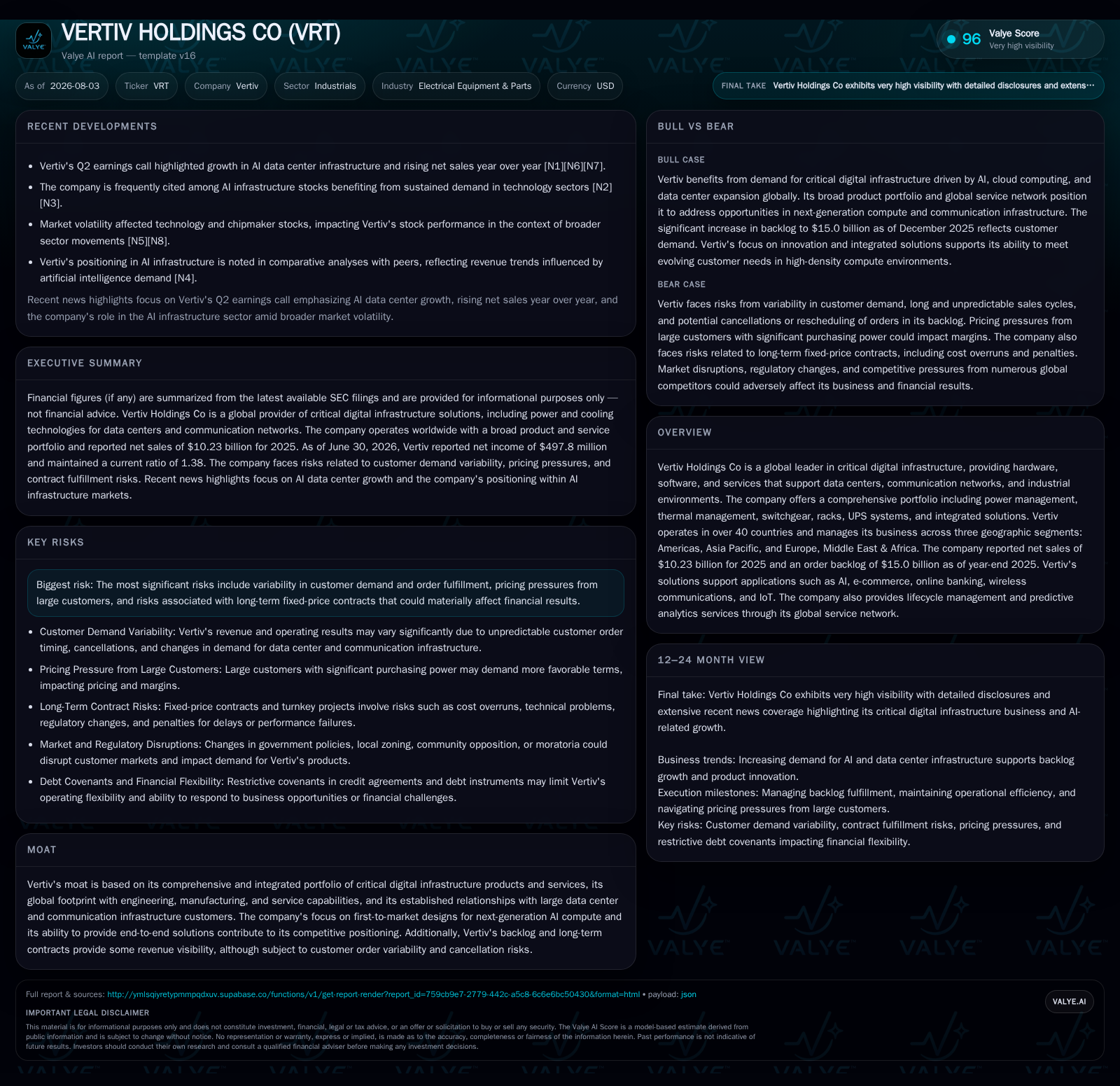
Vertiv Holdings Co reported a sharp increase in its order backlog, nearly doubling from $7.2 billion to $15.0 billion, driven by strong demand for critical digital infrastructure supporting data centers, especially AI deployments. The company’s diversified portfolio of power, thermal management, and integrated solutions positions it well in an expanding market, yet it faces risks from long sales cycles, order variability, and customer pricing pressure. Operational results hinge on execution amidst supply chain constraints, cyclical order patterns, and contractual risks in fixed-price agreements.
Recent Operating Update
The latest SEC disclosures underscore that while demand is robust across its portfolio—including power management systems (both AC/DC), thermal technologies like precision cooling units, uninterruptible power supplies (UPS), switchgear solutions, racks and enclosures—the company continues to grapple with lengthy sales cycles and irregular customer order patterns typical of this industry segment [S1], [S2]. Such dynamics create considerable quarterly operating result variability because clients often engage in protracted design and qualification phases for integrated systems that combine hardware with software-based lifecycle services.
Business Model Overview
Vertiv operates as an integrated supplier within the critical digital infrastructure hardware and services value chain. Its consolidated offerings serve hyperscale cloud operators, telecommunication providers upgrading network capacity (including emerging 5G/6G expansions), enterprises adopting hybrid cloud architectures, and industrial customers requiring resilient onsite computing environments [S1]. Revenue streams arise from product sales—encompassing power distribution units (PDUs), thermal management equipment like precision air conditioning systems, UPS devices ensuring uninterrupted operation during outages—and a growing share from associated lifecycle services including installation support, preventive maintenance contracts, and predictive analytics enabling condition-based asset management.
Profitability differentiates between hardware products characterized by capital expenditure-driven billing and tighter gross margins versus higher-margin recurring services that bolster cash conversion over time [S1]. Vertiv's ability to bundle hardware with analytics-supported service contracts enhances customer retention given the critical uptime requirements of data centers and communication networks. Geographically diversified operations split roughly among Americas, Asia Pacific, and Europe/Middle East/Africa regions allow Vertiv to capture global IT infrastructure development trends while mitigating region-specific demand variances
Industry Structure and Competitive Position
Vertiv functions within an industrial ecosystem comprising specialized critical infrastructure hardware producers (e.g., UPS manufacturers), comprehensive electrical equipment suppliers (like Schneider Electric or Eaton), network equipment firms catering to telecommunications architecture upgrades, and third-party service providers focusing on maintenance or predictive monitoring.
Its competitive moat springs largely from three pillars: a comprehensive end-to-end portfolio covering power through thermal solutions; a global footprint anchored in engineering innovation aligned with next-generation high-density compute platforms (particularly AI-focused rack-scale designs); and integrated lifecycle service capabilities that couple product delivery with ongoing operational support [S1]. Vertical integration in manufacturing combined with localized service centers facilitates agility in fulfilling complex orders despite current supply chain fragility observed industry-wide.
However, Vertiv shares sector-wide challenges such as customer consolidation trends yielding significant pricing leverage concentration among hyperscalers or telecom giants. These buyers can impose downward margin pressure through aggressive contract terms including fixed-price arrangements which subject Vertiv to cost inflation risk exposure if input costs accelerate beyond negotiated frameworks [S2]. Additionally, contract execution complexities tied to large-scale deployments increase the potential for schedule slippages impacting revenue recognition timing.
Growth Drivers
Core growth incentives arise from the rapid expansion of hyperscale cloud data centers fueled by AI workloads requiring massively parallel processing architectures demanding reliable power delivery and advanced cooling solutions [N1], [N2]. Edge computing gains further augment demand as distributed low-latency infrastructure is deployed nearer users creating additional points-of-presence necessitating compact but robust critical infrastructure systems.
Simultaneously technological advancements stimulate upgrades and refreshes across communication networks stimulated by evolving standards like 5G initial rollouts transitioning into broader 6G preparations globally. Vertiv’s broad solution set dovetails well into these megatrends by providing essential components spanning switchgear through UPS systems plus proactive service contracts that optimize uptime amid increasing operational complexity.
Outsourcing trends among enterprise customers who seek end-to-end lifecycle management also favor consistent demand for Vertiv’s predictive analytics-enabled service offerings enhancing long-term client stickiness beyond initial hardware transactions.
Risks and Constraints
Despite encouraging topline signals reflected in backlog expansion, Vertiv remains exposed to multiple risk factors common within critical infrastructure hardware industries:
- Order Variability & Sales Cycle Length: Highly unpredictable procurement processes lead to volatile bookings complicating forecast accuracy; some large orders may be delayed or canceled depending on macroeconomic shifts or capital allocation changes by customers [S1].
- Pricing Pressures: Increasingly consolidated customers wield negotiation power enforcing price concessions especially under fixed-price contract terms which curtail margin flexibility amid inflationary cost environments [S2].
- Supply Chain & Capacity: Continued global semiconductor shortages or raw material constraints could negatively impact manufacturing throughput prolonging delivery lead times risking customer satisfaction erosion.
- Technological Obsolescence: Rapid innovation cycles require sustained R&D investment; failure to anticipate next-gen compute demands might erode competitive positioning.
- Geopolitical & Currency Risks: International exposure introduces foreign exchange fluctuations alongside political uncertainties influencing operational costs or regulatory compliance burdens.
- Contractual Risk Management: Fixed-price long-term contracts carry potential material adverse impacts on financial results if costs inflate unexpectedly or project execution faces delays beyond planned timelines [S2].
What To Watch Next
Investors should monitor several key operating metrics indicative of future momentum:
- Backlog Evolution: Tracking changes in backlog size relative to billings will illuminate near-term revenue trajectory.
- Book-to-Bill Ratio: Sustained ratios above one signal rising order intake supporting growth; dips may indicate softness ahead.
- Service Contract Renewal Rates & Expansion: Recurring revenue stability via contract renewals can improve margin resilience.
- Gross Margin Trends on Hardware vs Services: Improvement therein suggests successful cost management or favorable product mix shifts.
- Supply Chain Developments: Any easing or worsening will materially affect fulfillment capability.
- Geographic Revenue Distribution: Growth in emerging markets versus mature regions provides insight into diversification effectiveness.
- Capital Spending & R&D Spend Ratio: Adequate reinvestment underpins technological leadership in a rapidly evolving digital infrastructure landscape.
Quarterly earnings commentary highlighting AI-related infrastructure orders would serve as bellwethers given their outsized influence on demand spikes currently reported in industry press covered on earnings calls [N1], [N4].
Financial Profile Discussion
As of June 30, 2026, Vertiv held approximately $2.8 billion in cash and cash equivalents against current liabilities near $7.2 billion resulting in a current ratio of about 1.38—indicating reasonable short-term liquidity available for operational needs amidst working capital cycles [F1]. Total debt stood at roughly $950 million measured at year-end 2025 with net debt effectively negative due to ample cash holdings. This conservative net leverage affords flexibility particularly valuable given industry cyclicality and capital intensity requirements.
The firm’s capital structure incorporates restrictive covenants limiting incremental indebtedness or asset disposals under certain conditions; compliance with these restrictions hinges partly on continued positive earnings performance reflecting stable price realization amidst competitive pressures as highlighted in recent filings [S2].
While operating income totaled nearly $1.83 billion for fiscal 2025 signaling profitable scale achievement at the group level, vigilance is needed around margin contraction possibilities provoked by pricing dynamics or cost inflation within supply chains. Management’s ability to execute cost reduction initiatives materially affects outcomes here along with favorable product mix evolution towards higher-margin service offerings given their relatively better cash conversion characteristics.
This analysis synthesizes evidence principally derived from Vertiv Holdings’ latest SEC filings alongside supporting industry insights relevant to its sector positioning within critical digital infrastructure hardware and lifecycle service markets. It refrains from speculative forecasts or market valuation commentary consistent with Valye News policy.
Disclaimer: This is research-only, informational analysis and not investment advice. It may include AI-generated interpretation and general industry context. Always verify important details using primary sources.

Comments