
Otter Tail Corp Balances Utility Stability Against Manufacturing and Legal Headwinds
Q2 2026 results reveal the tension between steady regulated utility earnings and volatility from legal settlements and commodity-driven manufacturing costs.
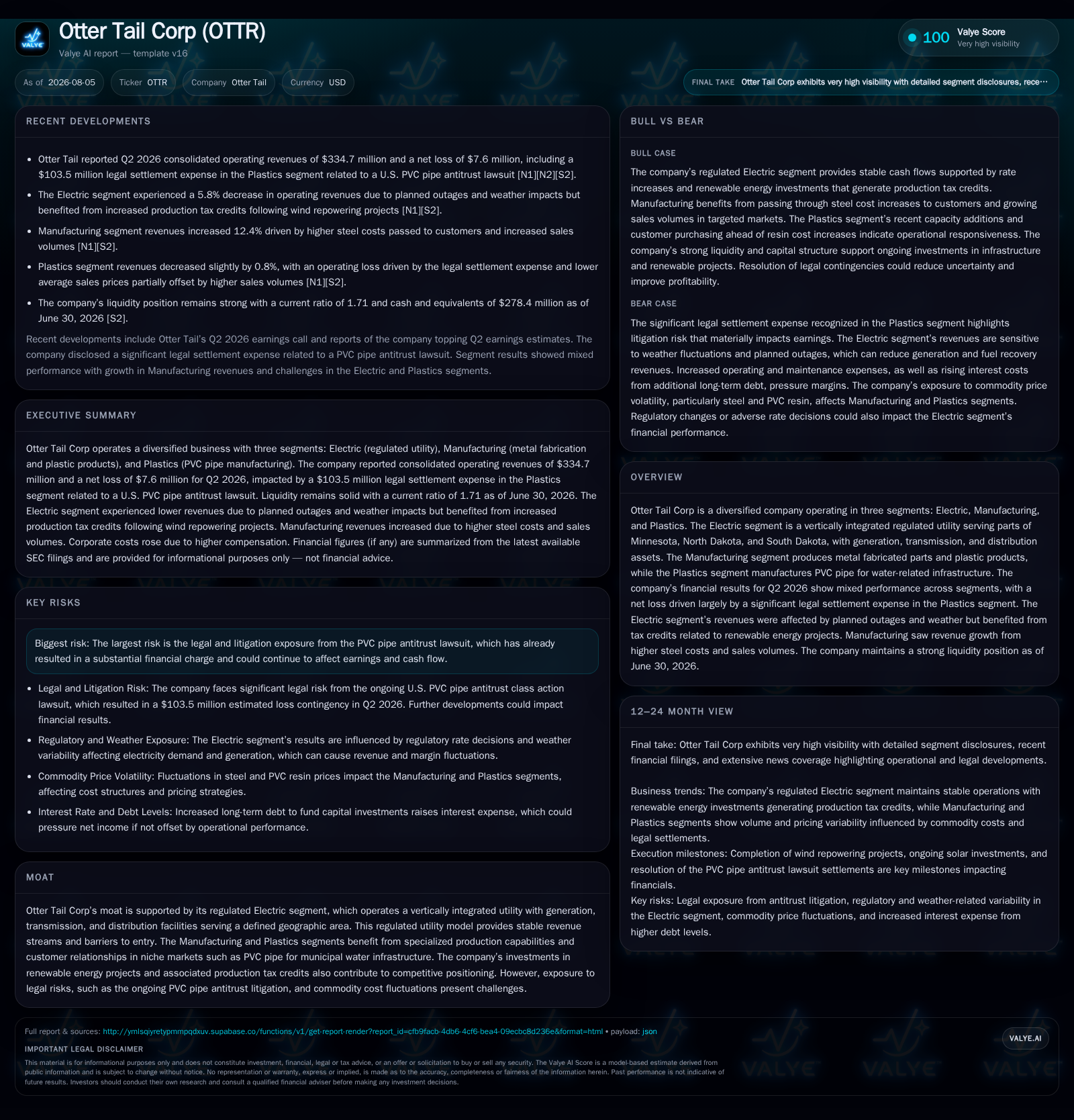
Otter Tail Corporation's latest quarterly report discloses a net loss primarily arising from a $103.5 million legal settlement in its Plastics segment, overshadowing gains in its Electric and Manufacturing lines. The Electric segment remains the backbone of stability through its regulated utility operations despite planned outages and weather challenges, supported by renewable energy tax credits. Meanwhile, manufacturing benefits from steel cost pass-throughs amid increased volumes. However, margin pressures in plastics persist due to lower prices and ongoing litigation risks. Capital allocation balances infrastructure investments with significant settlement payments, maintaining liquidity through new debt issuance.
Q2 Operating Snapshot: Settlement Expense Clouds Mixed Segment Results
Utility Segment Stability Despite Planned Outages and Weather Impacts
The Electric segment continues to anchor Otter Tail's operating stability as a vertically integrated regulated utility serving parts of Minnesota, North Dakota, and South Dakota [S1][S2]. While second-quarter revenues benefited from approved electric rate increases embedded in regulatory rate cases, planned plant outages and unfavorable weather moderated generation volumes. Notably, operating expenses climbed largely due to increased operating and maintenance costs necessary to support aging infrastructure and ongoing modernization efforts [S2]. The segment's investment in renewable energy projects such as Abercrombie and Solway solar installations added productive capacity that generated escalating production tax credits (PTCs) and elevated allowance for funds used during construction (AFUDC), partially offsetting cost pressures [S2]. These tax credits flow through as reductions to customer bills under the regulated tariff framework but enhance the utility’s financial results indirectly through increased construction-related income recognition.
Manufacturing Revenue Benefits from Steel Cost Pass-Throughs Amid Volume Gains
The Manufacturing segment reported improved top-line performance driven by an 11% increase in sales volumes coinciding with the added capacity from recent facility expansions like those at the Phoenix plant [S2]. Concurrently, heightened steel costs—an essential raw material—increased cost of goods sold but were largely passed through to customers via contractual pricing mechanisms that mitigate margin erosion typical in commodity-sensitive sectors [S2]. This dynamic indicates Otter Tail’s ability to sustain manufacturing profitability despite raw material volatility by leveraging pricing strategies aligned with input cost fluctuations. Nevertheless, operating expenses rose commensurately due to higher volumes requiring more labor and overhead absorption.
Pricing Pressure and Legal Risks Weigh on Plastics Segment Performance
Contrasting with manufacturing growth, the Plastics segment endured significant pricing pressures evidenced by a 16% average sales price decrease quarter-over-quarter driven by softness in PVC resin markets—a critical input—in addition to competitive dynamics within municipal water infrastructure channels [S2]. Although sales volumes advanced by approximately 11%, leveraging incremental pipeline capacity additions, average selling price declines pulled down overall revenue gains. Moreover, the substantial legal settlement tied to ongoing antitrust claims negatively impacted earnings both as a direct one-time charge ($103.5 million) and through operational uncertainty that clouds future contract negotiations and pricing power [S2][S11]. The timing of escrowed settlement funding restricts certain liquidity aspects but maintains balance sheet compliance.
Regulatory Dynamics Shaping Rate Base Growth and Renewable Incentives
Otter Tail’s regulated utility model secures stable cash flows anchored around its approved rate base—the cumulative value of invested capital recognized for utility ratemaking purposes—thereby allowing recovery of prudently incurred capital expenditures plus an authorized return on investment [S1]. Recent regulatory decisions have sanctioned accelerated cost recovery initiatives including advanced metering infrastructure upgrades, grid modernization projects, and inclusion of renewable assets like wind farms qualifying for enhanced PTCs [S1][S6]. Such mechanisms buffer earnings against inflationary pressures while enabling gradual rate increases enacted through formal proceedings with state regulators. This process underpins Otter Tail’s financial predictability compared to unregulated peers.
Capital Allocation Strategy: Funding Infrastructure Amid Liability Overhangs
In Q2 2026 Otter Tail issued $170 million of long-term unsecured notes (split between Series 2026A at 5.33% due 2036 and Series 2026B at 6.04% due 2056) strategically deployed to refinance short-term borrowings under existing credit facilities while funding construction expenditures across Electric segment solar projects as well as general corporate needs including the legal settlement payments [S2][F1]. The company retains strong liquidity positions with approximately $278 million cash on hand plus over $320 million unused credit lines available under revolving facilities featuring accordion provisions customizable up to nearly $600 million total credit capacity if needed [F1][S2].
Risks Around Litigation Costs, Commodity Volatility, and Regulatory Approvals
Principal risks center on continued exposure from yet unresolved PVC pipe antitrust lawsuits affecting Plastics earnings volatility—despite recent settlements—and potential for further claims or defense costs that could strain cash flows or require additional reserves [S11][S12]. Commodity price swings particularly in key inputs like steel for Manufacturing segments introduce unpredictability into cost structures even with pass-through pricing partially mitigating impacts. Additionally, regulatory risk remains inherent given dependency on successive rate case approvals; any delays or disallowances could defer capital recovery or pressure margins temporarily despite historically constructive regulator relationships [S1]. Operational hazards including planned outage management within Electric utilities could also influence availability metrics critical for efficient load serving.
(Re)Assessing Growth Levers: Renewable Investments, Volume Expansion, and Pricing
Looking forward, expanding demand for electricity consistent with regional economic activity combined with authorized incremental rate adjustments underpin potential top-line growth in Otter Tail’s Electric division [S1]. The accelerated buildout of solar assets promises enhanced PTC income streams which support profitability over their lifecycle—albeit dependent upon sustained legislative frameworks maintaining such subsidies. Meanwhile, Manufacturing growth is contingent on successful scaling of new production capacity paired with effective raw material cost management amidst global supply chain fluctuations. Plastics growth drivers rely heavily on increased penetration into municipal water infrastructure markets supported by volume gains although tempered by prevailing price competition post-litigation resolution.
Financial Profile Discussion: Liquidity Maintained Through Debt Issuance
At June 30, 2026 Otter Tail held cash & equivalents totaling approximately $278 million alongside current assets exceeding $837 million against current liabilities around $491 million yielding a conservative current ratio near 1.71x—a signifier of comfortable short-term liquidity coverage amidst ongoing operational demands [F1]. Total debt outstanding was approximately $1.217 billion with net debt post-cash roughly $939 million reflecting measured leverage given capital expenditure cycles focused on renewables project commissioning [F1]. The issuance of long-term debt effectively refinanced short-dated obligations reducing refinancing risk while supporting substantial investing activities mainly centered on solar development projects totaling an incremental expenditure increase north of $196 million relative prior period [F1][S2]. Compliance with all financial covenants further substantiates robust balance sheet discipline even considering restricted escrow deposits linked to legal settlements that constrain some working capital flexibility temporarily [S2]. Dividend distributions continue under close monitoring ensuring statutory limits aligned with regulatory agreements are respected.
What To Monitor Next: Rate Cases, Litigation Milestones, Operating Metrics
Key forthcoming catalysts largely hinge upon final court approval statuses resolving remaining PVC pipe class action suits which will settle lingering uncertainties affecting Plastics profitability outlooks [S2]. Regulatory case filings pending in Otter Tail’s service territories will determine allowed revenue adjustments impacting Electric segment growth trajectory; these decisions warrant scrutiny for timing conformity versus projected infrastructure investments deployment schedules. Operating KPIs such as megawatt-hours delivered amid evolving weather patterns will refine visibility into utilization rates alongside manufacturing volumes maintaining upward momentum given recent capacity expansions. Attention should persist toward average selling price trends especially within Plastics signaling whether competitive re-pricing pressure stabilizes post-litigation or intensifies further undermining margin recovery prospects.
This analysis leverages recent SEC filings alongside industrial sector knowledge relevant to vertically integrated regulated utilities combined with industrial manufacturing segments managing raw material sensitivity amid regulatory uncertainty. It highlights how Otter Tail balances foundational revenue stability from its Electric utility operations against episodic earnings shocks stemming from litigation liabilities within its plastics business line alongside commodity-driven fluctuations impacting manufacturing segments.
Disclaimer: This is research-only, informational analysis and not investment advice. It may include AI-generated interpretation and general industry context. Always verify important details using primary sources.

Comments