
Northwest Natural Holding Navigates Regulatory and O&M Pressures with Sustained Capital Investment
Q2 2026 results reflect balancing new rate benefits with higher costs amid ongoing infrastructure investments and regulatory dynamics.
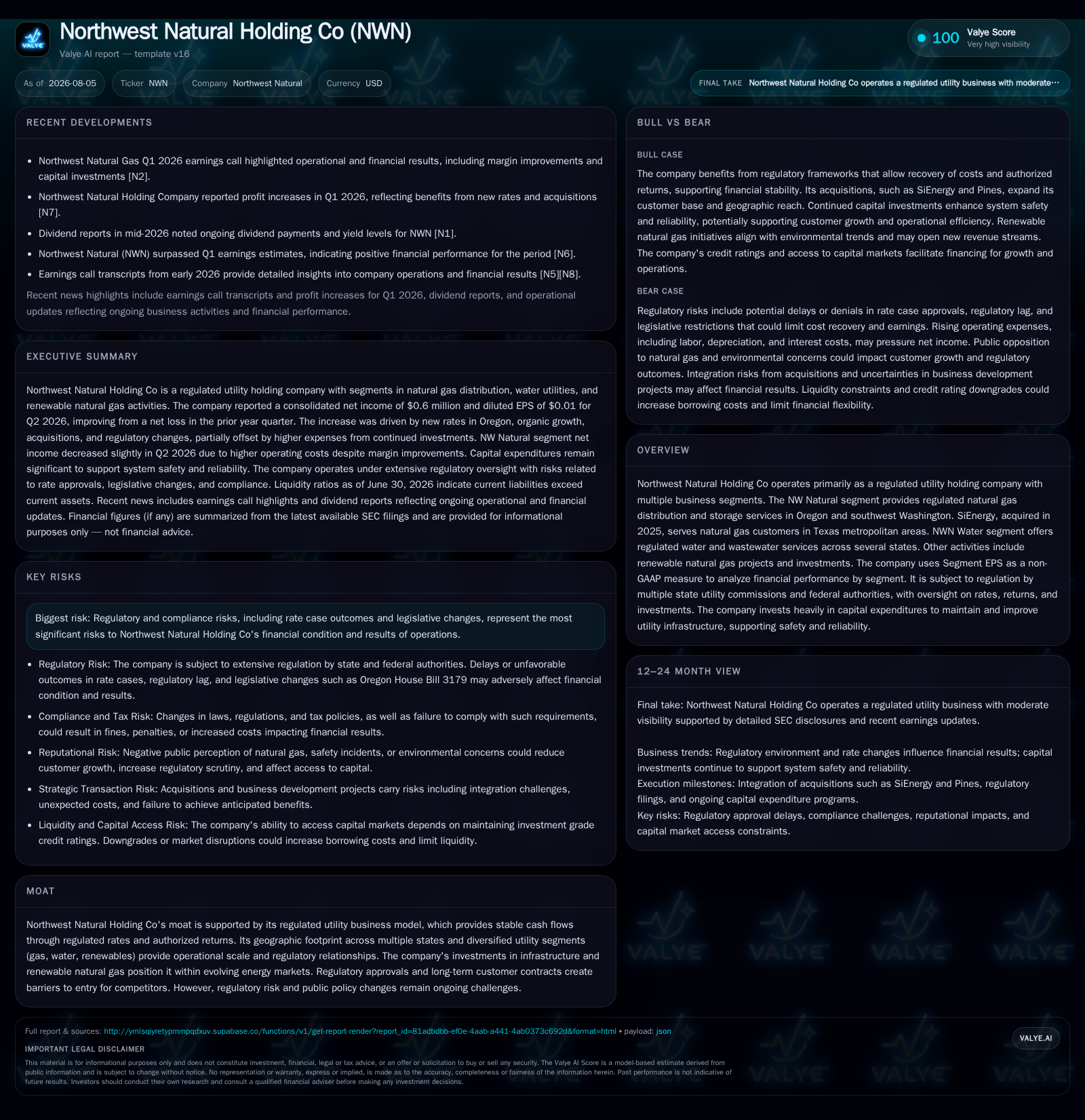
Northwest Natural Holding Co (NWN) reported a slight decline in net income for Q2 2026 despite margin improvement from recently approved Oregon rates effective late 2025. The company faces rising operations and maintenance (O&M) expenses and increased interest and depreciation charges tied to substantial capital expenditures supporting safety and reliability across its utility networks. NWN’s business model leverages regulated rates across natural gas distribution, storage, water services, and renewables, anchored by multi-state jurisdictional oversight. Key growth drivers include expanding rate base via acquisitions and infrastructure modernization alongside renewable natural gas initiatives. Core risks remain regulatory approval uncertainty, cost recovery lag, and evolving clean energy policies. NWN’s liquidity remains adequate but with significant debt reflecting capital intensity inherent in regulated utilities.
Recent Operating Update
Northwest Natural Holding Co reported its Q2 2026 financials indicating a subtle contraction in consolidated net income by about $1 million compared to Q2 2025. This occurred even though the NW Natural segment benefited from higher margins due to new gas distribution rates approved in Oregon and effective since October 31, 2025 [S2]. However, these gains were offset by materially increased operating and maintenance expenses alongside elevated interest and depreciation charges arising from ongoing investments into system modernization and reliability improvements. Capital expenditures reached approximately $87 million during the quarter primarily directed toward maintaining infrastructure integrity within NW Natural’s core Oregon/Washington service area [S2].
Segment-level analysis highlights NW Natural as the principal contributor to earnings albeit with modest year-over-year net income decline ($991k) primarily due to cost escalations despite margin improvements. The acquired SiEnergy business—which serves key Texas metropolitan areas through regulated natural gas utilities following its acquisition in early 2025—continued contributing incremental earnings growth as it integrates operationally under NWN’s umbrella [S2]. Additionally, the NWN Water segment provides steady but comparatively smaller EPS contributions reflecting its footprint across multiple states including Idaho and Arizona [S2]. The company’s non-GAAP reporting of Segment EPS facilitates transparency on performance drivers across these diversified regulated businesses.
Business Model Overview
Northwest Natural operates a diversified portfolio predominantly anchored by its regulated utility segments controlling natural gas distribution networks in Oregon, Washington (NW Natural), Texas (via SiEnergy), plus a growing water/wastewater business (NWN Water) spanning five states. Its revenue derives chiefly from regulated rates adjudicated by public utility commissions (PUCs) that set permissible charges based largely on the authorized rate base plus an approved return on equity (ROE). This model inherently delivers stable cash flows backed by long-term customer contracts largely insulated from commodity price volatility; utility commissions typically allow pass-through of commodity costs separately to customers.
Significant capital expenditure commitments are critical given the asset-intensive nature of gas pipelines, storage facilities (including NW Natural’s Mist underground facility), water treatment plants, and network upgrades necessary for compliance with safety regulations and environmental mandates. The company systematically recovers these investments through future rate cases which reset rates based on updated rate bases inclusive of new infrastructure additions—however, timing mismatches known as regulatory lag can temporarily depress earnings until cost recovery is fully realized.
Revenue mechanics hinge on customer counts (residential/commercial/industrial), volumetric delivery measured in therms or gallons depending on segment, adjusted prices per PUC mandates incorporating ROE targets typically ranging in mid-to-high single digits. Regulatory adjustment clauses such as weather normalization ensure more predictable revenues despite volume volatility caused by seasonal or weather-related demand fluctuations. Renewables integration via RNG procurement represents an emerging monetization vector where NWN either owns or contracts for biogas inputs enabling decarbonized customer supply options while still operating under regulatory frameworks.
Industry Structure and Competitive Position
In the U.S. regulated utilities space—which includes peers like Consolidated Edison (gas/electric), Atmos Energy (gas distribution), American Water Works (water services), Sempra Energy (diversified utilities)—companies function under tight oversight by state PUCs alongside federal agencies such as FERC for interstate pipeline/storage services. This environment creates high barriers to entry due to costly infrastructure requirements coupled with long lead times for regulatory approvals.
NWN's multi-jurisdictional presence spanning Pacific Northwest states through NW Natural’s legacy operations combined with strategic expansion into Texas via SiEnergy differentiates it by geographic scale relative to many more localized players. Furthermore, its water segment adds diversification not always present among pure-play gas utilities. NWN's investments in RNG projects also position it advantageously amid industry decarbonization trends that pressure traditional fossil fuel infrastructures.
However, competitive dynamics within this heavily regulated sector revolve more around regulatory outcomes than direct market rivalry. The company's ability to secure timely rate case approvals that authorize prudent investment recovery at fair ROE levels defines its financial health relative to peers. Execution efficiencies in O&M spending alongside capital allocation discipline also factor into relative cost competitiveness.
Growth Drivers
Several clear growth catalysts underpin NWN's strategic outlook:
- Infrastructure Modernization: Robust annual CapEx plans support pipeline replacement programs mandated for safety compliance along with water system upgrades enhancing reliability.
- Regulatory Rate Case Success: Achieving constructive outcomes granting fair authorized ROEs ensures that capital deployed translates into sustainable EPS growth.
- Acquisitions: The recent SiEnergy purchase expands footprint into fast-growing Texas metro markets adding scale and synergistic operational leverage.
- Renewable Initiatives: Procurement and deployment of renewable natural gas offer environmental credentials plus regulatory support that may enhance customer retention amid shifting energy mix preferences.
- Customer Base Expansion: Demographic-driven demand growth across served territories fuels incremental volumetric increases supporting revenue growth.
- Operational Efficiency Improvements: Managing O&M inflation pressures through productivity gains helps protect margins.
Tracking mid-cycle KPIs like rate base growth metrics, volume delivered trends across customer classes, allowed vs realized returns on equity will be critical markers validating these growth levers.
Risks and Watchpoints
NW Holdings faces several notable risks intrinsic to the regulated utility sector:
- Regulatory Risk: Unfavorable decisions such as lower-than-requested ROEs or disallowance of incurred costs can materially impair profitability.
- O&M Cost Inflation: Rising labor costs including contract labor alongside benefit expenses increase expense base potentially squeezing margins if not fully recoverable through rates.
- Legislative & Policy Changes: Evolving environmental legislation or policies promoting electrification or alternative fuels may alter future demand patterns or require additional capex beyond current planning.
- Integration Risks: Assimilating acquisitions like SiEnergy involves operational execution risks including cultural alignment and systems integration impacting cost controls.
- Capital Intensity: Continuous large-scale investments necessitate efficient capital deployment; delays or cost overruns curtail returns.
Monitoring ongoing regulatory filings especially pending rate cases outcomes or legislative developments related to energy transition will be essential near-term indicators of risk trajectories.
What to Watch Next
Key upcoming milestones include:
- Updates on any filed or anticipated rate cases across Oregon, Texas (SiEnergy), or water franchises that could alter allowed revenues or ROEs,
- Quarterly operational metrics detailing customer additions/losses particularly post-SiEnergy acquisition,
- Progress reports on RNG volumes procured versus targets,
- Capital expenditure pacing relative to guidance revealing capacity for further infrastructure enhancements,
- Changes in O&M expense trajectory signaling successful management of inflationary pressures,
- Debt refinancing activity impacting interest expense profile,
- Public statements or filings addressing response strategies toward evolving clean energy policies shaping fuel mix considerations.
Financial Profile Discussion
The sizable regulated asset base supports steady cash flows enabling manageable leverage despite elevated debt levels inherent in long-lived asset funding models prevalent among peers such as Atmos Energy or Dominion Energy.
In summary, Northwest Natural Holding demonstrates a classic regulated utility financial profile characterized by large-scale capex funded via sustained debt issuance balanced against predictable revenue streams regulated by PUCs designed to provide fair return facilitating reinvestment capacity while navigating inherent regulatory complexities affecting near-term earnings volatility.
Disclaimer: This is research-only, informational analysis and not investment advice. It may include AI-generated interpretation and general industry context. Always verify important details using primary sources.

Comments