
Edgewell Personal Care Boosts Q3 Results Despite Raw Material Pressures
Edgewell’s recent quarterly performance highlights resilience through pricing, brand focus, and innovation amid rising input costs and supply chain challenges.
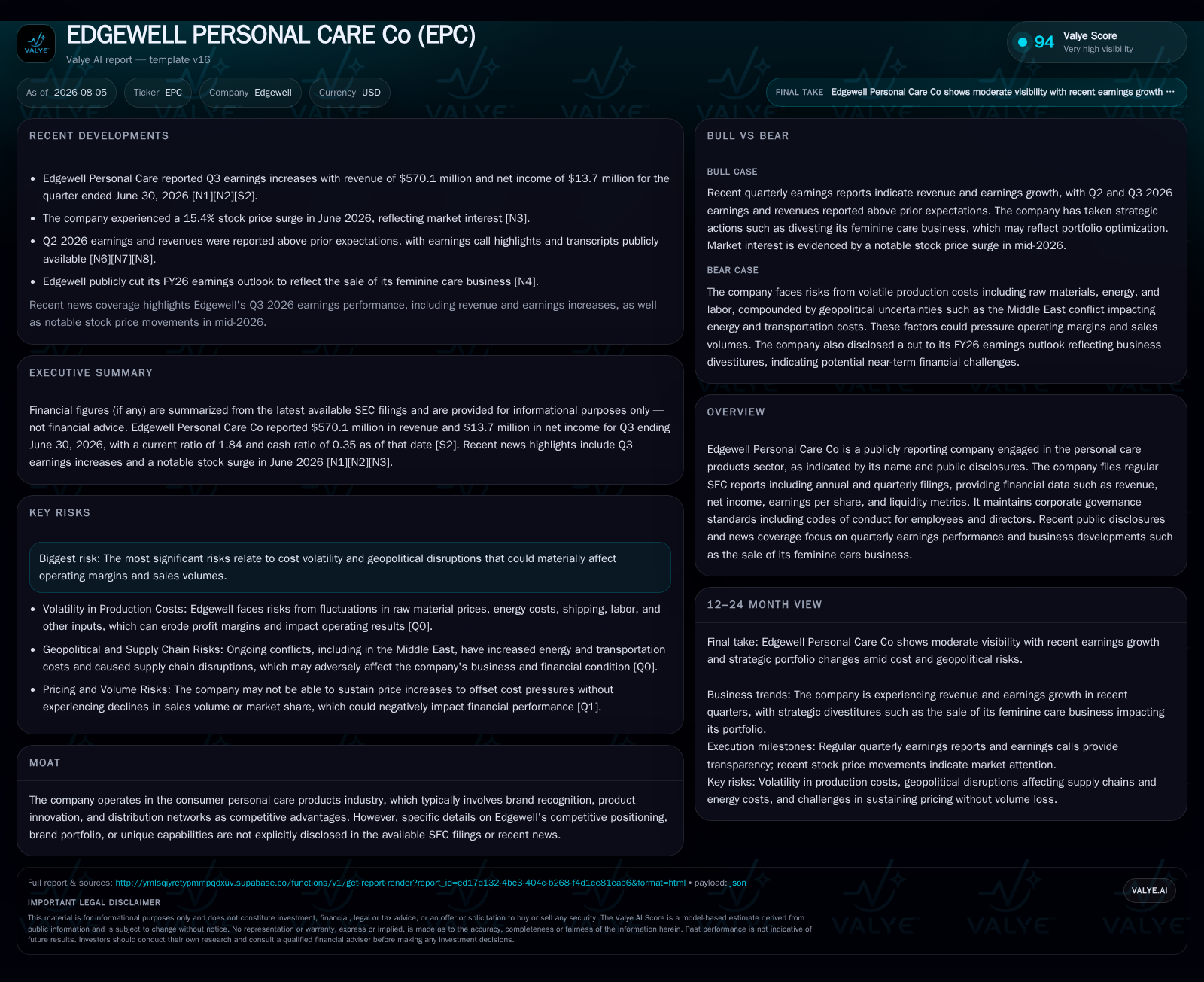
Edgewell Personal Care reported Q3 2026 results showing revenue growth sustained by effective pricing strategies and a concentrated brand portfolio despite raw material cost inflation. The company’s ongoing divestiture of its feminine care business sharpens strategic focus on higher-margin segments. However, supply chain volatility and cost pressure remain material risks that test Edgewell’s margin durability. Monitoring gross margin trends, promotional spend efficiency, and volume retention will be key to assessing near-term performance.
Q3 Results Reveal Raw Material Cost Pressures Testing Pricing Power
In its latest Q3 2026 filing [S2], Edgewell Personal Care detailed the continuation of significant raw material and energy cost inflation that materially impacted production expenses. These pressures stem from broad economic conditions compounded by geopolitical instability, notably the conflict in the Middle East affecting critical shipping routes such as the Strait of Hormuz. Such supply-side disruptions have increased transportation costs and introduced volatility into the company's supply chain costs. While Edgewell implemented price increases to offset these burdens, the filing acknowledges risks around sustaining these price hikes without eroding sales volumes or market share. The company’s ability to maintain gross margins will be confirmed by evaluating whether volume declines occur post-price adjustments or if efficient cost management can partially absorb inflationary shocks.
The related earnings commentary [N1][N2] confirms that despite cost headwinds, Edgewell surpassed analyst earnings estimates for the quarter. This suggests successful navigation through pricing power dynamics and reinforces that brand strength and product positioning play critical roles in consumer acceptance of higher prices in a competitive landscape.
Brand Portfolio Focus Supports Revenue Resilience Amid Market Shifts
Edgewell’s core business centers on branded personal care products sold primarily through mass retail and increasingly via e-commerce channels [S1]. The company recently completed the divestiture of its feminine care business [S3], streamlining its portfolio to focus resources on categories with stronger margin profiles and growth prospects. This strategic portfolio optimization underscores an emphasis on leveraging brand equity to sustain net sales growth despite upward pressure on average selling prices (ASPs).
The divestiture aligns with industry practice whereby companies concentrate capital and marketing effort on flagship brands with loyal consumer bases to withstand price elasticity constraints while defending market share against private-label or peer brand incursions. This sharpening of focus potentially allows more targeted product innovation investment which is critical given shifting consumer demands toward premiumization and sustainable formulations.
Volatile Supply Chain Demands Adaptive Production and Distribution Strategies
The Q3 risk disclosures [S2] emphasize that supply chain management remains a complex challenge due to fluctuating raw material availability, tariffs, labor shortages, port congestions, and energy price fluctuations—all exacerbated by heightened geopolitical tensions. These variables impose uncertainty on both production timing and unit cost.
Edgewell must maintain agile procurement frameworks with diversified supplier relationships or contingency production plans to mitigate these disruptions. Capacity utilization rates and inventory turnover ratios emerging in subsequent quarters will shed light on operational responsiveness. Furthermore, tariff exposure requires vigilant monitoring as sudden trade policy shifts could inflate landed costs unpredictably.
Promotional Spend Efficiency Critical Amid Competition and Margin Squeeze
Although explicit promotional spending figures for Q3 are not disclosed [S2][S1], in consumer packaged goods sectors like personal care maintaining marketing ROI amidst cost pressures is essential for sustainable margins. Advertising and promotional expense ratios typically rise under competitive intensity or when launching new products but can negatively impact operating income if not carefully managed.
Edgewell’s efficiency in converting promotional investment into market share gains relative to peers such as Procter & Gamble or Kimberly-Clark will influence long-term competitiveness. Effective expenditure balancing—avoiding excessive discount-driven volume versus brand dilution—is thus crucial especially when passing through input cost hikes via pricing.
Growth Drivers: Innovation Pipeline and Channel Mix Evolution
While the filings do not detail specific new product launches [S1], the company underscores product innovation as a driver to offset competitive pressure and changing consumption patterns amplified by growth in e-commerce distribution [N1]. Expanding digital retail reach broadens consumer access beyond traditional mass channels, potentially raising ASPs due to premium positioning opportunities.
The strategic emphasis on innovation must address contemporary consumer desires for natural ingredients, sustainability credentials, and personalized solutions—areas where incumbents invest heavily to maintain brand relevance. The speed-to-market of differentiated products affects revenue momentum significantly within the sector’s typical high promotional intensity environment.
Risks: Cost Inflation, Regulatory Compliance, and Consumer Preferences
Key risks articulated in both annual [S1] and quarterly filings [S2] revolve around raw material price volatility impacting manufacturing expenses unpredictably. Additionally, supply chain uncertainties tied to global conflicts introduce risk premiums that may not be fully recoverable via pricing adjustments.
Regulatory compliance remains another important factor; evolving environmental standards or ingredient regulations could necessitate reformulation or additional operational capital expenditures.[S1] Concurrently, shifts in consumer preferences toward sustainable or natural products impose innovation requirements that may increase R&D or marketing costs.
Legal proceedings disclosed appear manageable with no material liabilities currently anticipated [S1], but longer-term litigation risks could arise given size and scope of operations.
Upcoming Milestones: Monitoring Price Elasticity and New Product Impact
Looking ahead, key operational metrics include evaluating how sustained price changes affect volume sales across different product categories amidst competition from private labels or other branded players.[S2] Any erosion in volume would prompt reassessment of pricing strategy or margin expectations.
Additionally, tracking outcomes from new product introductions—both in terms of sales contribution and marketing efficiency—will indicate management effectiveness in leveraging portfolio strength amidst challenging external factors [N1]
These markers will collectively inform whether Edgewell’s balance of premiumization versus accessibility maintains overall revenue growth without disproportionate margin compression.
Financial Profile Discussion: Liquidity, Leverage, and Operating Margins
From a financial standpoint [F1], Edgewell maintains healthy liquidity with a current ratio of approximately 1.84 as of June 30, 2026—reflecting adequate short-term asset coverage over liabilities supporting operational flexibility during volatile periods.[F1][S2]
However, net debt remains elevated near $2 billion (total debt circa $2.26 billion less cash ~$209 million), implying substantial leverage typical for mid-sized CPG players with large-scale brand investments[F1]. This leverage necessitates robust free cash flow conversion from operations to service interest expenses while funding innovation pipelines and potential acquisitions.
In conclusion, Edgewell Personal Care demonstrates capability in managing complex cost inflation challenges through selective price increases backed by strong brand equity enhanced by recent portfolio trimming. Its success depends heavily on sustaining volume retention amid higher prices while navigating supply-chain complexities intensified by geopolitical strain. Advertising spend efficiency coupled with dynamic innovation efforts underpin medium-term revenue durability. Vigilance over regulatory shifts, input cost trajectories, and consumer demand trends remains essential for maintaining competitive positioning within the consumer personal care sector’s evolving landscape.
Disclaimer: This analysis is based solely on publicly available information as cited from SEC filings [S1–S3], companyfacts data [F1], and recent news reports [N1–N2]. It does not constitute investment advice or research views.
Disclaimer: This is research-only, informational analysis and not investment advice. It may include AI-generated interpretation and general industry context. Always verify important details using primary sources.

Comments