
Expeditors International Strengthens Airfreight and Customs Leadership with Balanced Capital Strategy
Expeditors’ Q2 2026 results underscore resilience in airfreight and customs services amid global trade volatility, supported by disciplined capital deployment and technology-driven productivity gains.
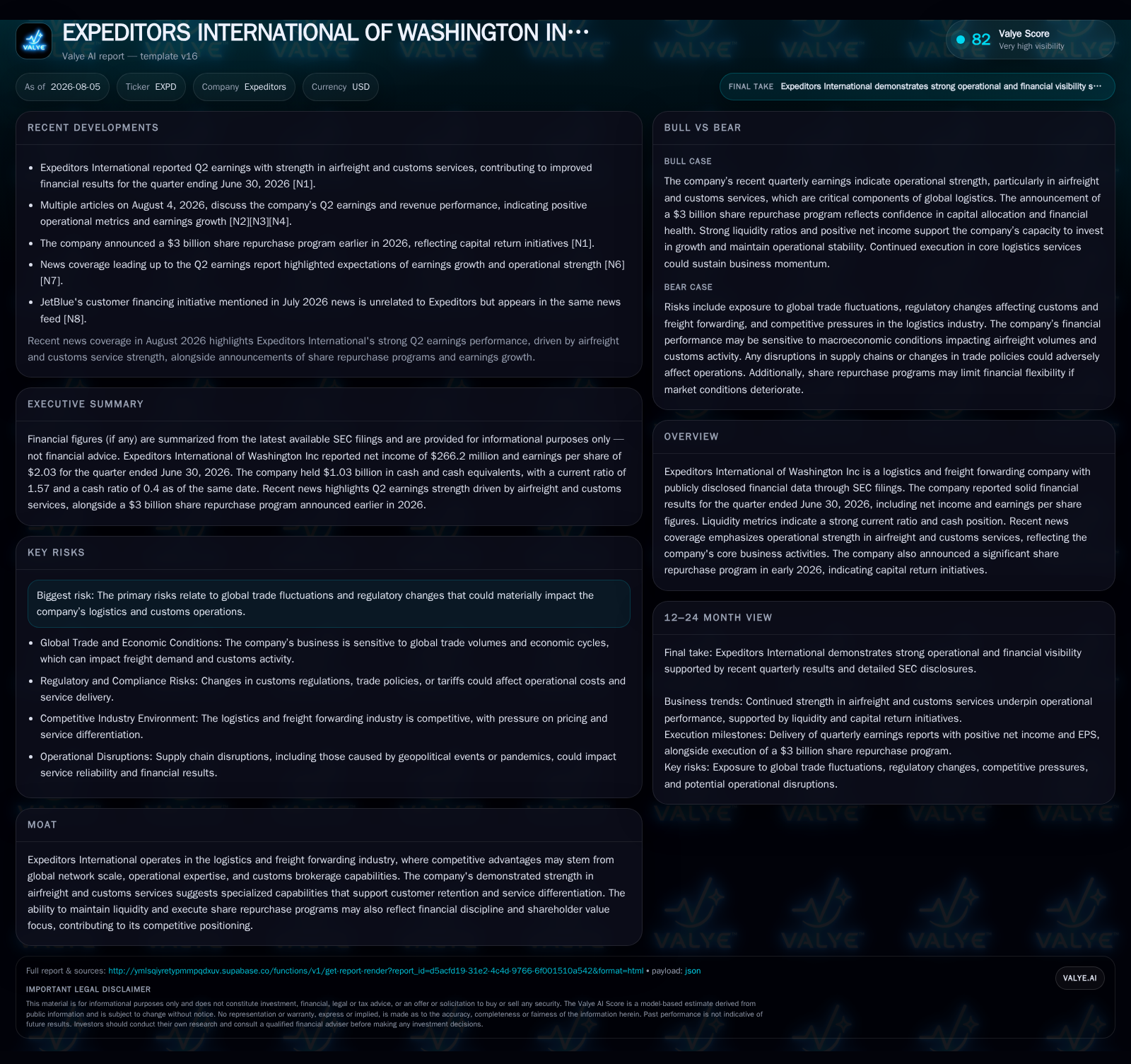
Expeditors International’s second-quarter 2026 performance demonstrates operational strength led by growth in airfreight volumes and customs brokerage activities despite wider freight market softness. The company’s integrated logistics service model, emphasizing value-added customs expertise and technology-enabled productivity gains, underpins pricing power and margin stability. Amid continuing trade regulatory complexity and capacity challenges in carrier markets, Expeditors maintains a strong liquidity position and has prioritized share repurchases while investing selectively in technology to sustain long-term profitable growth.
Q2 Operational Beats Reflect Airfreight and Customs Strength Amid Market Volatility
Expeditors International reported second-quarter 2026 results showcasing notable strength in core operational segments despite ongoing challenges in global trade flows. The company delivered earnings and revenues ahead of consensus expectations driven primarily by its airfreight forwarding business and customs brokerage operations [S2][N1][N3][S3]. This outperformance signals resilience within Expeditors’ business model amid a volatile market backdrop that has pressured many freight forwarding peers due to ocean capacity imbalances and rate softening.
The continued expansion in airfreight shipment volumes not only reflects enduring demand for time-sensitive goods but also leverages the company’s global logistics network optimized for flexibility in high-value cargo handling [S2][N1][S3]. Alongside this, the heightened volume and complexity of customs clearance transactions have bolstered revenue even as ocean freight volumes softened. Such transactional growth is linked to tariff changes, regulatory scrutiny, and increasing requirements for post-entry filings—areas where Expeditors’ specialized customs expertise allows it to capture premium fees and limit customer churn
Confirming this momentum over coming quarters will depend on whether ongoing rate adjustments can offset any potential dip in shipment volumes across transport modes and if customs activity maintains its trajectory amid evolving trade policies.
Integrated Freight Forwarding Model Drives Service Differentiation and Pricing Power
Expeditors operates an asset-light logistics network that integrates multiple freight modalities—primarily air and ocean forwarding—with value-added services such as customs brokerage, compliance consulting, post-entry filing support, and transportation management. Revenue streams tie closely to shipment volumes weighted by distance and cargo characteristics but increasingly benefit from customization driven by regulatory complexity.
This model allows Expeditors to charge differentiated fees reflecting specialized knowledge of tariffs, duties, and compliance protocols. Rising tariff unpredictability has inflated the need for detailed customs documentation beyond mere shipment handling, enabling the company to leverage superior pricing per transaction relative to more commoditized forwarding services [S1][S2]
Such service breadth differentiates Expeditors from broader global freight forwarders like DHL Global Forwarding or Kuehne + Nagel that may emphasize scale over niche customs intricacies. Meanwhile, the focus on higher-margin airfreight parallels peers like FedEx Logistics by capturing premium fees tied to expedited shipments frequently demanded by tech and AI infrastructure customers.
Customs Brokerage Amid Rising Regulatory Complexity Bolsters Revenue Stability
Global trade tensions have introduced substantive tariff volatility along with increased government enforcement actions that raise the bar for accurate customs documentation. Expeditors' customs brokerage segment benefits from growing transaction counts turned up not only by shipment numbers but by added reporting requirements per entry.
Increasing post-entry adjustments related to tariff refunds or IEEPA CAPE filings serve both as new revenue sources and switching-cost mechanisms [S1][S5][S6]. These complex filings require seasoned expertise rarely replicable by asset-based carriers or purely digital platforms attempting disintermediation via AI automation alone
With recurring custom transactions accounting for an expanding revenue fraction independent of ocean container volume declines—and given reported margins benefiting from technology-enabled efficiency—the segment provides a defensive buffer against broader shipping cycle downturns.
Global Logistics Network Scale Underpins Competitive Positioning Versus Peers
Expeditors leverages a global non-asset network coordinating between shippers, carriers, customs authorities, and local agents to orchestrate supply chains worldwide. This scale confers significant negotiation leverage with air/ocean carriers on contracted capacity allocation amid fluctuating demand.
Compared with less diversified or regional operators, this franchise flexibility curtails exposure to route-specific disruptions or sudden capacity tightening that often expose tighter-margin peers [S1][S2]. It also enables more agile re-routing strategies during geopolitical events or fuel price shocks especially in the high-margin airfreight segment
While DHL Global Forwarding may command greater absolute scale globally, Expeditors’ deep integration of customized compliance services alongside logistical coordination presents a more resilient earning base particularly under tariff uncertainty regimes.
Technology Investment Enhances Productivity Without Proportionate Headcount Growth
A salient operating theme for Expeditors is the decoupling of headcount growth from revenue increases through targeted technology investments including artificial intelligence (AI) automation applied within the customs brokerage workflow [S5][S6]
These improvements boost headcount productivity metrics—revenue or shipments managed per employee—thereby reducing incremental labor cost pressures amid rising shipment complexity. This strategy supports margin expansion potential without large-scale labor scaling often seen in lower-productivity 3PL providers.
Management commentary indicates these modest but steady productivity gains are sustainable longer-term drivers that justify capital allocation toward technology while maintaining disciplined workforce management.
Growth Catalysts: AI Infrastructure Shipments, Outsourcing, and Regulatory Complexity
Significant secular tailwinds arise from increased hyperscale data center construction fueling shipments tied to AI infrastructure hardware—an end-market segment demanding expedited airfreight services supported by Expeditors’ network [S5][N1]
Simultaneously, continued outsourcing of logistics functions by manufacturers seeking compliance assurance amidst escalating tariff regulations feeds into growing demand for integrated forwarding plus customs solutions.
Further regulatory complexities such as shifting de minimis import thresholds amplify reliance on expert brokers managing intricate cross-border filings; this trend supports continued volume growth especially in higher-margin segments reliant on skilled oversight rather than commoditized transport alone.
Risks from Trade Volume Cyclicality, Capacity Constraints, and Policy Shifts Remain Key Watchpoints
Despite current strengths there remain persistent risks typical to the logistics sector: cyclical downturns in global trade volumes could compress shipment activity materially; capacity imbalances in air/ocean carrier markets limit negotiating power over rates; policy uncertainty around tariffs or sanctions could swiftly alter customs filing workloads; moreover digitization threatens some labor-intensive broker tasks [S13][S6]
Currency fluctuations impacting international contracts alongside rising fuel prices add further operational cost pressures. Cybersecurity risk exposure remains another consideration given the critical data flows handled throughout supply chains.
Monitoring these factors is critical given their direct influence on pricing ability, volume stability, margin profile, and ultimately free cash flow generation.
What to Watch: Upcoming Guidance Signals, Rate Trends, Productivity Metrics, Contract Updates
Investors should closely track next quarterly disclosures for guidance on transit times and on-time delivery rates reflecting operational execution under current constraints [S2][N3]. Headcount productivity trends will indicate whether technology investments continue delivering sustainable cost control.
Renewal terms on key carrier contracts will reveal capacity utilization trends critical to pricing power maintenance amid volatile freight markets. Any material shifts in customs transaction counts or invoiced complexity will signal durability of this revenue stream.
Overall rate realizations per shipment/freight unit relative to incremental costs remain a key monitorable metric confirming pricing discipline versus competitive pressure.
Financial Profile Discussion: Liquidity Strength, Cash Generation, and Capital Allocation Balance
As of June 30, 2026, Expeditors held roughly $1.03 billion in cash and equivalents with total current assets at $4 billion against current liabilities near $2.56 billion yielding a healthy current ratio of 1.57 supportive of operational flexibility [F1]. Strong free cash flow generation underpins both organic investment initiatives—primarily technology—and shareholder returns demonstrated through an active share repurchase program initiated early 2026 described in recent filings [S3].
This balance between reinvesting in productivity-enhancing capabilities while deploying capital efficiently back to shareholders highlights disciplined financial stewardship aligned with sustaining profitable long-term growth.
This analysis integrates data drawn directly from Expeditors International’s latest SEC filings including its August 2026 Form 10-Q quarterly report alongside related corporate disclosures with grounded insight into logistics sector dynamics. It does not provide investment advice nor endorse security transactions.
Disclaimer: This is research-only, informational analysis and not investment advice. It may include AI-generated interpretation and general industry context. Always verify important details using primary sources.

Comments