
Sprouts Farmers Market Advances Fresh Supply Chain and Loyalty Program While Managing Market Challenges
Sprouts Farmers Market's Q2 2026 update highlights operational resilience amid soft comp-store sales and ongoing supply chain transitions.
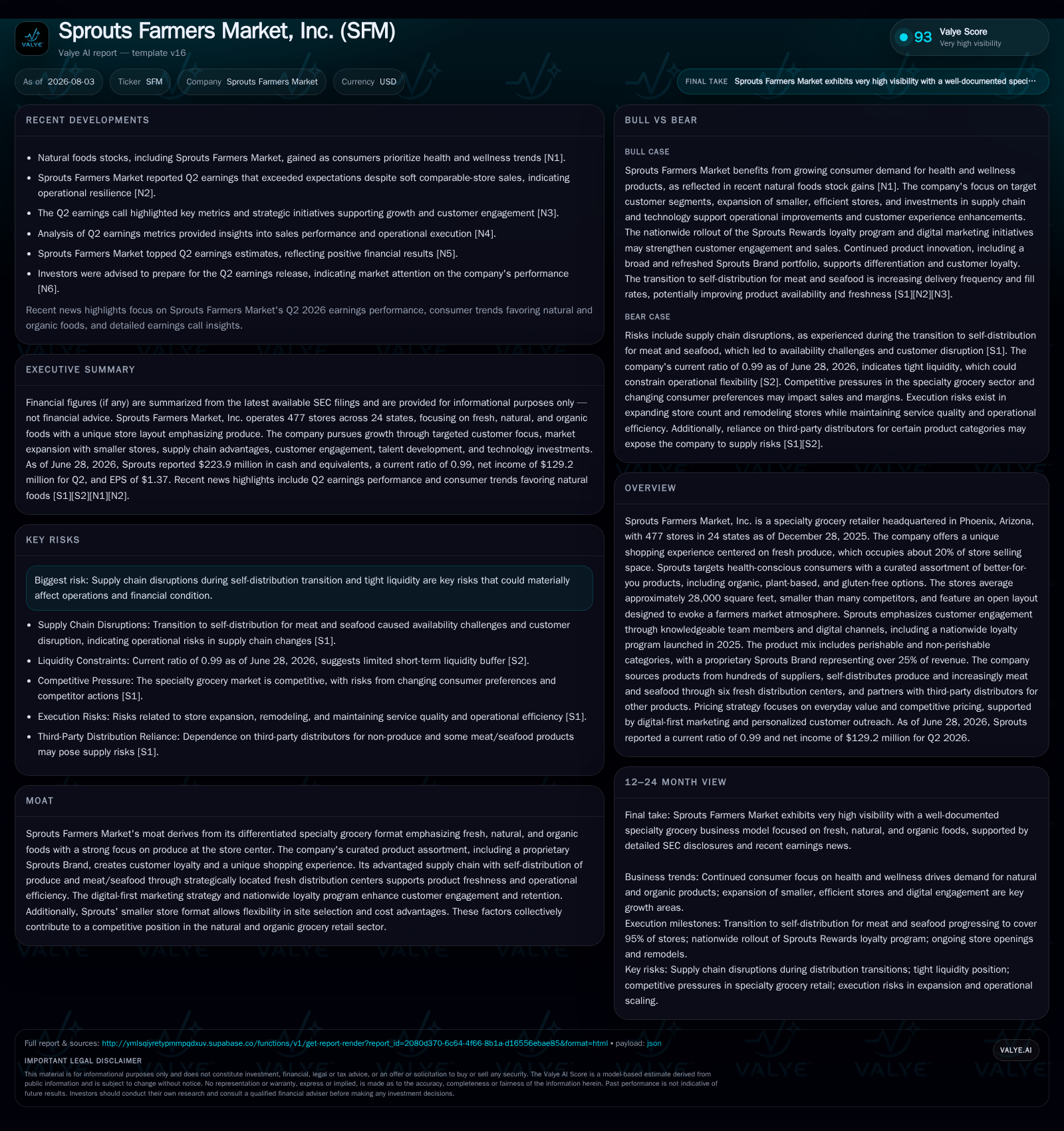
Sprouts Farmers Market reported Q2 2026 results showing solid execution of its growth strategy through expansion of self-distribution for fresh meat and seafood, alongside nationwide loyalty program rollout. Despite soft comparable-store sales pressured by macroeconomic factors, the company remains focused on its specialty grocery model that centers on fresh produce and health-conscious customers. Investment in omnichannel offerings and private-label innovation underpin customer engagement, while capacity in distribution centers supports margin improvement. Risks include supply disruptions during the self-distribution transition and competitive pricing pressures. Monitoring same-store sales recovery and supply chain stability will be critical near-term indicators.
Recent Operating Update
Sprouts Farmers Market’s Q2 2026 results showed a mixed operating environment with a clear focus on strategic initiatives advancing despite soft comparable-store sales [S2][N1]. The quarter underscored ongoing execution of the self-distribution transition for fresh meat and seafood products, which began in 2025 to enhance supply chain control and fresher product delivery [S1][S15]. As of late 2025, approximately 80% of Sprouts’ stores were located within a 250-mile radius of one of its growing network of fresh distribution centers, a critical milestone enabling fresher inventory receipt while leveraging existing warehouse capacity [S1].
Comparable-store sales softness reported in Q2 largely reflected macroeconomic headwinds such as cautious consumer spending amid inflationary pressures rather than fundamental erosion of demand for natural or organic offerings [N1][S2]. This softness is consistent with broader trends affecting specialty grocery retailers facing competitive pressure from discount merchants, warehouse clubs, and online grocers. The sustained investment in omnichannel capabilities including delivery and pickup options via Sprouts’ website and app reflects management’s emphasis on evolving consumer shopping preferences [S1].
Business Model Overview
Sprouts operates approximately 477 stores across 24 states as of end-2025 with an average store footprint around 28,000 square feet — notably smaller than many conventional supermarkets — designed to invoke a farmers market atmosphere emphasizing fresh produce centrally placed at the heart of each store [S1]. This unique store format supports Sprouts’ value proposition targeting “health enthusiasts” and “selective shoppers,” key customer segments identified through internal research that seek better-for-you foods including organic, plant-based, gluten-free, and other lifestyle-conscious options.
Revenue generation primarily derives from direct retail sales at point-of-sale transactions with discounts recognized as revenue reductions. The company’s product mix includes both perishables like fresh produce, meat, seafood, dairy, bakery items as well as non-perishables. Over 25% of total revenue is attributed to the proprietary Sprouts Brand private label portfolio focused on differentiated attributes such as wellness benefits and quality at competitive entry-level price points [S1]. This private label penetration fosters customer loyalty while supporting margin enhancement through better cost control compared to branded goods.
The launch of the nationwide Sprouts Rewards loyalty program in 2025 has been a pivotal element for customer engagement transformation [S1]. By allocating portions of transaction prices to deferred loyalty liabilities under this program, Sprouts captures valuable consumer purchase data to fuel personalization efforts through digital marketing channels. Management views this data-driven approach as integral to driving repeat visits and higher average ticket sizes over time
Industry Structure and Competitive Position
Operating within the specialty grocery retail sector, Sprouts competes against a spectrum of grocery formats: natural/organic chains like Whole Foods Market known for premium curation; Trader Joe’s distinguished by unique private labels; large supermarket chains such as Kroger offering broad assortments including health-focused lines; warehouse clubs like Costco leveraging scale efficiencies; and digital entrants like Amazon Fresh enhancing convenience for online grocery buyers. Each peer group competes on factors including product differentiation, pricing strategies, store footprint optimization, customer engagement mechanisms such as loyalty programs, omnichannel fulfillment capabilities, and supply chain robustness.
Sprouts differentiates itself by emphasizing fresh produce which occupies roughly one-fifth of selling space within an approachable store footprint optimized for convenience and experience [S1]. The company’s advantaged supply chain positions it well to control freshness through localized distribution centers strategically placed near stores — an advantage over competitors reliant solely on third-party distributors. The curated better-for-you product assortment combined with Sprouts Brand offerings creates switching costs based on unique product availability not easily replicated by conventional grocers.
Growth Drivers
Key growth drivers stem from expanding geographic presence targeting health-conscious markets where demand for natural and organic foods continues to rise [S1]. Between 2021 and 2025 Sprouts opened over 110 new stores with expectations to maintain about a 10% annual unit growth rate aligned with its distribution infrastructure scaling plans.
Investment in technology bolsters inventory management efficiency—critical given perishability challenges—and analytics powering personalized marketing contributes to traffic retention. The omnichannel retailing strategy including delivery/pickup options responds directly to shifting consumer buying patterns accelerated by digital adoption trends.
Innovation within the Sprouts Brand private label catalog offers opportunities to deepen margins while reinforcing brand loyalty by addressing evolving wellness trends such as plant-based foods or allergen-friendly formulations. Continuous remodeling into updated formats aims to enhance shopper experience without abandoning core brand heritage rooted in farmers market values.
Risks and Watchpoints
Sprouts faces execution risks associated with its self-distribution transition for fresh meat and seafood; supply interruptions or quality lapses could materially impact sales if not tightly managed given high perishability sensitivity in fresh categories [S1][S15]. Competitive dynamics pose ongoing margin pressure risks since competitors may undercut prices or expand health-focused assortments aggressively within overlapping markets.
Regulatory risks tied to food labeling compliance—especially regarding health claims—and evolving state restrictions (e.g., PFAS in food packaging) present potential cost increases or reputation risk if violations occur [S10][S13]. Regional concentration remains notable; California alone accounted for roughly one-third of stores as of fiscal year-end 2025 exposing operations more acutely to localized economic downturns or environmental disruptions such as droughts affecting produce sourcing [S17]. Labor shortages impacting skilled talent needed for customer service differentiation also warrant careful monitoring given specialty grocery’s dependence on team member expertise.
What to Watch Next
Key near-term indicators include stabilization or improvement in comparable-store sales signaling recovery post-macroeconomic headwinds. Progress metrics on self-distribution implementation beyond timing milestones into volume throughput consistency will reveal supply chain resilience gains or risks.
Customer engagement metrics stemming from the nationwide rollout of Sprouts Rewards—such as loyalty membership adoption rates, incremental spend lifts per member, and digital sales penetration—will provide insight into omnichannel strategy effectiveness. New store opening cadence aligned with achieving targeted unit growth runway offers visibility into expansion execution.
Margins tracked alongside private label penetration trends will evidence how well operational efficiencies from distribution center network scale translate into financial performance improvements. Finally, watch regulatory developments around food safety claims or packaging materials that could increase compliance costs or require operational adjustments.
Financial Profile Discussion
As of June 28, 2026, Sprouts held cash and equivalents totaling approximately $224 million juxtaposed against current liabilities near $777 million yielding a current ratio just below parity at ~0.99 typical for grocery retailers where inventory turns are high but payables are significant [F1]. Total debt figures reported from prior years indicate low leverage levels relative to asset base suggesting financial flexibility exists but working capital tightness may constrain short-term liquidity maneuvering.
Overall liquidity appears sufficient for planned expansion initiatives including distribution center investments; however, close attention to capital expenditures pacing versus cash generation will be essential especially if competitive pricing actions compress profitability unexpectedly.
This analysis relies exclusively on publicly available SEC filings supplemented by recent earnings call narratives and industry context frameworks relevant to specialty grocery retailing. It does not constitute investment advice but aims to provide an informed operating outlook grounded in evidentiary disclosures.
Disclaimer: This is research-only, informational analysis and not investment advice. It may include AI-generated interpretation and general industry context. Always verify important details using primary sources.

Comments