
First Solar Grows Margins with Domestic Market and Thin Film Innovation
Q2 2026 results reveal improved profitability driven by operational efficiencies, technological advances in CdTe modules, and strategic domestic market expansion.
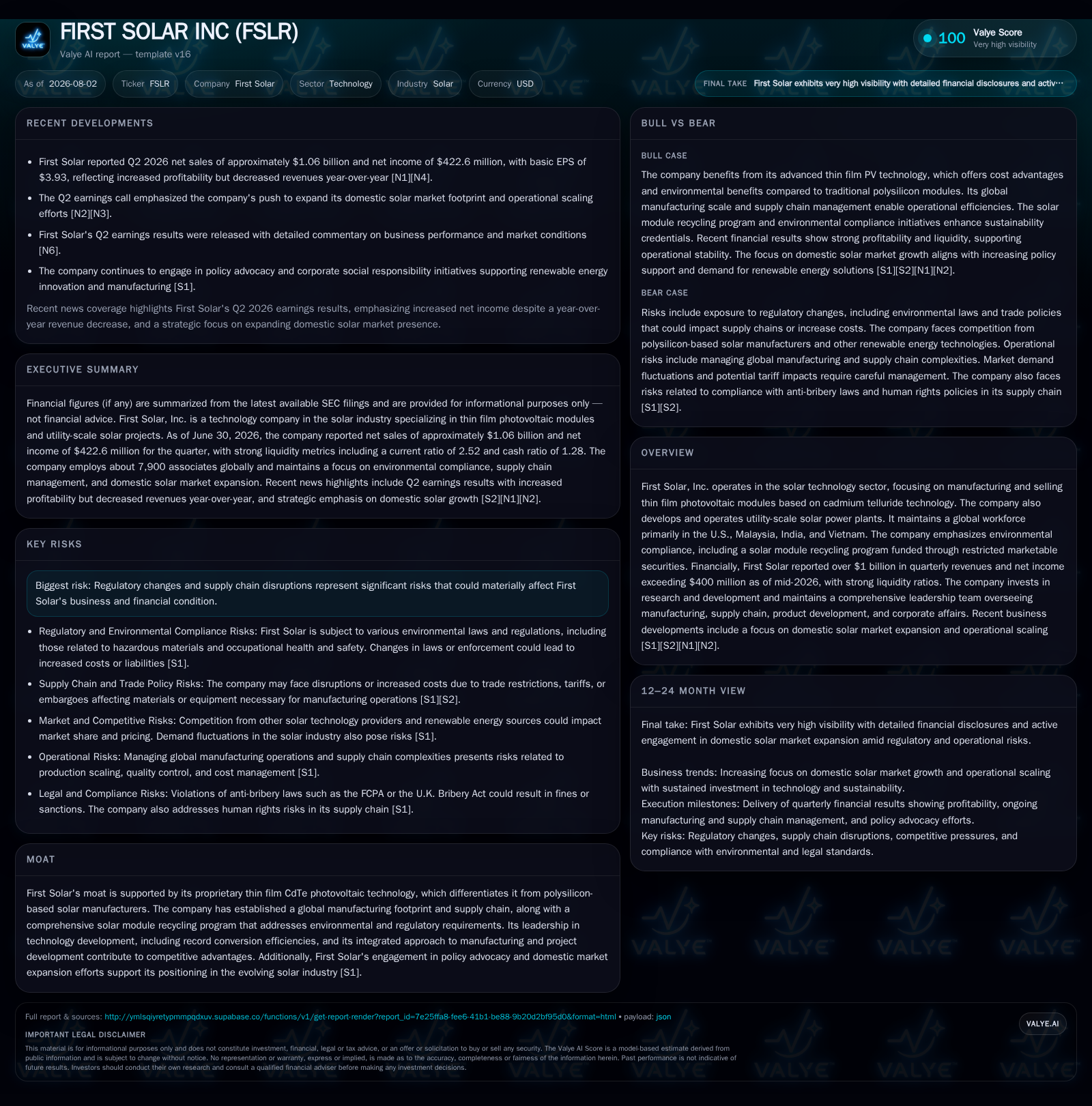
First Solar's Q2 2026 earnings showcased a notable gross margin expansion despite a slight year-over-year revenue decline, reflecting gains from manufacturing efficiencies and rising conversion efficiencies in its proprietary thin film cadmium telluride (CdTe) photovoltaic technology. The company’s integrated business model, combining PV module manufacturing with utility-scale solar project development, underpins margin strength and pipeline growth. Its geographic footprint, embracing U.S., Malaysia, India, and Vietnam plants, aids supply chain resilience amid regulatory pressures and global market shifts. While regulatory risks and supply chain uncertainties persist, First Solar’s focus on domestic markets aligned with attractive renewable energy incentives positions it well for sustainable profit growth.
Q2 Results Illuminate Margin Expansion With Operational Advances
The company's investment in R&D rose notably to $76 million for the quarter from $54 million a year earlier, underscoring a commitment to advancing proprietary cadmium telluride (CdTe) thin film photovoltaic technology. This uptick supports First Solar’s strategic intent to sustain competitive advantage through technology differentiation in an industry heavily dominated by crystalline silicon module producers [S2][S1]. Meanwhile, selling, general & administrative expenses remained relatively flat despite scaling operations.
Integrating Thin Film CdTe Technology as Core Competitive Moat
First Solar’s foundational competitive strength lies in its proprietary thin film CdTe photovoltaic modules which diverge substantially from the polysilicon-based technologies used by peers such as SunPower or Canadian Solar. This technology enables a lower carbon footprint production process with potentially better performance under high temperature or partially shaded conditions typical in utility-scale installations [S1]. The thinner semiconductor layer reduces raw material costs while increasing module conversion efficiency –key in reducing cost per watt– as evidenced by ongoing efficiency improvements reported within the latest filings.
Moreover, First Solar has embedded sustainability into its business model through a comprehensive solar module recycling program funded via restricted marketable securities to cover future collection and recycling costs. This initiative sets it apart amid rising environmental compliance demands worldwide and enhances customer appeal by addressing end-of-life lifecycle responsibility [S20]. Such circular economy integration not only mitigates regulatory risk but helps fortify brand equity against competitors largely reliant on traditional silicon modules without comparable recycling frameworks.
Manufacturing Footprint and Supply Chain Alignment Enable Cost Discipline
To reinforce supply chain resilience amid geopolitical challenges such as import bans linked to regions supplying polysilicon - notably Xinjiang - First Solar operates manufacturing sites strategically located in the United States, Malaysia, India, and Vietnam [S1]. This multinational footprint distributes exposure across geopolitical zones less affected by controversial trade restrictions or forced labor concerns.
Despite operating multiple global sites that could face variable utilization rates depending on demand cycles, First Solar’s modular manufacturing scale allows dynamic volume adjustments helping maintain cost discipline reflected in falling cost per watt trends for Q2 2026 [S2]. Although average revenue declined slightly compared to prior quarters due in part to product mix shifts or timing delays in module shipments, gross margin gains offset these impacts suggesting effective operational leverage and process optimizations.
Solar Project Development Pipeline Fuels Near-Term Growth Visibility
Moving beyond module manufacturing alone, First Solar integrates project development and operation into its value chain providing additional higher-margin revenue streams that complement hardware sales [S1]. The company maintains an active pipeline of utility-scale solar projects measurable in gigawatts (GW), with increasing emphasis on domestic U.S. market projects energized by federal incentives under the Inflation Reduction Act.
This multi-pronged approach improves overall earnings quality by buffering fluctuations inherent in hardware markets with longer term contracted project cash flows plus renewable energy credits monetization [N2]. Successful project execution alongside module commercialization reinforces scalability potential while deepening customer relationships through turnkey solutions rather than standalone product shipments.
Regulatory Risks and Environmental Compliance: Navigating A Complex Terrain
First Solar operates within an intensely regulated environment governed by myriad federal, state, local, and international laws affecting environmental safety including hazardous materials handling intrinsic to CdTe usage [S8]. Despite current compliance status considered substantial without expected near-term material capital expenditures for health or safety controls, emergent regulations can impose unforeseen costs or retrospective liabilities.
Additionally, legal disputes remain an ongoing source of uncertainty including patent infringement litigations against various TOPCon crystalline silicon competitors alleging violation of key First Solar patents covering manufacturing processes [S25][S26]. Also material is exposure to government policies like the Uyghur Forced Labor Prevention Act restricting polysilicon imports. Although First Solar avoids direct reliance on polysilicon feedstock mitigating this threat structurally, shifts toward more stringent trade barriers could indirectly impact equipment or ancillary inputs requiring adaptive supply chain strategies [S1][S8].
Growth Catalyst: Domestic Market Focus Tied To Renewable Incentives
Perhaps most critical among recent company developments is heightened emphasis on expanding presence within the domestic U.S. solar market leveraging attractive tax credits under federal legislation like the Inflation Reduction Act. First Solar executives underscored this strategic pivot during Q2 earnings calls highlighting pipeline growth fueled by state-level solar adoption incentives paired with national carbon reduction commitments from corporations and utilities alike [N2][N3]
This domestic focus taps into growing governmental support counterbalancing pressures abroad related to tariffs or trade uncertainties while simultaneously allowing First Solar to capitalize on proximity advantages such as reduced logistics cost or quicker project turnaround times relative to foreign competitors.
Risks: Supply Chain Disruptions And Price Competition Watchpoints
Heightened industry capacity amid periodic structural imbalances poses price risks especially given global polysilicon-based manufacturers' ability sometimes to operate at breakeven or negative margins temporarily suppressing market prices [S12][N12]. Though First Solar’s differentiated CdTe technology avoids direct cost competition at some levels by offering alternative attributes like performance under heat stress and sustainability benefits, relentless market pressure constrains full pricing power.
Moreover, supply chains remain susceptible to disruption stemming from components sourced globally alongside fluctuating raw material costs amid geopolitical tensions including those affecting China-centric suppliers dominant for several solar value chain inputs. While First Solar’s multi-site footprint mitigates single-point vulnerabilities somewhat, potential shortages could restrain output growth or elevate per-watt costs ahead of planned plant ramp-ups [S1][S8].
Financial Position Discussion: Liquidity Strength Supports Strategic Investment
Financially, First Solar maintains robust liquidity enabled by approximately $1.69 billion in cash and equivalents as of June 30, 2026 alongside minimal net debt positioning reflecting total debt around $374 million booked at end-2025 offset significantly by cash reserves yielding net cash status near $-1.3 billion [F1]
Refinancing completed early in 2026 replaced prior credit lines with an enhanced unsecured revolving credit facility totaling $1.5 billion capacity broadening financial optionality supporting capacity expansions particularly focused on U.S.-based projects aligned with policy-driven demand surges [S6][S11]. This robust capital structure underpins strategic agility allowing management to pursue technology development while scaling operational deployment domestically without immediate liquidity constraints.
Disclaimer: This analysis is provided solely for informational purposes based on publicly available data including recent SEC filings and news reports pertaining to First Solar Inc. It does not constitute investment advice or research views regarding the purchase or sale of securities.
Disclaimer: This is research-only, informational analysis and not investment advice. It may include AI-generated interpretation and general industry context. Always verify important details using primary sources.

Comments