
Healthcare Realty Trust Advances Portfolio Growth and Capital Strategy Despite Tenant Sector Risks
Healthcare Realty Trust reports stable leasing performance and share repurchases amid sector-specific uncertainties in healthcare real estate.
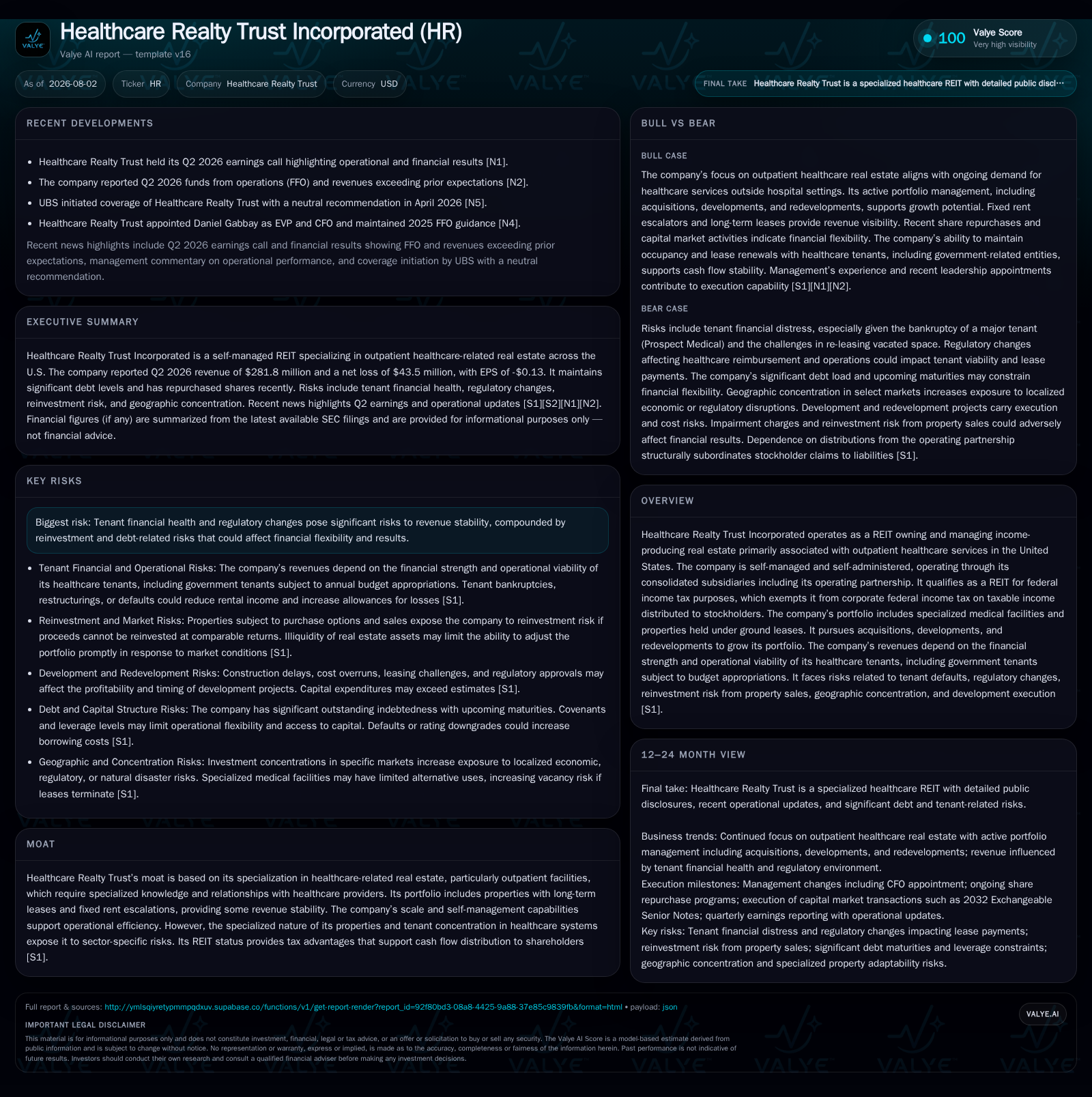
Healthcare Realty Trust Inc (HR) recently filed its Q2 2026 10-Q, highlighting sustained occupancy and leasing activity within its outpatient-focused healthcare property portfolio. The company continues its disciplined capital allocation through $500 million authorized share repurchases and debt issuances, balancing growth with financial flexibility. However, tenant credit risk tied to healthcare reimbursement and regulatory shifts remains a pivotal challenge. The REIT’s specialized outpatient facilities and long-term lease structures underpin revenue stability but require ongoing tenant credit vigilance given government budget dependencies and sector consolidation dynamics.
Recent Operating Update
Healthcare Realty Trust Incorporated’s latest quarterly report for Q2 ended June 30, 2026, demonstrates a continuation of stable operating trends within its specialized healthcare real estate portfolio [S2]. The company disclosed active negotiations on leases expiring in 2026, with several renewals secured and others under discussion, maintaining occupancy at levels consistent with prior periods. Share repurchases totaled approximately 3.9 million shares during the quarter at an average price of $19.56 per share as part of a $500 million buyback authorization approved in late 2025, reinforcing management's confidence in underlying cash flow generation and capital discipline [S2][S5].
Business Model: Specialized Healthcare Real Estate
Healthcare Realty operates as a self-managed REIT focused primarily on income-producing real estate assets dedicated to outpatient healthcare services across the U.S., including medical office buildings (MOBs), outpatient facilities, and properties held under long-term ground leases [S1]. This specialization requires domain expertise due to the physical asset customizations necessary for clinical operations, regulatory compliance standards, and tenant operational needs.
Revenue is generated mainly via leasing arrangements structured predominantly as long-term leases with fixed rent escalations that provide predictable cash flow streams. Lease terms are generally lengthy; for example, Healthcare Realty’s single-tenant buildings have an average lease term near 11.6 years, though the weighted average remaining lease term is shorter due to staggered expirations [S1]. This model emphasizes occupancy rate stabilization and tenant retention as critical KPIs.
From a monetization angle, capital expenditures on tenant improvements—both first generation (space built out from shell condition) and second generation (for renewals)—represent significant investments calibrated to support competitive lease pricing while preserving asset value. Leasing commissions also represent an important cost component, increasing as the company pursues new leases or renewals; these costs are amortized over the lease duration [S1]. Rental income also includes amortization of excess tenant improvement costs financed by tenants through lease installments.
Industry Structure and Competitive Position
Healthcare Realty sits within the Healthcare REIT industry segment alongside peers like Medical Properties Trust and HCP Inc., focusing heavily on outpatient care real estate rather than inpatient hospital facilities. This segment benefits from secular trends driving ambulatory care growth due to demographic aging and shifts toward lower-cost outpatient procedures.
The company’s scale—owning over a hundred single-tenant buildings plus numerous properties under ground leases—and in-house self-management capabilities confer operational efficiency advantages versus externally managed REITs. Its specialization in customized outpatient facilities positions it well relative to generalist REITs but also concentrates exposure on healthcare provider credit quality.
Tenant credit risk remains a primary competitive differentiator; large health systems and government tenants often sign longer terms but can face regulatory reimbursement pressures impacting rent payment reliability. Ground leases add complexity as they introduce long-term rental obligations that must be serviced irrespective of property use volatility.
Growth Drivers
Key growth drivers include continued demand expansion for specialized outpatient facilities reflecting broader healthcare delivery shifts away from inpatient care settings. Healthcare Realty can capitalize by expanding acquisitions of well-located MOBs and redeveloping existing properties to accommodate advanced medical technologies.
Moreover, incremental tenant improvement investments support higher leasing spreads on renewals and help attract new tenants requiring modernized clinical spaces.
The aging U.S. population will sustain increasing procedure volumes shifting towards outpatient models, which underscores the strategic importance of Healthcare Realty’s targeted portfolio composition driven by enhanced tenancy quality over broad generalist approaches.
Risks and Watchpoints
Financial performance depends heavily on tenants' capacity to generate revenue sufficient to cover rent payments. Given that some tenants’ revenues are linked to federal or state budgets subject to annual appropriations or policy shifts (e.g., Medicare/Medicaid reimbursement changes), Healthcare Realty faces risk from delayed or reduced payments potentially leading to overdue rents or defaults [S1]. Tenant bankruptcies or restructurings could materially disrupt cash flows.
Interest rate volatility presents another risk layer affecting borrowing costs given substantial debt maturities upcoming in 2026-27 that may require refinancing at potentially higher rates or under more restrictive terms [S17]. Capital deployment missteps—such as overpaying for acquisitions or development cost overruns—could impair returns.
Operational risks include potential difficulties maintaining high occupancy amidst evolving healthcare provider consolidation trends which could reduce demand for standalone MOB space. Furthermore, rising tenant improvement costs could compress margins if not offset by commensurate rental increases.
What to Watch Next
Going forward, monitoring quarterly occupancy rates alongside weighted average lease term (WALT) metrics will be crucial indicators of portfolio health. Lease renewal outcomes particularly for single-tenant buildings expiring in 2026 represent near-term catalysts reflecting tenant retention strength.
Execution progress on redevelopment projects funded via committed capital expenditures will also reveal how effectively Healthcare Realty sustains competitive market positioning. Any updates regarding tenant defaults, government spending appropriations impacting public-sector lessees, or major financing transactions will materially influence operational outlook.
Financially, watch for disclosures regarding leverage ratios post-refinancing activities or additional share repurchase activity providing insight into management's confidence in cash flow sustainability.
Financial Profile Discussion
As of June 30, 2026, Healthcare Realty held cash and equivalents totaling approximately $19 million based on the latest available balance sheet data [F1]. The most recent reported net debt figure from mid-2022 was approximately $3.1 billion [F1].
Disclaimer: This is research-only, informational analysis and not investment advice. It may include AI-generated interpretation and general industry context. Always verify important details using primary sources.

Comments