
Uniti Group Expands Fiber Infrastructure Amid Competitive Broadband Market
Uniti Group’s Q2 report reveals ongoing fiber network growth and diverse revenue streams against a backdrop of intensified industry competition and capital constraints.
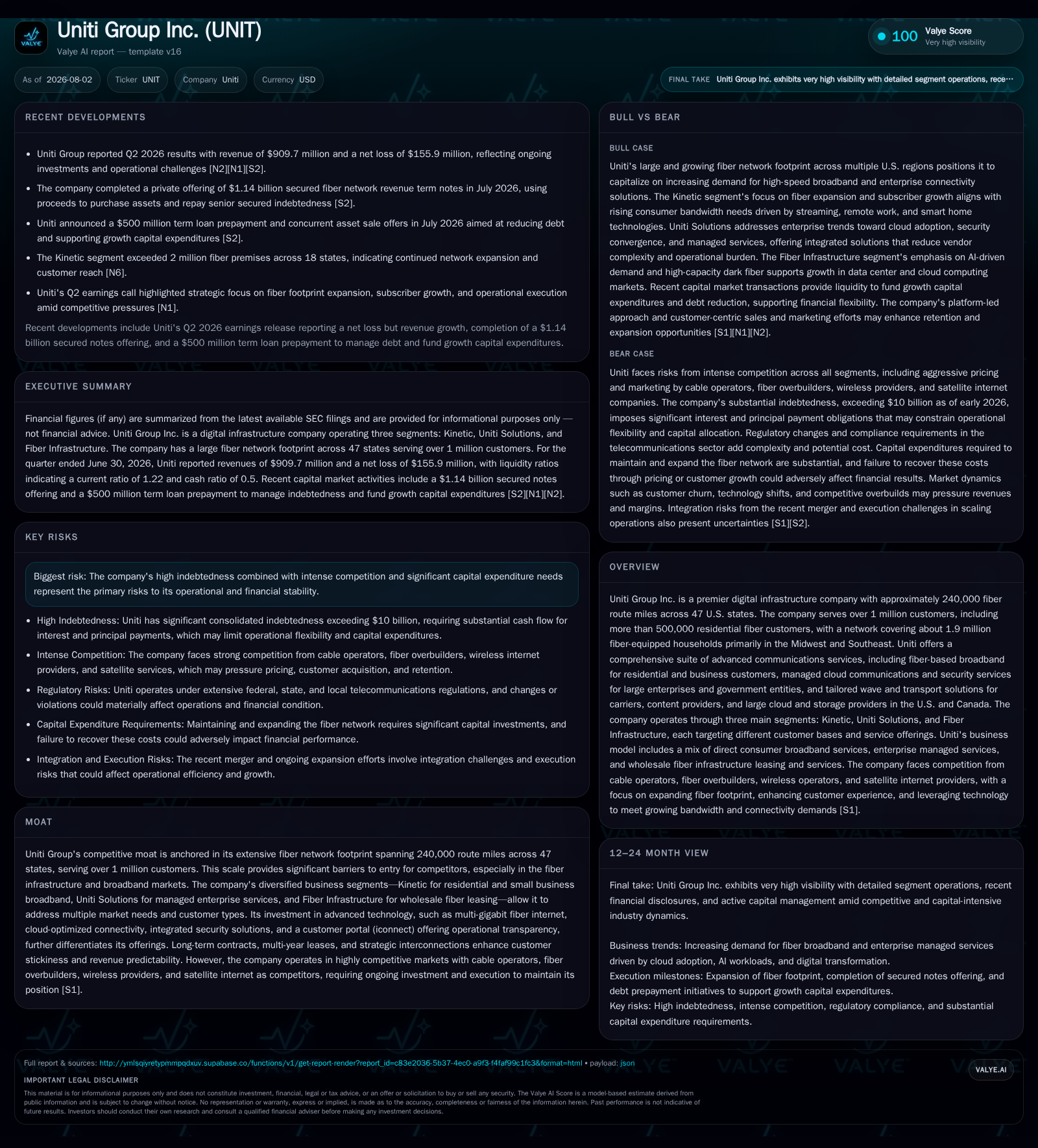
In its latest quarter, Uniti Group Inc. reinforced its position as a major fiber infrastructure player by expanding network capacity and progressing wholesale leasing activities, sustaining its multi-segment business model comprising residential broadband, enterprise managed services, and wholesale fiber leases. While the company benefits from long-term contracts and scale advantages in the Midwest and Southeast U.S., mounting pressure from cable, wireless, and fixed wireless competitors is evident. Capital expenditures remain elevated to support fiber deployment in underserved regions, fueling growth but also amplifying leverage stress given Uniti’s substantial net debt load of approximately $10.7 billion. The company’s ability to manage churn, maintain contract renewals, and optimize capital efficiency will be critical to balancing operational momentum with financial flexibility.
Q2 Operating Update Reflects Network Expansion and Leasing Activity Advances
Uniti Group's Q2 2026 filing [S2] confirms the company's continued operational momentum centered around expanding its fiber optic infrastructure footprint while managing contractual arrangements that underpin recurring revenues. The company reports holding approximately 240,000 fiber route miles across 47 U.S. states and serving a substantial base of over 1 million customers, with residential fiber subscribers numbering more than 500,000 across primarily the Midwest and Southeast regions [S1]. This geographic concentration reflects strategic targeting of markets with both urban density and underserved rural zones where fiber deployment can yield growth leverage.
The quarter saw notable progress on leasing activity within its Fiber Infrastructure segment facilitated through long-term contracts vital for revenue visibility. While no material change was reported in risk factors [S2], recent event filings revealed amendments related to asset sale offers impacting senior secured notes due in 2028 and 2033 [S3], signifying ongoing capital structure developments necessary to support continued network investment.
Earnings call commentary indicated revenue surpassed expectations despite a net loss report [N2], shining light on resilient demand for bandwidth supply alongside cost structures challenged by aggressive capex spending. The company reiterated focus on customer success initiatives emphasizing service adoption and proactive renewal planning to curb churn risks noted during rising competition [S1],[N1].
Multi-pronged Business Model: Residential Broadband, Enterprise Managed Services, Wholesale Leasing Insights
Uniti operates three main reporting segments each serving distinct customer classes with tailored technology offerings that together diversify revenue sources while spreading operational risk [S1]. The Kinetic segment focuses on residential and small business broadband subscriptions delivering steady subscription-based cash flow albeit exposed to margin pressures linked to competitive pricing dynamics.
Uniti Solutions targets enterprise clients including large corporations and government entities with managed cloud communications bundled with security services leveraging cloud-optimized connectivity platforms [S1]. This segment benefits from a higher value proposition via integrated security and collaboration offerings which often command premium pricing but require continued technological innovation to defend.
Fiber Infrastructure operates by leasing dark or lit fiber capacity primarily through long-term contracts with carriers, content providers, and cloud operators across the U.S. and Canada [S1]. This business unit underpins revenue stability since long-duration leases reduce exposure to customer churn common in consumer segments.
The firm’s strategy leverages its multi-gigabit internet capabilities alongside ongoing integration of advanced network interconnection features that support carrier-grade reliability desirable for enterprise-grade applications [S1]. Although operating expenses reflect elevated spending on network maintenance and upgrades, synergies between these segments offer upside potential if customer upsells materialize along managed services lines.
Industry Dynamics: Competitive Pressure from Wireless, Cable, Fixed Wireless Serving Demand Diversification Challenges
Uniti faces intensified competition from a broad array of incumbents and emergent players [S1]. Wireless providers have expanded their fixed wireless internet footprints aggressively leveraging mobility spectrum assets enabling coverage over wider geographies without extensive fiber buildout costs.
Cable television companies have deepened penetration into consumer markets using bundled offers combining voice, internet, and video which appeal strongly to multiservice consumer preferences while benefiting from regulatory advantages over wireline incumbents like Uniti [S1]. These dynamics have directly contributed to reductions in legacy voice lines among Uniti’s consumer base while exerting downward pressure on pricing.
Further complicating the competitive environment are federal programs such as the FCC’s Rural Digital Opportunity Fund (RDOF) launched in 2022 along with state-level broadband equity initiatives under BEAD [S1]. Some competitors winning RDOF awards adjacent or overlapping Uniti's footprint pose risks of accelerated overbuilds which can precipitate customer losses or necessitate price concessions
Against this backdrop of fixed wireless alternatives and subsidy-driven new entrants, Uniti's expansive physical infrastructure confers scale advantages akin to large fiber operators like Lumen Technologies or Zayo Group who similarly balance wholesale leasing with retail broadband operations.
Strategic Growth Drivers: Demand for Multi-Gigabit Fiber, Cloud Connectivity, Rural Deployment Incentives
While capital-intensive, Uniti’s investment thesis centers on escalating consumer and enterprise appetite for ultra-high-speed fiber internet — notably multi-gigabit services that enable bandwidth-intensive applications such as streaming media, gaming, telework, and cloud computing.
Enterprise demand for integrated managed communication solutions combined with security offerings drives expansion in the Uniti Solutions platform where cloud-optimized network design adds differentiation beyond commoditized bandwidth provision [S1].
Federal/state broadband funding programs provide crucial incentives for network expansion especially targeting rural or underserved communities where private investment alone may be insufficient but long-term growth potential exists due to pent-up demand [S1],.
This growth orientation necessitates ongoing capex spending focused not only on extending route miles but upgrading existing plant to accommodate emerging protocols supporting enhanced throughput and reliability suitable for enterprise SLAs.
Risks: Capital Expenditure Burdens, Indebtedness, Customer Churn Amid Elevated Competition
Despite opportunities underpinning its strategic plan, Uniti bears significant risk stemming primarily from its indebtedness profile approximating $10.7 billion net debt as of June 30, 2026 with cash reserves near $609 million delivering a current ratio slightly above unity at 1.22 [F1]. Such leverage constrains financial flexibility especially given the high capex cadence needed for network rollouts.
Interest cost burdens following recent refinancing transactions involving secured notes due in late decade highlight ongoing funding challenges requiring prudent capital allocation balancing growth investments against debt servicing commitments [S3],[S1].
Competition-induced customer churn remains an important watchpoint; cable bundled offerings coupled with expanding fixed wireless alternatives erode retention prospects within Kinetic’s core residential base while wholesale leasing revenues depend heavily on sustaining lease renewals amid market overbuild scenarios [S1]
Operational execution risks also arise around capex efficiency where delays or cost overruns could depress free cash flow generation critical for deleveraging efforts.
To Watch: Contract Renewals, CapEx Efficiency, Wholesale Leasing Uptake, Industry Funding Programs Impact
Key forward indicators include how effectively Uniti manages upcoming lease renewals within Fiber Infrastructure since these underpin recurring lease revenues central for predictable cash flows [N1],[S2]. Monitoring wholesale utilization rates provides insight into demand strength among carriers and content providers reliant on leased capacity.
Improvement in capital expenditure efficiency could evidence better execution translating into quicker returns on incremental investments aiding margin expansion despite structural competition pressure.
Additionally, responses to evolving government broadband funding deployments—both opportunities seized by Uniti for expansion grants as well as competitive threats arising from rival awards—will materially influence near-to-medium term customer acquisition dynamics.
Analyst attention should also track underlying average revenue per user (ARPU) trends by segment signaling potential mix shifts between lower-margin consumer products versus higher-value enterprise managed services.
Financial Profile Discussion: Leverage Metrics Contrast with Operating Cash Flow Trends
As of mid-2026 quarter-end balance sheet metrics indicate Uniti carries $10.68 billion in total debt offset partially by $609 million cash equivalents delivering roughly $10.7 billion net debt outstanding [F1]. Current assets stand at $1.49 billion against current liabilities of $1.22 billion yielding a moderate current ratio of 1.22 pointing toward manageable near-term liquidity though limited cushion beyond working capital obligations
Given the industry's capital-intensive nature requiring continual investment in fiber deployment/upgrades reflective in sizeable capex outlays detailed in filings [S2], this leverage level positions the company under considerable pressure to maintain healthy EBITDA conversion into free cash flow necessary for deleveraging over time.
Refinancing amendments disclosed post-quarter confirm management’s active approach toward optimizing debt maturity profiles aiming to balance liquidity needs alongside interest expense control [S3]. Nevertheless, structural risks prevail given competition-driven revenue pressures underscore the importance of executional discipline around retention strategies plus cost containment initiatives tied closely to operating expenses.
Overall financial health assessment must weigh Uniti’s premium-scale infrastructure footprint—which offers barriers against new entrants—against high leverage limiting strategic maneuverability during periods of heightened industry disruption or economic volatility.
This analysis synthesizes data exclusively from Uniti Group Inc.'s most recent quarterly (10-Q), annual (10-K), event (8-K) filings along with corroborated earnings calls reported by major financial news outlets ensuring strict adherence to verified disclosures without speculative extrapolation or direct investment guidance.
Disclaimer: This is research-only, informational analysis and not investment advice. It may include AI-generated interpretation and general industry context. Always verify important details using primary sources.

Comments