
Climb Global Solutions Advances Scalability Through Strategic Cloud Integration and Drop Shipping Efficiencies
Climb Global Solutions maintains stable growth by leveraging a capital-efficient distribution model enriched with cloud enablement and operational automation.
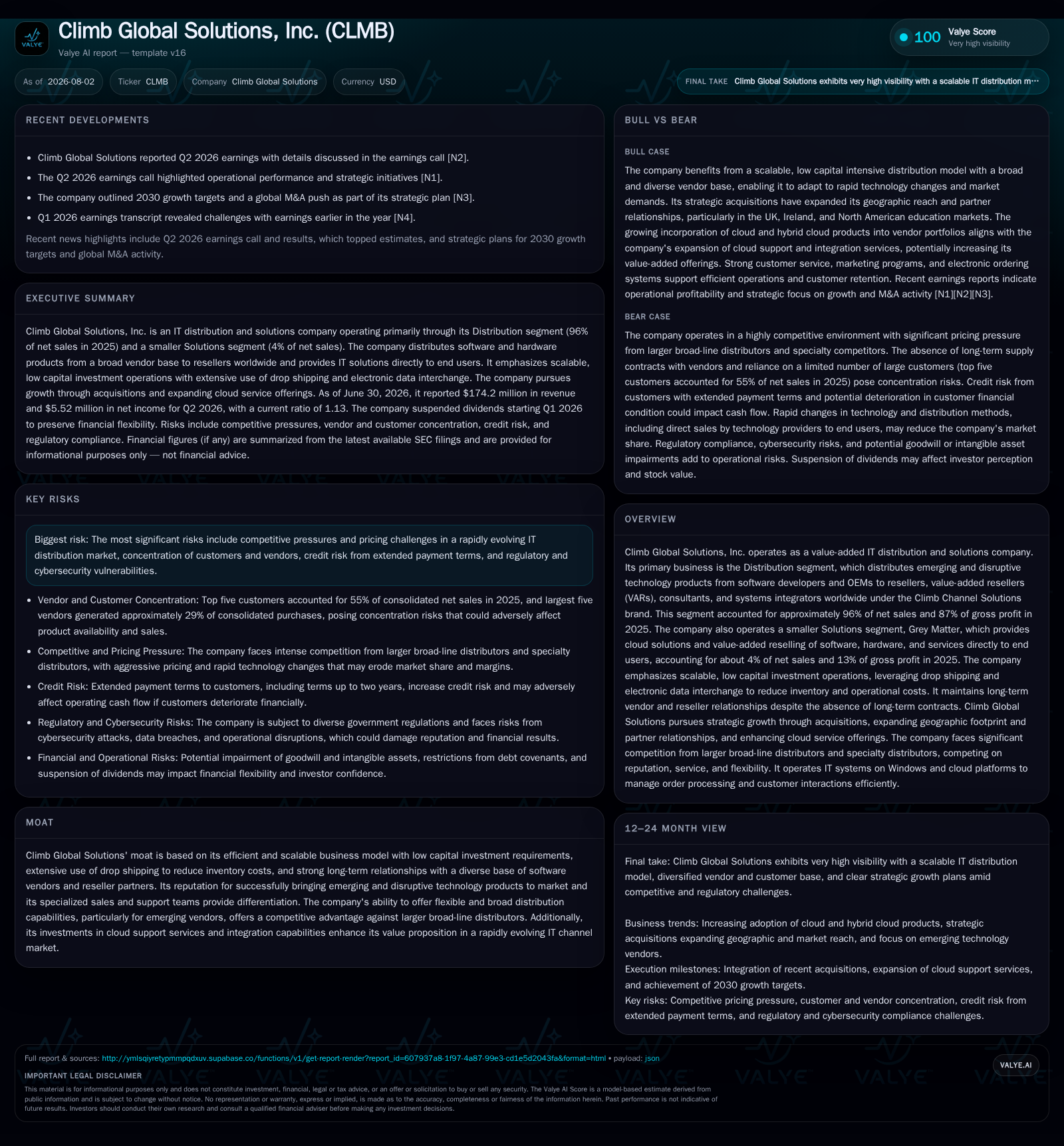
In its latest quarterly filing, Climb Global Solutions demonstrated steady execution of its low-capital intensity business model. The company’s Distribution segment, which constitutes the bulk of revenue and gross profit, benefits from extensive drop shipping and EDI automation to scale efficiently amid competitive pricing pressures. Complementing this is the growing Solutions segment, Grey Matter, which enhances margin profile via cloud solutions integration and technical enablement. Climb’s focus on emerging technology vendors and expanding reseller partnerships positions it well against broad-line distributors while managing typical sector risks such as customer concentration and credit exposure.
Q2 Update Frames Climb’s Efficient Capital-Light Model Amid Competitive Pressures
Climb Global Solutions’ latest quarterly report for the period ended June 30, 2026, reaffirms its stable operating momentum driven by an efficient, scalable business model optimized for a rapidly evolving IT distribution landscape [S2][S3]. The Distribution segment continues to dominate revenue generation at approximately 96% of net sales while contributing around 87% of gross profit. This segment’s predominance underscores the company’s strategic focus on high-volume reselling of software licenses, maintenance contracts, networking/storage/security hardware predominantly drop shipped directly from vendors to end customers [S1]. The Solutions segment Grey Matter remains a smaller yet meaningful contributor (~4% of net sales; ~13% gross profit), providing cloud solutions and integration services that enhance overall profitability.
Despite persistently slim gross billings margins characteristic of the IT distribution sector—where price competition is intense—Climb leverages technology-enabled logistics such as drop shipping combined with electronic data interchange (EDI) to reduce physical inventory handling costs and improve order fulfillment efficiency. These factors collectively help maintain profitability while limiting capital expenditure needs. The recent filings show no material adverse changes in risk or operating profile compared to prior periods but underscore ongoing competitive pricing headwinds [S2][S3]
Operational Leverage Through Drop Shipping and EDI Automation Drives Scalability
The backbone of Climb's operational scalability lies in its sophisticated use of drop shipping for hardware products and comprehensive deployment of EDI systems to automate order processing. Drop shipping shifts inventory holding away from Climb directly to OEMs or software vendors who fulfill orders straight to customers. This mitigates inventory obsolescence risk—a chronic challenge given rapid technology innovation cycles—and substantially reduces working capital commitment.
Concurrent use of EDI facilitates real-time communication between Climb, its vendor partners, and reseller clients, significantly cutting down order cycle times, minimizing errors, and reducing fulfillment costs. These efficiencies enable Climb to handle high transaction volumes at low marginal cost—a vital capability given the typically low gross billings margin structure inherent to IT distribution businesses [S1]. This capital-light operating philosophy aligns with peer models in specialized IT distribution segments rather than asset-heavy broad-line distributors.
Robust Vendor-Reseller Ecosystem Supports Low-Margin High-Volume Distribution
Climb cultivates a diverse ecosystem of emerging technology vendors alongside more established OEMs to supply a wide portfolio encompassing software licenses, maintenance contracts, networking gear, storage solutions, security appliances, and complementary products. This vendor mix aligns with channel partners’ demands for disruptive technologies in virtualization, cloud computing, application lifecycle management, security infrastructure, and networking domains.
On the customer side, Climb serves an extensive base comprising value-added resellers (VARs), corporate resellers including government accounts, consultants, systems integrators as well as direct marketers. An increasing share of revenues derives from larger VAR customers generating over $1 million annually—a deliberate move to deepen relationships that offer higher volume predictability and cross-selling opportunities [S7][S13]. However, concentrated top-tier customer accounts represent roughly 55% of net sales as per latest annual disclosures—a double-edged sword boosting revenue visibility but elevating exposure should those relationships wane.
Strategic Cloud Integration Enhances Value-Added Reselling Via Grey Matter Segment
Beyond traditional distribution dynamics, Climb’s Solutions segment named Grey Matter plays a crucial role in margin enhancement by delivering cloud-centric offerings that complement hardware/software reselling activities. Grey Matter provides technical enablement services around hybrid cloud infrastructures—helping channel partners transition towards SaaS licensing models—and assists customers with integration services essential for digital transformation initiatives.
With rising enterprise adoption of hybrid environments blending on-premises resources with multiple public clouds, such value-added cloud services embed Climb more deeply into customers’ IT ecosystems while offsetting pressure on low-margin product sales [S1]. This pivot underscores management's recognition that sustainable competitive advantage increasingly depends on embedding technical expertise alongside product distribution
Industry Comparison Highlights Strengths vs. Broad-Line Distributors
Within the IT distribution landscape—which encompasses large broad-line players like Ingram Micro and Tech Data versus more specialized distributors—Climb distinguishes itself through an emphasis on operational scalability enabled by automation and drop shipping rather than capital-intensive warehousing or physical inventory buildup.
While broader distributors may command greater absolute scale with diversified hardware portfolios including commoditized components yielding thin margins offset by volume leverage, Climb’s niche focus on emerging technology products combined with value-added solutions services affords it flexibility and differentiation [S1]. However, this approach naturally constrains absolute margin expansion potential but supports respectable returns on equity via capital efficiency measures
Growth Catalysts: Emerging Tech Vendors, Cloud Adoption, and Channel Expansion
Key growth vectors for Climb lie in onboarding new emerging technology vendors introducing disruptive products that resonate within resellers’ portfolios. Continued expansion within large VAR customers further stabilizes recurring volume streams. Moreover, accelerating adoption of cloud computing frameworks coupled with proliferation of SaaS licensing necessitate enhanced distribution infrastructures capable of managing digital entitlements alongside traditional hardware shipments.
These dynamics fuel demand for integrated channel support encompassing licensing infrastructure management plus technical enablement services—areas where Climb’s Grey Matter segment is positioned for acceleration. Market trends toward hybrid multi-cloud setups increase complexity for end users seeking interoperability solutions which provides an additional revenue runway through integration offerings [S1][N3]
Watchpoints: Pricing Pressure, Customer Concentration, and Credit Risk Management
Persistent industry challenges center around pricing erosions as competitive pressures intensify due to market saturation among distributors coupled with vendor direct-to-reseller or direct-to-customer sales channel disruptions.
Customer concentration risk remains notable; with top five customers accounting for over half the consolidated net sales (55%), losing a major account could materially impact revenue stability unless mitigated by expanding other reseller relationships or acquiring new clientele [S7][S13]. Additionally, credit risk inherent in distributing on extended payment terms requires close monitoring through days sales outstanding (DSO) metrics to safeguard cash flow consistency.
Vendors’ ability to continuously introduce compelling new technologies also forms an operational dependency; failure to secure fresh offerings could reduce reseller demand over time impacting top-line growth prospects.
Upcoming Milestones: Quarterly Guidance Indicators and Execution on Cloud Enablement
Investors tracking Climb should watch for forthcoming earnings guidance updates reflecting execution progress on cloud-focused initiatives within the Grey Matter segment as well as updates regarding vendor/reseller network expansions.
Recent investor presentations emphasize ongoing efforts to scale global M&A to bolster footprint further while enhancing product portfolio breadth aligned with strategic growth targets set through 2030 [N3][N1][S3]. Pragmatic evaluation of backlog expansion or order intake trends aligned with cloud solution deployment will serve as valuable near-term demand indicators.
Financial Profile Discussion: Healthy Liquidity Supports Growth Strategy
At quarter-end June 30, 2026, Climb held $56.6 million in cash and cash equivalents against modest debt reported at approximately $1.2 million trailing best effort from March 2024 figures [F1]
This robust liquidity profile complements Climb’s low-capital intensity operational framework facilitating reinvestment into scaling cloud enablement capabilities while allowing measured risk-taking in vendor onboarding or selective M&A pursuits without over-leveraging balance sheet resources.
This analysis synthesizes pertinent company filings alongside sector industry knowledge without offering investment advice or forecasting guidance.
Disclaimer: This is research-only, informational analysis and not investment advice. It may include AI-generated interpretation and general industry context. Always verify important details using primary sources.

Comments