
Republic Airways Expands Fleet and Secures Long-Term CPAs, Anchoring Revenue Stability
Recent quarterly filings highlight Republic Airways' growing operational scale under long-term contracts with major airline partners, underpinning its role as a leading independent regional carrier.
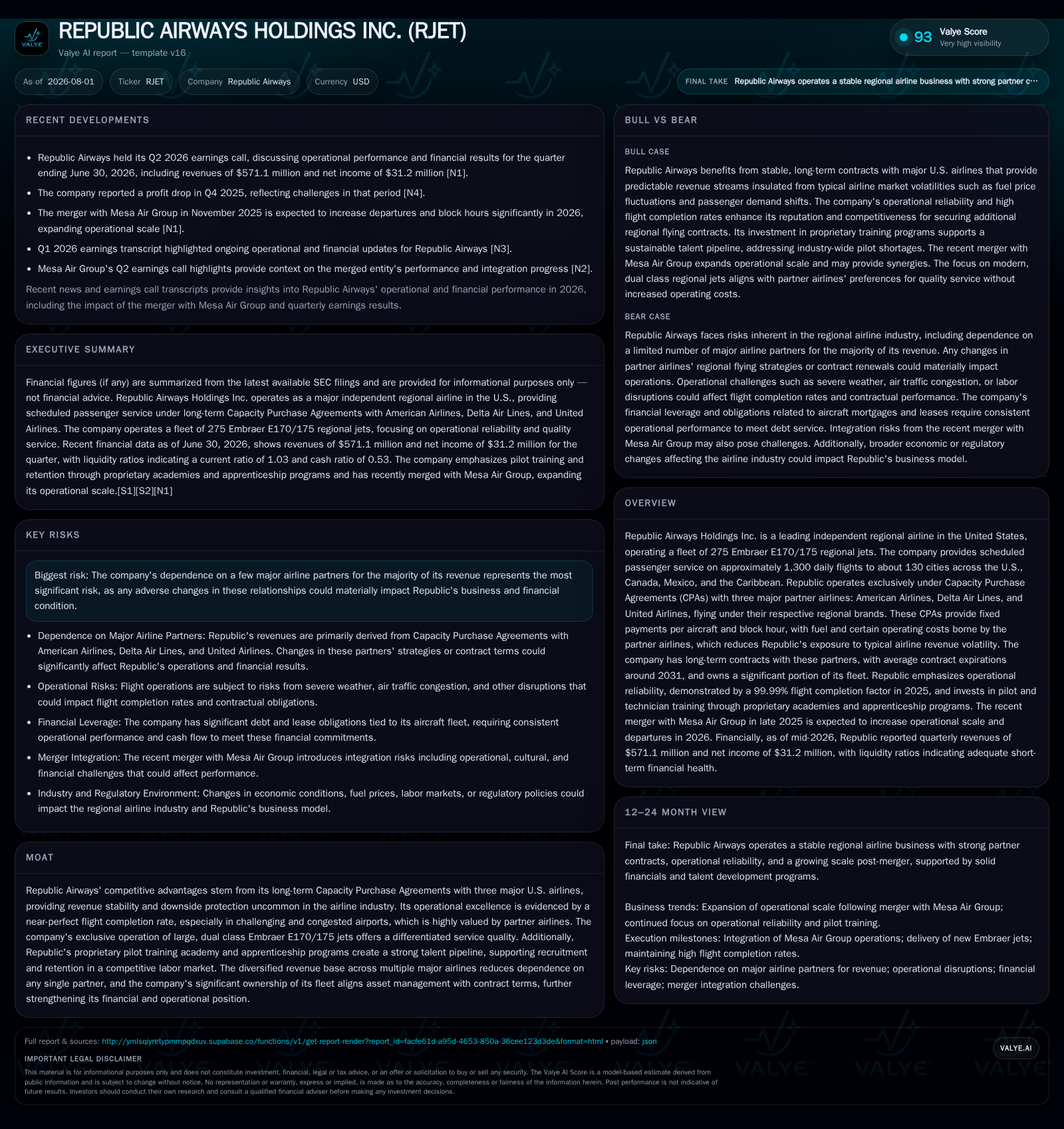
Republic Airways Holdings Inc. reported operational consistency and strategic expansion in its Q2 2026 filing, anchored by multi-year Capacity Purchase Agreements (CPAs) with American Airlines, Delta Air Lines, and United Airlines. The company operates roughly 275 Embraer E170/175 jets, performing approximately 1,300 daily flights across North America and the Caribbean. Its exclusive reliance on block-hour-based CPA revenue mitigates exposure to fare volatility and fuel prices. Recent industry consolidation through the merger with Mesa Air Group has positioned Republic for about 24% expected block hour growth in 2026, while pilot training investments aim to address labor challenges typical in the regional airline segment. Despite strong operational metrics like high flight completion rates, reliance on a few partners remains a key risk.
Recent Operating Update
Additionally, no material changes have been reported in risk factors since the last annual filing [S2], implying continuity in underlying risks such as partner concentration and labor market conditions. The recent event filing reaffirmed Q2 financial results without introducing new strategic developments beyond merger integration updates [S3].
Business Model and Revenue Mechanics
Republic Airways operates exclusively under long-term multi-year Capacity Purchase Agreements with American Airlines (American Eagle), Delta Air Lines (Delta Connection), and United Airlines (United Express) [S1]. Under these CPAs, Republic does not engage directly with passengers nor bear fuel cost exposure; instead, it receives fixed payments based on aircraft availability (block hours) which significantly stabilizes its revenue stream against typical volatility seen in passenger fares or fuel price fluctuations.
The company's monetization hinges primarily on maximizing block hours operated per contracted aircraft while maintaining high operational efficiency. The exclusive use of Embraer E170/175 regional jets — sizable dual-class aircraft serving roughly 65-76 seats — caters to partner airlines’ requirements for reliable feeder service into their hub networks [S1]. These Embraer jets distinguish Republic from peers operating smaller or more heterogeneous fleets by providing better passenger experience aligned with mainline brand standards. Moreover, owning a considerable portion of the fleet aligns asset lifecycle management closely with contract terms.
Operational costs like crew wages, maintenance beyond fuel (borne by partners), airport services, and training represent key variable expense levers within Republic's control. Notably, pilot training academies and apprenticeship initiatives are integral to managing labor supply risks prevalent across the regional airline industry segment [S1]. Pilots trained via proprietary programs help secure recruitment pipelines critical for uninterrupted service delivery.
Industry Structure and Competitive Position
Regional airlines act as subcontracted feeders within the broader U.S. air travel value chain. As the second-largest independent regional carrier post-merger with Mesa Air Group, Republic interfaces upstream exclusively through contracts rather than direct sales channels—a hallmark of this industry sector [S1]. The competitive basis among peers centers around CPA negotiations involving pricing per block hour, operational reliability metrics such as flight completion rate (Republic approaches near perfection especially at congested airports), fleet composition suitability for partner network needs, and pilot staffing stability.
Peers such as SkyWest Airlines or Envoy Air (American Airlines’ wholly owned subsidiary) compete for similar CPA volume but differ in fleet diversity or ownership structure. In comparison, Republic’s all-Embraer jet strategy simplifies maintenance complexity but may limit flexibility against shifts toward different aircraft models.
Reliance on three major airline partners—American, Delta, United—provides diversified yet concentrated revenue streams; any adverse renegotiation or contract loss would significantly affect financial health given over 90% flying tied to these CPAs [S23]. This concentration remains an inherent structural risk typical of regional carriers.
Growth Drivers
Key demand drivers include growing network feed requirements by major airlines seeking enhanced connectivity to smaller cities where mainline aircraft are uneconomical. Post-pandemic recovery contributing to increased regional travel demand also supports higher utilization [S1]
The recently expanded operational base through the Mesa merger affords scale advantages ranging from cost synergies to larger bargaining power during CPA renewals.
Fleet modernization focusing on efficient Embraer E170/175s promises improved economics over older CRJ series retired previously. In turn, the company's ongoing investment in pilot training infrastructure addresses chronic labor shortages—a constraint affecting many regional operators—facilitating capacity growth without compromising operational reliability.
Technological investments such as mobile applications aimed at enhancing recovery actions during irregular operations add resilience against disruptions impacting scheduled departures.
Risks and Watchpoints
Primary risks remain customer concentration given dependency on three majors whose strategic shifts could materially impact volume or pricing; contract renewal outcomes merit close monitoring given their direct link to future revenue streams [S6]. Fuel price volatility is largely mitigated but not eliminated—as flying decisions by partners respond indirectly to macroeconomic fuel cost dynamics affecting overall routing demands.
Labor markets pose risks through potential pilot attrition or shortages; while proprietary training mitigates this somewhat, cost pressures from inflationary wage trends could elevate operating expenses.
Third-party vendor dependence—for MRO services or IT infrastructure—introduces potential for service level disruptions or cost increases that may adversely affect flight schedules or margins [S1]. Regulatory changes involving emissions standards or import tariffs could heighten maintenance costs or constrain parts availability given international sourcing predominantly from Brazil (Embraer).
Macro-level economic uncertainties including recessions or geopolitical events continue to challenge demand predictability.
What to Watch Next
Monitor upcoming quarterly filings for actual block hour growth post-Mesa integration versus guidance indicating ~24% increase. Any deviations will signal execution effectiveness helping validate capacity expansion assumptions.
Track renewal negotiations for existing CPAs traditionally extending well into early 2030s; updates here will materially alter revenue visibility horizon.
Pilot recruitment metrics such as hiring rates or attrition levels would offer early insights into sustaining operational scale amid tight labor markets.
Watch operational performance KPIs like flight completion rate especially during peak seasons as key indicators of service quality underpinning partner retention.
Financial results including contract revenue per available seat mile (CRASM) trends represent granular pricing power assessment alongside cost per block hour changes reflecting margin dynamics.
Any notable regulatory developments regarding aircraft usage restrictions or tariffs impacting parts could shift cost structure notably.
Financial Profile Discussion
As of June 30, 2026, Republic held approximately $116 million in cash and equivalents supporting liquidity needs during fleet expansion cycles [F1]. Total debt stood near $95 million as of September 30, 2025, primarily linked to secured financing of aircraft acquisitions where mortgage terms generally align with CPA durations ensuring amortization matches contractual revenues [F1][S21].
The current ratio close to parity at approximately 1.03 reflects balanced short-term asset-to-liability match mainly due to timing variances between receivables from partners and payables [F1]
Capex levels remain focused largely on fleet ownership growth and training facility expansion ensuring aligned investment capacity supporting contracted growth estimates [S20]
Overall financial posture characterized by moderate leverage balanced against high-quality receivables mitigates liquidity concerns amidst cyclical sector challenges.
This analysis synthesizes SEC-filed data along with industry context highlighting Republic Airways Holdings Inc.’s structure as an influential independent regional airline anchored by dependable CPAs mitigating traditional carrier margin volatility through contractual revenue models. Operational execution post-Mesa merger alongside pilot training investments position Republic well within prevailing labor market constraints while maintaining differentiated service quality through exclusive Embraer jet operations. Ongoing evaluation of contract renewals and macroeconomic/regulatory headwinds remain essential watch points shaping future trajectory.
Disclaimer: This is research-only, informational analysis and not investment advice. It may include AI-generated interpretation and general industry context. Always verify important details using primary sources.

Comments