
W. R. Berkley Strengthens Niche Specialty Insurance and Reinsurance Amid Rising Premiums and Investment Income
Latest quarterly results show Berkley's decentralized underwriting model supports premium growth and investment income gains despite persistent industry cyclicality.
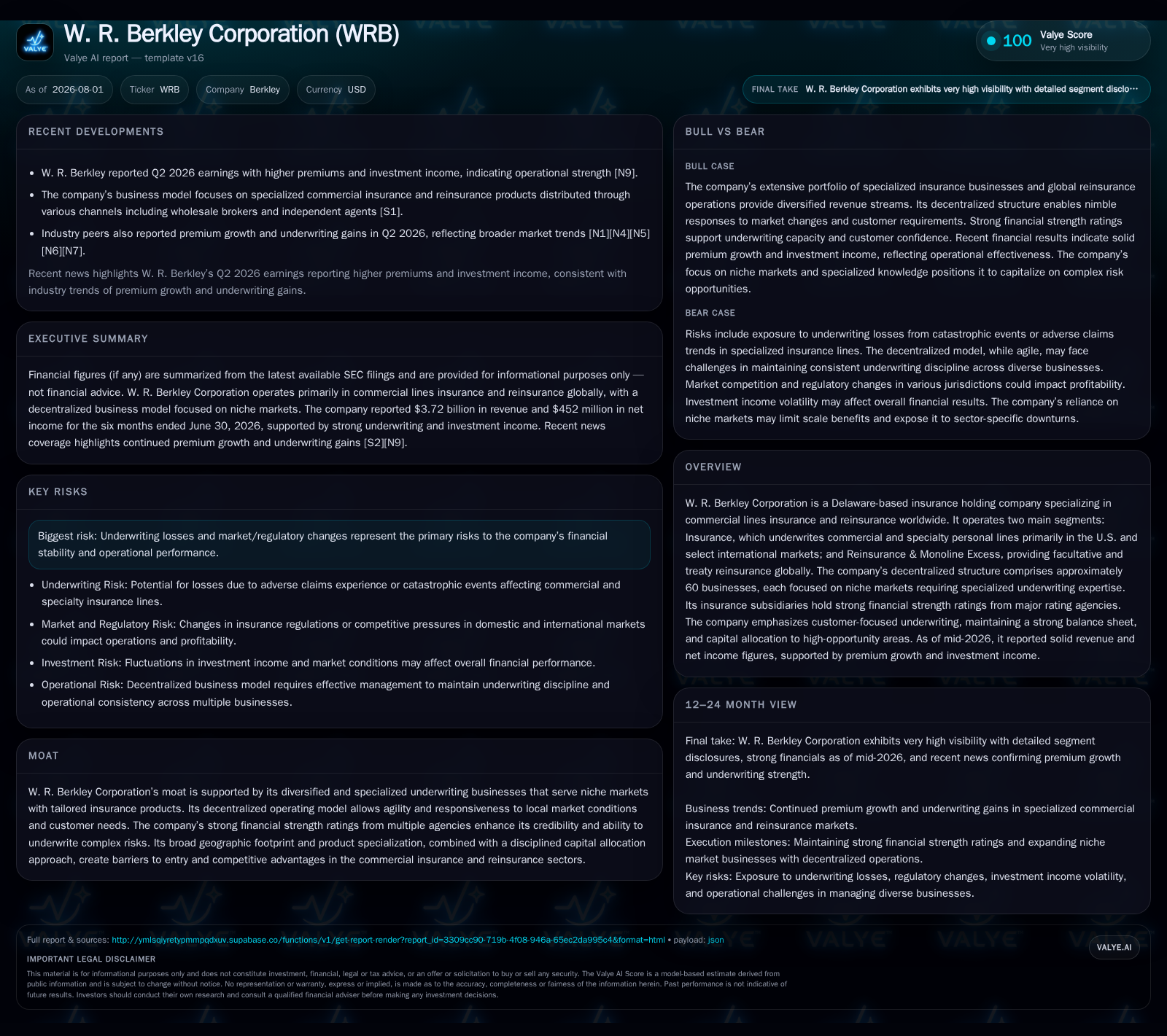
W. R. Berkley Corporation reported a strong second quarter in 2026, driven by higher net premiums written across its specialty commercial insurance and reinsurance segments, alongside improved investment income. The company's decentralized structure allows agile market response in diverse niche segments worldwide, supported by high financial strength ratings. Yet, underwriting profitability is subject to ongoing risks from cyclical pricing pressures, loss reserve uncertainties, and evolving catastrophe exposures. Capital allocation towards new specialty ventures and geographic expansion are key growth drivers to watch amid competitive headwinds.
Recent Operating Update
In the latest quarterly filing for Q2 ended June 30, 2026, W. R. Berkley Corporation reported continued premium momentum across its Insurance and Reinsurance & Monoline Excess segments [S2]. The company experienced an increase in net premiums written compared to prior periods, buoyed by selective underwriting rate actions and expanding specialty commercial lines exposure. Concurrently, Berkley’s investment portfolio benefited from increased equity securities holdings leading to enhanced investment income contributions during the quarter [S2][S3]. This synergy between underwriting performance and investment gains illustrates the dual-engine revenue model characteristic of property casualty insurers.
The Q2 financials further reflect the influence of Berkley’s decentralized operating model consisting of roughly 60 niche-focused underwriting businesses positioned close to their customer bases globally. This structure empowers responsiveness to localized market conditions while leveraging centralized capital deployment and risk management expertise [S1]. Financial strength remains robust with multiple subsidiaries rated A+ by A.M. Best—a critical factor for underwriting large or complex risks and sustaining broker confidence.
Business Model
Berkley operates primarily in the commercial lines property casualty insurance space complemented by a global reinsurance segment offering facultative and treaty coverage along with monoline excess retention products [S1]. The company monetizes through upfront premiums collected on policies tailored by specialized underwriters well-versed in distinct industries or geographies. This specialization mitigates risk through granular underwriting discipline while enabling pricing power in less commoditized niches.
Premium volume directly correlates with policy issuance volume and average pricing levels; margins hinge critically on managing loss frequency/severity via prudent case reserving and claim settlement efficiency [S1][S2]. Berkley’s significant float of premiums prior to claim payouts also facilitates meaningful investment income generation—especially from fixed maturity instruments held nearly to maturity plus equity positions aimed at growth sectors like financial services and energy
The mix of admitted lines, excess & surplus policies, reinsurance treaties, and program-based arrangements diversifies both risk pools and revenue streams [S1]. Moreover, the project pipeline includes start-up specialty ventures focusing on underserved sectors such as cybersecurity or international commercial expansions—leveraging the company's ability to capitalize on emerging insurance demand pockets rapidly
Industry Structure and Competitive Position
The property casualty insurance sector is notably cyclical with soft/hard market oscillations impacting rate adequacy over multi-year cycles influenced by capital supply fluctuations, catastrophe events, social inflation effects on claims, regulatory shifts, and macroeconomic activity [S1]. Berkley sits among top U.S. commercial lines writers but differentiates via its decentralized niche focus rather than broad-market mass underwriting.
Competitors range from global giants like Chubb Corporation and Allianz SE to specialty underwriters such as Hiscox Ltd. and Arch Capital Group Ltd., each competing partially on premium pricing but also service quality, financial strength perception, product innovation, and claims handling reputation. Insurtech entrants further intensify competition by introducing digitization efficiencies potentially compressing expense ratios but often lacking deep specialty niche expertise.
Berkley's tight capital management combined with strong balance sheet metrics—including liquidity buffers exceeding $2.6 billion as of Q2 2026—positions it well against capacity constraints that typically curb growth during hard markets or large catastrophic loss absorption phases [F1][S2]. Its diversified geographic footprint spanning North America, Asia-Pacific, Europe, Latin America, and Australia broadens market opportunity while distributing event-specific concentration risks.
Growth Drivers
Key drivers include expansion into selective specialty insurance fields where analytic capabilities yield underwriting advantage—such as healthcare liability or energy sector risks—and international markets demonstrating rising commercial insurance needs [S1]. New business incubation is strategic: Berkley assesses opportunities for internal formation when expert talent is available rather than solely relying on acquisitions.
Geographic diversification reduces dependence on U.S.-centric economic cycles and regulatory developments while capturing growth trajectories in Asia-Pacific emerging economies or European specialty verticals. The reinsurance segment's facultative treaty offerings support client risk transfer needs amid growing global catastrophe exposures heightened by climate change-related volatility.
Additionally, technology investments enhancing underwriting data analytics promise improved loss selection accuracy driving lower combined ratios long term—a critical profitability lever given fluctuating claims environments across segments.
Risks and Constraints
Underwriting risk remains paramount: mispriced premium rates or unexpected surge in claims frequency or severity can lead to reserve strengthening charges adversely affecting earnings. These outcomes are amplified by inflationary pressures on claim costs as well as judicial shifts expanding liability coverage scope [S1].
Regulatory changes may impose tighter capital requirements or altered coverage mandates impacting product design or profitability metrics. Intensifying competition fueled by abundant insurer capital inflows can suppress price increases essential for adequate loss cost coverage.
Investment portfolio volatility—particularly related to equity security valuations—and exposure within alternative investments like real estate loans secured in the U.K. also present risk points requiring active monitoring given their material weighting in total invested assets [S2][S6]
Catastrophe event losses remain inherently unpredictable but significant exposures are mitigated somewhat through reinsurance purchases combined with sophisticated catastrophe modeling embedded within underwriting processes.
What to Watch Next
Market observers should track upcoming quarterly disclosures for combined ratio trends as a proxy for underwriting discipline efficacy amid evolving claims environments.
Reserve development indicators will signal adequacy of current loss reserves amid ongoing claim maturation cycles—a crucial signpost for potential future earnings volatility.
Investment income trajectory influenced by interest rate cycles alongside realized/unrealized gains in equity allocations will impact overall profitability stability.
Progression in strategic new business formations or international footprint expansions may confirm management's ability to deploy capital opportunistically toward high-return niches despite competitive headwinds.
Finally, any material litigation outcomes related to reinsurance disputes could influence capital allocation priorities or reserve adjustments given recent lawsuits initiated against reinsurers regarding policy payouts without material adverse effects forecasted thus far [S1].
Financial Profile Discussion
As of June 30, 2026, Berkley maintained a strong liquidity position with approximately $2.6 billion in cash and cash equivalents supporting operational flexibility including claim settlements during peak payment periods [F1][S2]. The firm continues managing a substantial equity securities portfolio valued at about $1.5 billion fair value that enhances its investment yield beyond traditional fixed income returns underpinning float profitability [S2].
Debt obligations are structured with long-term maturities stretching into the 2050s plus subordinated debentures providing durable leverage capacity without near-term refinancing pressure [S3][S6]. This stable capital framework supports ongoing underwriting capacity expansion while preserving ratings vital to customer trust.
Net income improvements seen YTD reflect both underwriting gain resilience amidst cyclical pressures plus accretive investment results that offset adverse market factors common across property casualty insurers recently.
This analysis synthesizes publicly filed regulatory disclosures up to July 31, 2026 without offering investment research views. It aims to provide an informed industry-focused perspective reflecting operating realities for W. R. Berkley Corporation within the complex property casualty insurance environment.
Disclaimer: This is research-only, informational analysis and not investment advice. It may include AI-generated interpretation and general industry context. Always verify important details using primary sources.

Comments