
FTAI Aviation Streamlines Asset-Light Growth Amid Aviation Cyclicality and Credit Risks
FTAI advances proprietary engine MRE model and third-party capital leasing while navigating cyclical demand and credit pressures.
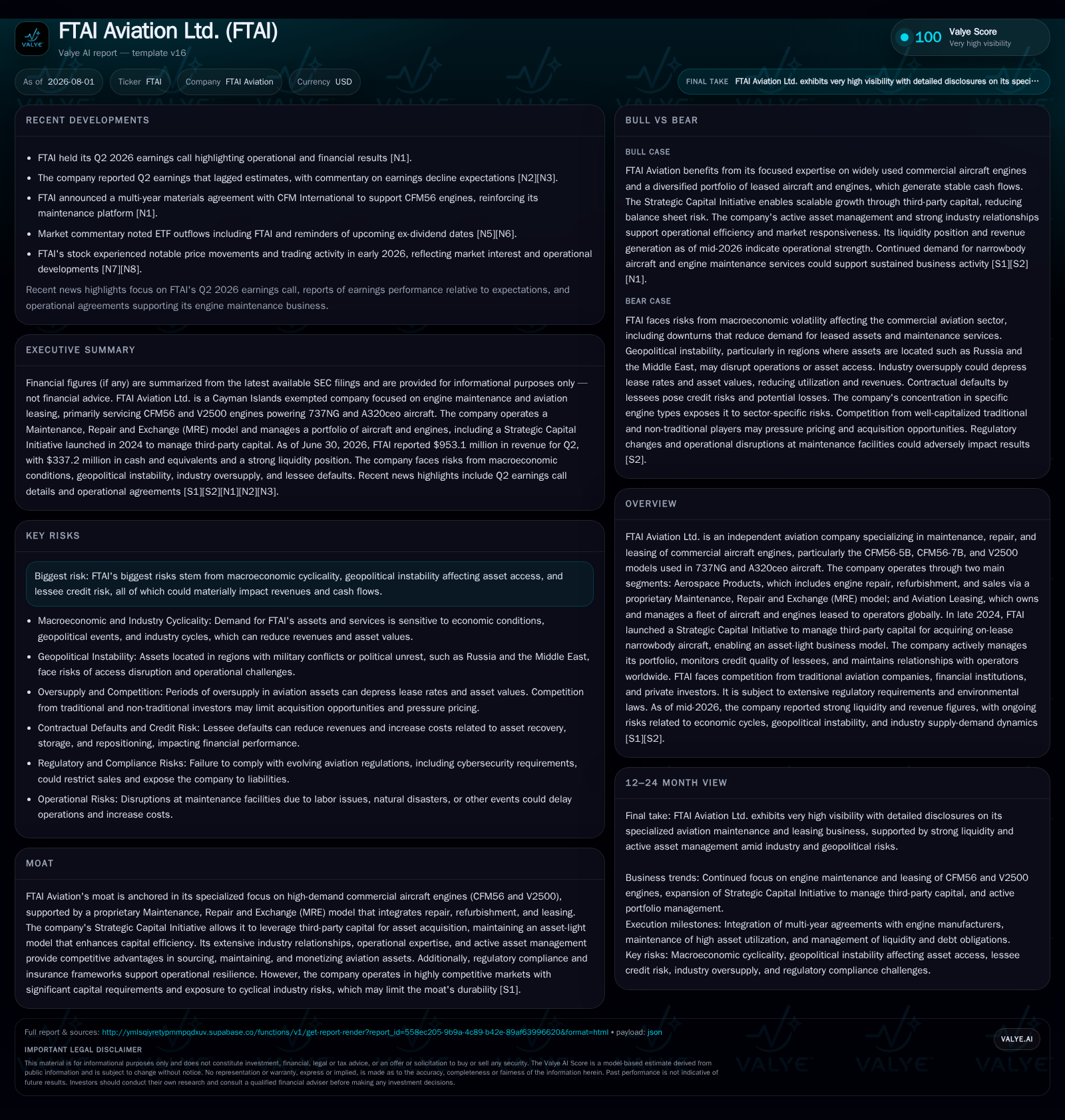
In Q2 2026, FTAI Aviation Ltd. reinforced its strategic focus on commercial engine maintenance and narrowbody aircraft leasing through its proprietary Maintenance, Repair and Exchange (MRE) model complemented by a growing Strategic Capital Initiative managing third-party capital for asset acquisition [S2][S3]. While macroeconomic uncertainties and aviation industry cyclicality persist as headwinds, FTAI’s specialized portfolio of CFM56 and V2500 engines supports cash flow stability amid competitive pressures [S1][S2]. The company’s asset-light strategy enhances capital efficiency but also hinges on lessee credit quality monitoring and geopolitical risks in operational footprints. Near-term growth depends on lease utilization, prudent portfolio management, and maintaining repair facility availability [S1][S20].
Recent Operating Update
In its Q2 2026 Form 10-Q filing dated July 31, 2026, FTAI Aviation Ltd. reaffirmed its dual-segment business structure centered on Aerospace Products and Aviation Leasing. The Aerospace Products segment continues focusing on repair, refurbishment, sales, and leasing of CFM56-5B/-7B and V2500 aircraft engines through its proprietary Maintenance, Repair and Exchange (MRE) model. This model facilitates continuous asset renewal by exchanging engines under maintenance contracts rather than outright sales alone. Complementing this is the Aviation Leasing segment managing a fleet of aircraft and engines leased worldwide.
A key strategic evolution is FTAI’s Strategic Capital Initiative (SCI), launched at the end of 2024 to mobilize third-party institutional capital specifically for acquiring on-lease narrowbody aircraft such as Boeing 737NGs and Airbus A320ceos [S1][S2][S8]. This initiative allows FTAI to pursue an asset-light approach by leveraging external capital while focusing internal resources on maintenance capabilities and portfolio management rather than outright ownership
Despite these structural advantages, the Q2 update cautions that broad economic uncertainties continue to weigh on demand [S2][S13]. Tightening credit markets might limit customers’ spending capacity or affect lease payments. Moreover, manufacturing costs—such as commodities volatility—and regulatory constraints remain risks that could pressure earnings unpredictably. Geopolitical tensions remain salient with assets in Eastern Europe subject to export controls or access restrictions linked to ongoing conflicts affecting Russia and Ukraine
Business Model
FTAI generates revenue through several verticals within aerospace aftermarket services: engine maintenance (MRO), refurbishment and parts sales via the MRE model under Aerospace Products; plus lease rental income generated from their managed fleet under Aviation Leasing. The MRE model is a differentiator as it promotes a closed-loop inventory system where repaired or overhauled engines are re-leased or sold in tandem with returns subject to standard exchanges—this reduces downtime for airline customers while optimizing FTAI’s asset utilization.
The Strategic Capital Initiative further refines monetization mechanics by segregating asset ownership from operations—third-party investors provide acquisition capital for aircraft assets, reducing balance sheet burdens on FTAI yet allowing it to earn management fees plus capture upside through operational control. This hybrid approach offers capital efficiency gains compared with owning all leased assets directly.
Revenue drivers revolve around engine turnaround volume (number repaired/refurbished), lease fleet utilization rate (percentage of assets leased vs idle), pricing dynamics influenced by market rates for leasing or parts sales, client creditworthiness shaping contract renewals or defaults, operational throughputs at maintenance facilities impacting service speed, plus underlying macro demand for commercial aviation affecting passenger/cargo traffic growth [S1][S8][S20]
Margins are influenced by repair cost variability including parts availability in supply chains as well as labor costs at facilities across North America and Europe. Lease portfolio margins depend heavily on market lease rates versus financing costs — given inherent leverage utilized within asset acquisitions—and any impairment charges recognized due to shifts in asset valuation.
Industry Structure & Competitive Position
FTAI operates at a critical juncture between OEMs' aftermarket divisions (e.g., GE Aviation servicing CFM56 engines) and independent MRO specialists like Standard Aero. Their advantage lies in combining specialized expertise managing high-demand legacy engines powering workhorse narrowbody fleets globally along with integrated leasing capabilities backed by their SCI.
However, competition is robust: OEMs maintain scale advantages with proprietary parts access; large lessors like AerCap hold expansive fleets offering scale lease pricing; financial players including hedge funds increasingly deploy capital into aviation assets seeking yield in a low-rate environment. FTAI's relatively focused engine-base contrasts with broad-spectrum peers but offers niche customer appeal.
Capital requirements remain front-and-center challenges given approximately $3.5 billion total debt reported mid-2026 against just over $300 million in cash balances; maintaining flexible financing structures under revolving credit agreements backed by lienable collateral enables operational continuity but raises sensitivity to interest rate movements or covenant compliance risks typical of leveraged aviation businesses [F1][S8][S26]
Regulatory oversight of maintenance standards enforces compliance costs but also protects operating licenses essential for service credibility among airlines.
Growth Drivers
Key growth levers include sustained expansion of global passenger traffic supporting higher aircraft utilization driving aftermarket activity; growth in emerging market aviation creating demand for narrowbody fleets; outsourcing trends where airlines prefer leasing over ownership boosting lease portfolio opportunities; technological advances improving engine overhaul efficiency enhancing capacity; regulatory emphasis on safety compelling stringent maintenance regimes; plus continued aging of legacy CFM56/V2500 powered aircraft necessitating recurring maintenance cycles.
FTAI’s ability to scale third-party capital via SCI also serves as a structural lever accelerating fleet growth without proportional balance-sheet investment enhancing ROIC potential longitudinally [S1][F1].
Risks & Watchpoints
Cyclicality poses perhaps the greatest risk: downturns sharply depress charter/lease rates causing revenue declines while simultaneously impairing asset valuations necessitating impairment recognition impacting profitability negatively. Credit risk remains acute given concentration among few major lessees accounting for material revenue portions; defaults can exert outsized effects requiring vigilant ongoing credit assessment practices supported by contractual credit enhancements.
Other watchpoints include geopolitical instability—particularly proxies operating or holding assets near conflict zones—that could disrupt maintenance operations or impair access to physical assets.
Operational disruptions at maintenance facilities caused by labor disputes or severe weather events may reduce capacity leading to slower turnaround times eroding customer satisfaction or contracts renewal odds.
Lastly technological shifts threatening obsolescence of models serviced by FTAI could reduce addressable market size requiring adaptation through diversification or new service lines [S2][S13][S20].
What To Watch Next
Upcoming quarterly earnings releases will be pivotal in signaling how effective FTAI's portfolio management is amid market conditions. In particular: - Lease renewal rates along with average lease terms measure customer stickiness. - Maintenance throughput figures reveal whether facilities operate near capacity underpinning revenue stability. - Credit loss provisions or contract non-performance events indicate financial resilience under current macro stressors. - Deployment progress of Strategic Capital Initiative funds will reflect growth pace of managed assets beyond owned portfolios. - Guidance commentary may detail impact from geopolitical developments or potential regulatory changes affecting leasing or MRO activities [N1][N2][S2]
Financial Profile Discussion
As of June 30, 2026, FTAI reported approximately $337 million cash against total debt nearing $3.5 billion resulting in net debt around $3.16 billion—typical leverage levels for an asset-heavy aviation lessor/MRO hybrid entity but requiring disciplined cash flow generation for interest coverage [F1]. Current assets of $2.54 billion and current liabilities of $481 million imply a current ratio near 5.28x for 2026-06-30, indicative of solid near-term liquidity cushions supporting ongoing operations without immediate refinancing pressure [F1].
Given the capital-intensive nature of aerospace leasing balanced against cyclical end-market exposures reflected through variable maintenance volumes and lease income streams, free cash flow conversion remains highly sensitive to macroeconomic swings—hence prudent working-capital management alongside selective capex investments into facility upkeep are crucial going forward [F1][S8]
Management's move towards internalizing functions as completed May 2024 also eliminated external management fees benefiting operating expense control marginally while streamlining governance structures enhancing integration agility over time [S1]
Disclaimer: This analysis is based solely on disclosed public information as cited from SEC filings dated through July 31, 2026; it does not constitute investment advice but aims to provide an industry-informed perspective on FTAI Aviation Ltd.'s strategy, operations, and market environment.
Disclaimer: This is research-only, informational analysis and not investment advice. It may include AI-generated interpretation and general industry context. Always verify important details using primary sources.

Comments