
Newell Brands Faces Execution and Supply Chain Challenges While Boosting Outlook on Resilient Brand Portfolio
Second quarter results show sales growth and tariff recoveries, but cost pressures and restructuring risks loom.
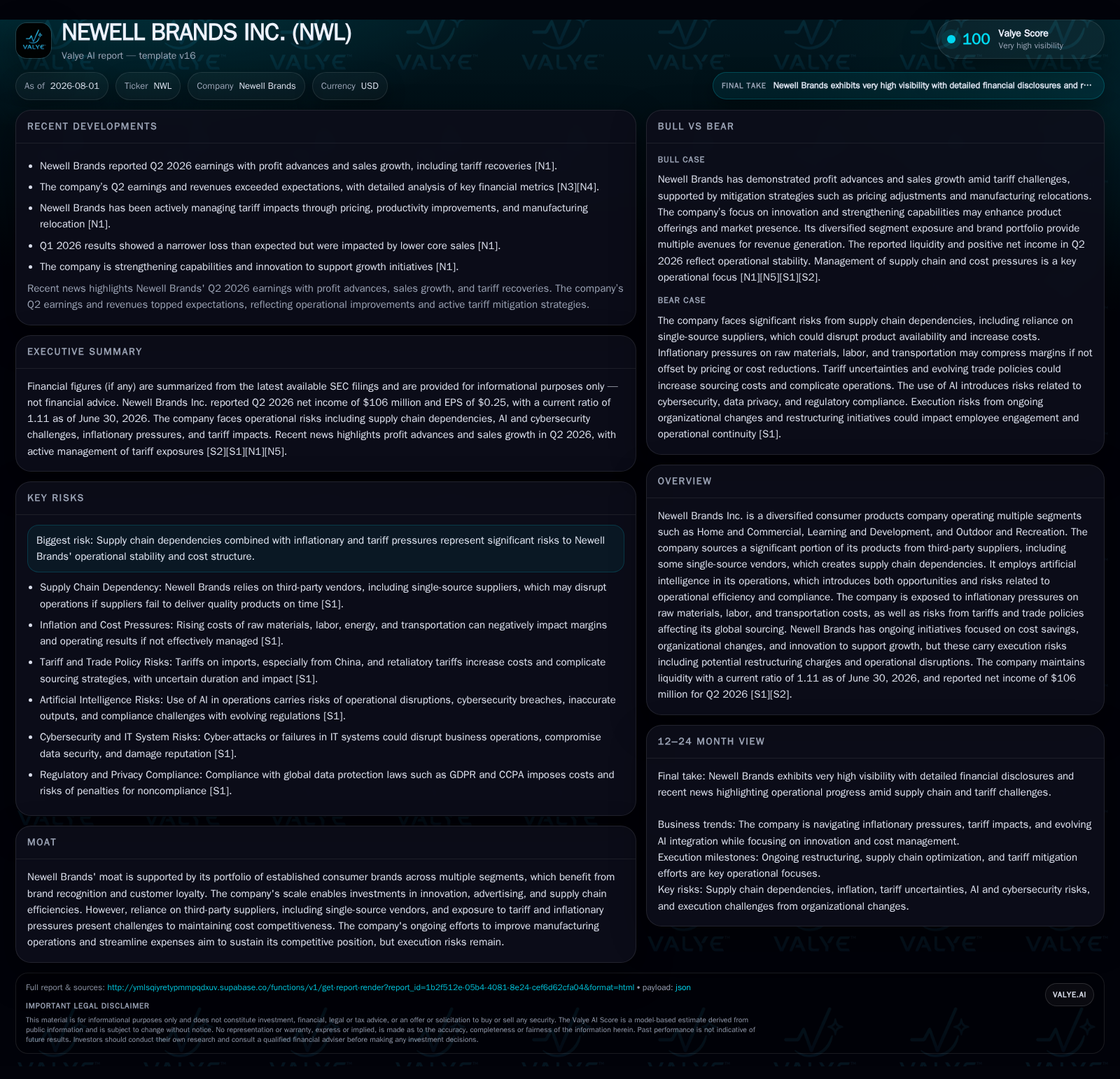
Newell Brands reported improved second-quarter earnings driven by sales growth and favorable tariff recoveries, accompanied by increased confidence in its full-year outlook. Its diversified consumer products portfolio spanning home, commercial, learning, and outdoor segments supports brand resilience. However, the company remains exposed to supply chain dependencies, inflationary pressures on raw materials and labor, and execution risks associated with ongoing cost savings and restructuring initiatives. Monitoring supply chain dynamics, margin trends, and integration of operational improvements will be critical to sustaining gains.
Recent Operating Update
Alongside financial results, Newell granted approximately 9.6 million time-based restricted stock units (RSUs) valued at $44 million in aggregate during the first half of 2026 as part of its employee compensation program intended to retain talent amidst ongoing organizational changes [S2]. These grants vest over roughly three years conditional on continued employment, signaling management’s focus on stability during transformation efforts.
Business Model Overview
Newell Brands operates as a diversified consumer products manufacturer with a broad portfolio of established brands such as Rubbermaid, Sharpie, Graco, Coleman, Yankee Candle, Paper Mate, FoodSaver, Dymo, EXPO, Elmer’s, Oster, NUK, Spontex, and Campingaz [S2]. Its reporting segments—Home and Commercial; Learning and Development; Outdoor and Recreation—span household goods, commercial supplies, educational products, and outdoor equipment categories. This diversified scope supports more stable revenue streams by reducing dependence on any single category or customer segment.
Revenue is generated primarily through wholesale distribution channels supplying major retailers across North America and globally. Increasingly, the company is also investing in direct-to-consumer (DTC) capabilities via e-commerce platforms and branded retail outlets (notably Yankee Candle's ~235 retail stores) to capture higher margin sales and enhance consumer engagement [S1]. Monetization hinges on leveraging brand equity through advertising and promotion investments balanced against cost control imperatives.
Critical operating variables for revenue include net sales growth propelled by successful product innovation pipelines, channel mix shifts favoring DTC penetration versus wholesale reliance, price/mix adjustments reflective of inflation pass-through capabilities, and retail same-store sales performance where applicable.
Cost structure is significantly influenced by raw material inflation (plastics, metals), labor costs associated with manufacturing operations (both in-house and contract manufacturing settings), transportation expenses linked to global supply chains, plus overhead tied to selling general & administrative functions including advertising spend as a percentage of sales [S1]
Industry Structure and Competitive Position
In the consumer products manufacturing sector where Newell operates, brand portfolio strength is vital given intense competition from peers like Clorox, Procter & Gamble, Kimberly-Clark among diversified branded goods manufacturers. Newell's scale allows meaningful investments in marketing innovation fostering customer loyalty—a critical moat feature. However, it faces heightened supply chain risks due to dependence on third-party vendors with some suppliers being single-source providers [S1]. Vendor reliability directly impacts inventory turnover rates and product availability.
Trade policy volatility has imposed tariff layers complicating global sourcing economics; Newell's ability to recover these costs through pricing actions materially affects gross margins [S1]. Competitors exhibit varying success in managing such inflationary pressures depending on scale efficiency and supply chain agility. Newell's active initiatives around operational efficiency aim to improve these parameters but involve execution risks tied to organizational restructuring that might temporarily disrupt operations or employee morale
Growth Drivers
Sustained growth prospects hinge primarily on expansion of product lines via innovation that meets evolving consumer needs across its categories. Development of higher-margin premium or differentiated products can help offset pricing pressures while enhancing brand appeal. New geographic market penetration—especially within emerging economies—and strengthening DTC channels will contribute additional growth levers.
Further opportunities reside in continuous improvements to supply chain management enabling better inventory turnover and reduced lead times. Strategic acquisitions to complement existing brands or acquire new technologies form another potential avenue though carry integration risk [S1]. Digital transformation initiatives employing AI-driven operational enhancements could also incrementally improve productivity.
Advertising effectiveness remains essential to reinforcing brand awareness which drives retail partner demand forecasts; balancing advertising spend intensity amid cost savings programs requires careful management.
Risks and Watchpoints
The most prominent risks include:
- Supply Chain Dependencies: Delays or failures from third-party suppliers can disrupt product flows impacting sales fulfillment. Reliance on some single-source vendors magnifies this vulnerability [S1].
- Inflationary Pressures: Raw material price surges alongside shipping/logistics inflation create margin compression unless recovered via pricing or mitigated by cost controls.
- Tariff Exposure: Changes in trade policies could reimpose or expand tariffs raising COGS unpredictably.
- Execution Risk: Ongoing organizational restructuring aimed at cost savings involves significant capital expenditure plus risk of operational disruption or loss of key talent.
- Inventory Obsolescence: Volatile consumer demand patterns elevate risk of excess stock write-downs.
- Cybersecurity Threats: Given operational reliance on technology systems including AI applications there exists exposure to cyber incidents affecting data integrity or continuity.[S1]
Monitoring vendor on-time delivery rates alongside gross margin percentage fluctuations will provide early signals regarding supply-chain health. Management commentary concerning restructuring progress is also critical due to potential non-recurring charges or impairment exposures.
What To Watch Next
Investors should track quarterly net sales growth trends segmented by channel (wholesale vs DTC), changes in gross margin percentage reflecting input cost recovery or compression narratives, inventory turnover velocity indicating supply chain responsiveness, plus operating margin progress linked to cost savings implementation.
Updates on new product introductions indicating vitality of innovation pipeline will signal forward demand prospects. Also important are disclosures regarding tariff developments or supplier disruptions which could materially alter cost forecasts.
On the financial side, observing any adjustments to leverage ratios following debt maturities or refinancing efforts alongside liquidity positions will inform balance sheet flexibility amid continuing capital deployment for restructuring.
Financial Profile Discussion
As of June 30, 2026, Newell Brands held cash and equivalents totaling approximately $209 million against current liabilities near $2.9 billion resulting in a current ratio around 1.11 — modest liquidity supporting short-term obligations [F1][S2]
Conclusion
Newell Brands continues to leverage its diversified brand portfolio across several large consumer product categories which underpins revenue durability even amid economic uncertainty. The recent surge in second-quarter results fueled by tariff recoveries provides partial relief from inflationary pressures that otherwise compress margins.
That said their heavy reliance on global third-party suppliers creates vulnerabilities around supply stability especially given ongoing geopolitical trade complexities. Execution risk from substantial organizational changes designed for long-term leaner operations must be vigilantly monitored as disruptions could impair near-term financial results.
Multi-channel distribution strategies incorporating both wholesale partners and expanding direct-to-consumer platforms reflect an adaptive approach deserving close attention for signs of successful channel mix optimization.
Overall Newell’s path forward hinges critically upon its ability to sustain gross margin amidst input cost volatility while extracting efficiencies from complex supply chains—success here will shape the durability of its competitive moat embodied in a strong brand portfolio recognized across multiple markets.
This analysis synthesizes information available as of August 2026 from public SEC filings including the latest Q2 quarterly report (10-Q), recent event disclosures (8-K), industry context knowledge frameworks specific to consumer products manufacturing sectors, and verified news reports. It avoids speculative claims without direct evidence.
Disclaimer: This is research-only, informational analysis and not investment advice. It may include AI-generated interpretation and general industry context. Always verify important details using primary sources.

Comments