
Gates Industrial Advances Through Q2 with Strength in Aftermarket Margins and Innovation
Q2 2026 results underscore Gates Industrial’s durable aftermarket revenue engine and innovation-driven pricing power amid emerging tax regulatory challenges.
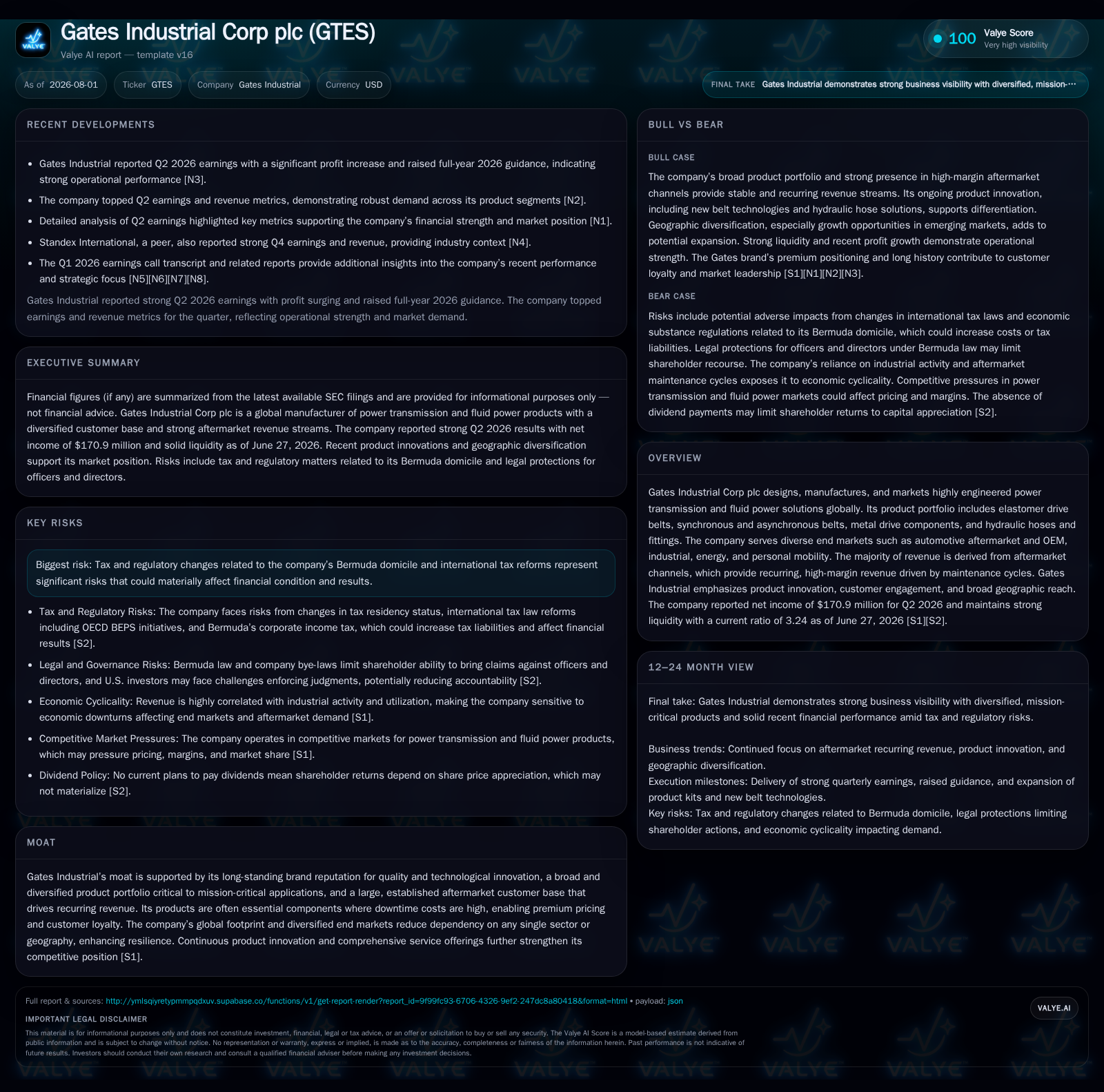
Gates Industrial Corp plc delivered a solid Q2 2026 performance highlighted by net income of $170.9 million and a strong current ratio of 3.24, reflecting robust aftermarket sales that underpin recurring, high-margin revenue streams. The company’s broad portfolio of engineered power transmission and fluid power products serves mission-critical applications globally, enabling premium pricing through reliability and innovation. While diversification across regions and end markets mitigates cyclicality, new Bermuda Economic Substance Act requirements introduce potential operating cost risks. Monitoring upcoming sales trends and product innovation will be key to assessing sustained growth.
Q2 Results Highlight Robust Aftermarket Margins and Earnings Momentum
Gates Industrial Corp plc reported a notable net income of $170.9 million for Q2 ended June 27, 2026, signaling robust operational performance amid an otherwise mixed industrial macro environment [S2][S3]. This earnings strength is closely tied to the company’s durable aftermarket business model that delivers recurring revenue streams through maintenance-driven product replacement cycles. The maintained high current ratio of 3.24 reflects prudent liquidity management supporting ongoing investment in product development and market expansion [F1]. Such financial health allows Gates to withstand cyclical pressures typical in industrial end markets while leveraging its strong global footprint.
Aftermarket Recurring Revenue: Gates’ Durable Growth Engine
Gates derives the majority of its revenue from aftermarket channels servicing automotive service shops, industrial equipment maintenance providers, and other end users worldwide—a strategy that underpins margin stability rarely matched by purely OEM-focused suppliers [S1][S2]. Aftermarket sales capitalize on predictable wear rates of drive belts, hoses, and other components subject to normal wear-and-tear in mission-critical operations where downtime costs are substantial. This repeat demand yields not only steady revenue but also superior gross margins due to the premium nature of replacement parts versus new equipment sales. The inclusion of comprehensive kits tailored for specific vehicle models enhances customer convenience and loyalty by simplifying sourcing and installation processes—an important switching-cost dynamic fostering retention [S1].
This focus contrasts with industry peers like Continental AG's ContiTech division or SKF who similarly emphasize aftermarket revenues but may differ in regional concentration or product breadth. Gates' ability to maintain a large share of recurrent sales amidst diverse geographies reflects robust channel partnerships and extensive distribution networks—critical competitive advantages that ease pricing pressures prevalent in commoditized segments.
Broad Product Portfolio Fuels Premium Pricing Power Across Mission-Critical Components
The company’s product suite encompasses elastomeric synchronous and asynchronous drive belts, metal drive components designed for rugged use cases, as well as hydraulic hoses and fittings integral to fluid power systems [S1]. These offerings serve applications where reliability directly impacts operational uptime—ranging from automotive engines to heavy machinery in energy extraction or material handling. Consequently, customers demonstrate willingness to pay premium prices for products that extend component life or reduce failure risk.
Advancements in product innovation further reinforce Gates’ moat by enhancing durability and efficiency attributes compared to low-cost alternatives. For example, developments in belt materials or hose compositions frequently yield higher temperature tolerance or abrasion resistance—features translating to longer service intervals within maintenance cycles. This sustained innovative output supports premium pricing strategies while challenging competitors to match quality standards.
Industry Structure Support: Peer Benchmarking Highlights Competitive Advantages
Comparing Gates Industrial with recognized peers such as SKF or Parker Hannifin reveals shared emphasis on diversified end markets and global sales footprints as buffers against sector cyclicality [S1]. Within this peer set, Gates notably balances strong aftermarket revenue concentration alongside broad product categories spanning both power transmission and fluid power domains. This dual-market presence diversifies risk across automotive aftermarket replacement parts demand and capital equipment OEM supply chains.
Additionally, Gates' geographic diversification spans the Americas, EMEA regions including Europe’s mature industrial base, Greater China’s dynamic growth environment, plus emerging markets across East Asia & India; this spatial spread diminishes exposure to localized downturns observed periodically across global industrial indices [S1][S2]. Effective utilization rates at manufacturing sites aligned with these key markets ensure capacity responsiveness without excessive inventory buildup—a factor contributing indirectly to margin preservation.
Innovation Fuels Moat: New Product Introductions Drive Customer Retention
A critical pillar sustaining Gates’ competitive edge is its continual pipeline of new product introductions aimed at anticipating evolving customer needs for enhanced operational efficiencies or emission standards compliance [S1]. These innovations deepen customer switching costs since opting for alternate suppliers entails risk of inferior compatibility or lower uptime performance.
The company's R&D investment facilitates tailored solutions such as advanced timing belt kits integrating tensioners and idlers alongside water pumps for synchronized replacements—reducing labor complexity for service workshops and cementing preferred supplier status. This approach nurtures high customer retention rates vital to recurring sales visibility.
Geographic Diversification Mitigates Cyclical Demand Fluctuations
Operating across four major commercial regions enables Gates to offset softness in any one geography with relative strength elsewhere. For instance, while industrial production indexes might contract modestly in Europe during economic slowdowns, growing infrastructure investments or fleet renewals in North America or Asia-Pacific can partly compensate through sustained parts demand [S1][S2]
This balanced exposure is evident in consistent order backlogs reported at regional levels despite transient market headwinds. Sector peers often struggle with disproportionate end-market reliance; Gates' approach reduces such vulnerability through diversified product-channel-geography alignment.
Growth Opportunities Anchored in Fleet Renewal and Energy Sector Investments
Looking ahead, growth trajectories lean on expanding penetration into fleet renewal cycles driven by transportation industry shifts toward newer emission-compliant equipment necessitating frequent maintenance parts supply [S1]. Parallel infrastructure projects worldwide create fresh demand for durable mechanical components essential for energy generation and resource extraction machinery.
Moreover, broader adoption of automation technologies integrates fluid power solutions requiring sophisticated hoses/fittings—offering additional avenues for incremental aftermarket sales growth. Strategic acquisition activities could further complement organic initiatives by enhancing portfolio breadth or geographic reach.
Tax & Regulatory Risks: Bermuda Economic Substance Act Presents Emerging Variable
The latest quarterly filings introduce new risk disclosures regarding the implications of Bermuda's Economic Substance Act amendments on corporate operations [S2]. Although primarily classified as a holding entity subject to minimal requirements currently, any reclassification toward financing/leasing activities or headquarters functions under the law may compel increased local substance establishment including physical office premises and qualified personnel.
Such changes could elevate operating costs materially or invite scrutiny altering the company’s tax residency stance—thereby impacting effective tax rates and overall profitability over time. Stakeholders should monitor regulatory developments closely given enforcement ambiguities inherent in multinational tax regimes.
Key Near-Term Milestones: What to Watch Next in Sales Trends and Innovation Pipeline
Upcoming quarters will reveal whether the momentum sustaining strong Q2 earnings persists amid ongoing macroeconomic volatility [N1][N2][S3]. Particular focus should be placed on aftermarket kit sales trends within automotive channels as well as order intake data from industrial OEMs navigating fleet modernization timelines
Furthermore, announcements regarding new product launches—especially those enhancing durability or efficiency—will serve as tangible signals confirming Gates’ continued commitment to innovation-led differentiation crucial for maintaining pricing power amid competitive pressures.
Financial Profile Discussion: Liquidity Strength Supports Strategic Flexibility
At quarter-end June 27, 2026, Gates held cash & equivalents totaling approximately $823.5 million against total debt close to $2.24 billion resulting in net debt around $1.4 billion; this position underpins a healthy current ratio standing at 3.24 emphasizing robust short-term liquidity reserves available for operational needs or investment opportunities [F1][S2]
This financial stability facilitates ongoing capital expenditure directed toward expanding manufacturing capabilities or R&D efforts necessary to stay ahead technologically.
Gates Industrial’s latest quarterly results reflect a business firmly anchored by recurring aftermarket revenue streams buttressed by continuous product innovation delivering premium-priced solutions essential across diversified global end markets. Its multi-region footprint mitigates exposure to localized downturns while emerging regulatory complexities around Bermuda domicile introduce an evolving risk dimension warranting vigilance. Moving forward, incremental growth will depend heavily on sustaining aftermarket momentum via customer retention-enhancing kits offerings alongside successful navigation of evolving compliance landscapes.
Disclaimer: This analysis is provided solely for informational purposes based on publicly available sources as of August 2026. It does not constitute investment advice or research views.
Disclaimer: This is research-only, informational analysis and not investment advice. It may include AI-generated interpretation and general industry context. Always verify important details using primary sources.

Comments