
Veracyte Expands Molecular Diagnostic Reach Amid Supply Chain and Regulatory Challenges
Second-quarter results highlight Veracyte’s strengthening commercial momentum, tempered by operational risks in manufacturing and reimbursement.
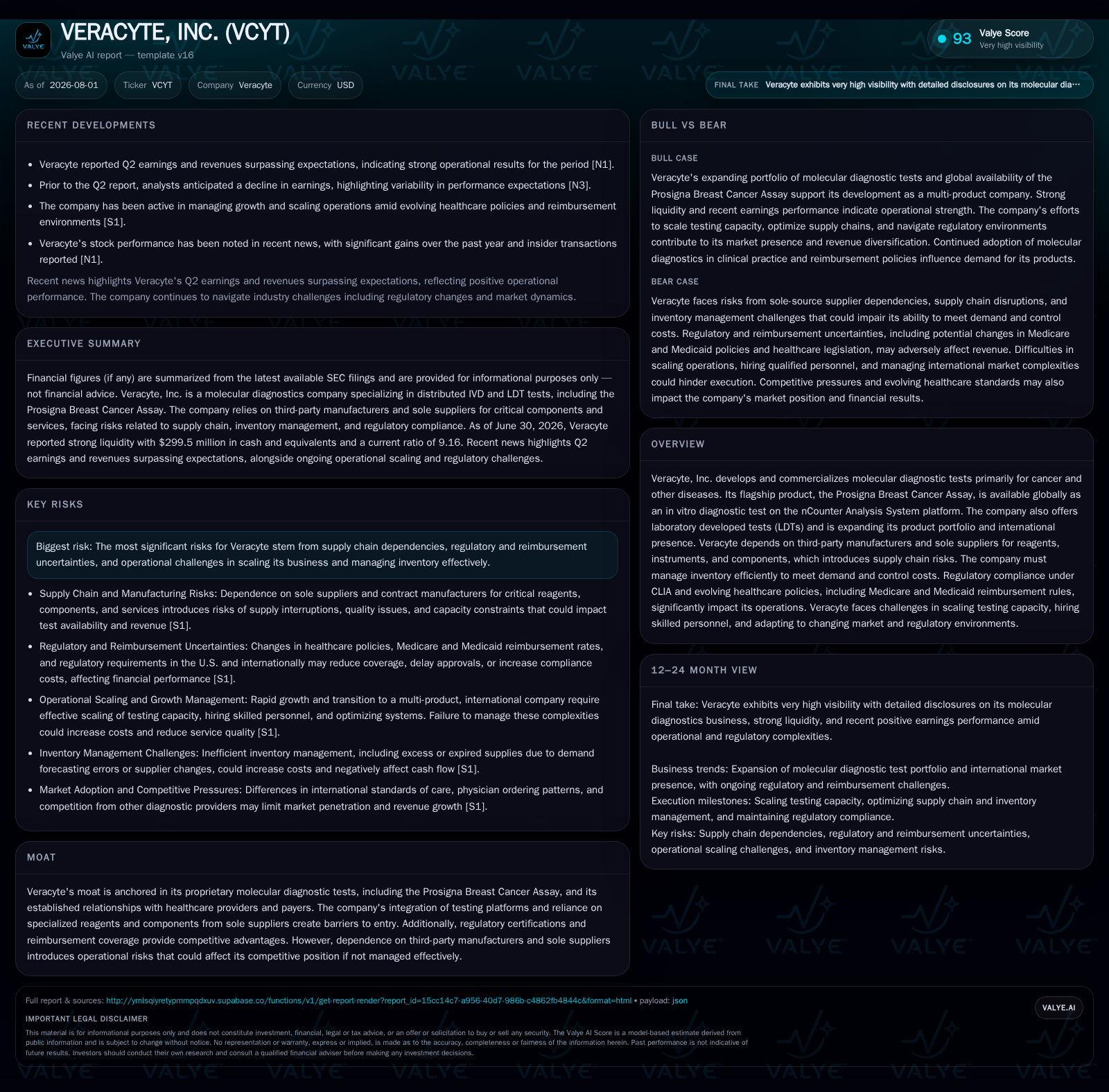
Veracyte's Q2 2026 earnings surpassed estimates, reflecting robust adoption of its molecular diagnostic assays including the internationally distributed Prosigna Breast Cancer Assay. The company’s business model centers on proprietary test development and commercialization, leveraging both laboratory-developed tests (LDTs) and in vitro diagnostic (IVD) platforms reliant on complex supply chains and payer coverage. Despite steady growth, Veracyte faces notable vulnerabilities from sole-source reagent suppliers, inventory management pressures, and evolving regulatory landscapes impacting reimbursement and international market expansion. Operational scalability and strategic supplier diversification remain critical to sustaining growth momentum alongside ongoing investments in clinical validation and geographic penetration.
Recent Operating Update
Veracyte’s second quarter ended June 30, 2026, marked a solid performance that surpassed analyst revenue expectations, as detailed in its July 30 filing. Revenues reflect continued adoption of its molecular diagnostic tests, notably the Prosigna Breast Cancer Assay—a globally offered in vitro diagnostic (IVD) test running on the nCounter Analysis System platform—which anchors Veracyte’s product portfolio [S2][N1][S24]. This result evidences sustained demand in oncology diagnostics despite ongoing macroeconomic uncertainties.
The Q2 earnings release ([S24], [N1]) confirms improving operational execution driven primarily by volume increases across core assays; however, the company continues to navigate inherent operational complexities tied to scale-up. These recent operating disclosures highlight that while commercial traction is accelerating, margins could face pressure from supply chain constraints and inventory-related costs.
Business Model
Veracyte’s revenue generation stems from developing proprietary molecular diagnostic tests addressing cancer and other diseases. It deploys a dual monetization approach: selling test kits for use on licensed diagnostic platforms abroad (e.g., Prosigna on the nCounter system) alongside offering laboratory-developed tests (LDTs) performed internally or via partner labs [S1]. Customers comprise healthcare providers ordering tests to support diagnosis, prognosis, or treatment decisions, with payers—government entities like Medicare/Medicaid and commercial insurers—playing a pivotal role via reimbursement mechanisms.
Revenues depend on three principal variables: kit sales volume influenced by clinical adoption rates; the reimbursement environment affecting price realization; and lab testing throughput determining service fee income. Margins hinge on controlling costs related to specialized reagents—often sourced from sole suppliers—and optimizing manufacturing yields while ensuring quality standards under CLIA certification. The firm’s dependence on third-party manufacturers for component sourcing introduces operational leverage but simultaneously elevates risk exposure to supply disruptions or regulatory compliance issues.
Efficient inventory management emerges as a significant component of the business model due to complex demand forecasting needs compounded by material expiration dates that can cause write-offs if mismanaged [S1]. Failure in this domain could inflate cost of goods sold or cause delays affecting customer service levels.
Industry Structure and Competitive Position
Molecular diagnostics operates within a highly regulated environment characterized by rapid technology evolution, rigorous clinical validation requirements, and evolving payer coverage policies shaping market access. Industry players compete based on product accuracy, clinical utility evidence, platform integration capability, and broad payer acceptance.
Veracyte maintains a defensible position anchored by its proprietary biomarker assays proven through clinical validation studies. Its integration with third-party diagnostic platforms such as the nCounter system enables global reach but also creates dependency on external partners for manufacturing scale-up and regulatory registrations [S1], introducing competitive risk if alternative technologies or partnerships gain preference.
Peers span companies like Exact Sciences with a focus on screening assays or Guardant Health specializing in liquid biopsy technologies; however, direct competitor comparison requires caution given product mix differences. Nonetheless, Veracyte must continually innovate biomarker portfolios while managing manufacturing quality to counter competition from alternative diagnostic modalities offering potentially lower cost or faster turnaround.
Growth Drivers
Key growth levers include expanding test portfolios beyond breast cancer into additional oncology subtypes or disease areas where molecular diagnostics provide incremental clinical value. International market penetration offers additional runway as regional standards of care evolve towards molecular-guided decision-making; however, this requires navigating diverse regulatory landscapes and obtaining payer coverage locally [S1][S18].
Improving reimbursement policies represent critical catalysts since broader coverage correlates strongly with increased ordering volumes. Veracyte’s investments in payer engagement strategies aim to convert clinical utility data into favorable coverage decisions.
Strategic collaborations with healthcare providers assist in driving clinician awareness—the crucial factor in sample collection frequency—and facilitate smoother adoption curves for new tests. Advances in diagnostic platform technologies that improve throughput or reduce turnaround times can compellingly expand testing capacity without proportional capital outlays.
Risks and Watchpoints
The foremost risks stem from heavy reliance on sole-source suppliers for key reagents and components used both in test kits produced externally as well as internal LDT workflows [S1]. An inability to secure timely deliveries or maintain quality specifications could disrupt testing pipelines or inflate costs materially.
Inventory management challenges linked to demand forecasting inaccuracies or supply volatility risk increased obsolescence expenses which could weigh on gross margins. Additionally, evolving regulatory frameworks—particularly FDA oversight changes concerning RUO/IUO labeling practices—could restrict access to necessary materials or necessitate costly alternative development programs [S23].
Reimbursement uncertainty remains a persistent threat; any adverse shifts in Medicare/Medicaid coding rules or payer policies could reduce test utilization or pricing power. Furthermore, international expansion carries geopolitical risks including currency fluctuations impacting competitive pricing and localized compliance requirements complicating global rollout efforts [S7][S18]. Intellectual property disputes present additional legal contingencies potentially incurring substantial defense costs or licensing obligations if unfavorable judgments occur [S26][S29].
Scaling laboratory operations also presents execution risk: inadequate investment or planning could bottleneck testing throughput thereby delaying results delivery times affecting customer satisfaction levels.
What to Watch Next
Investors should closely monitor quarterly indications of volume trends across flagship assays like Prosigna alongside emerging tests entering commercialization pipelines [N1]. Track progress on international regulatory approvals and payer coverage expansions which will be pivotal demand signals.
Operational metrics such as reagent yield improvements, inventory turnover rates, lab capacity utilization percentages, and turnaround time reductions will signal efficiency gains vital for margin expansion [S1]
Further updates regarding supply chain diversification efforts or new manufacturing partnerships would indicate proactive mitigation of sole-supplier risks.[S1]
Financial guidance updates reflecting anticipated capex tied to lab automation or commercial infrastructure investments may provide insight into scalability plans [N1]
Finally, developments related to intellectual property cases or FDA regulatory clarifications surrounding reagent classifications should be watched closely given their potential impact on business continuity.[S23][S29]
Financial Profile Discussion
Veracyte’s balance sheet at June 30, 2026 demonstrates strong liquidity with approximately $300 million in cash and equivalents paired with zero long-term debt reported as of end-2021 figures available—the absence of debt positions it favorably to invest heavily in R&D and manufacturing capacity expansions without near-term refinancing pressure [F1]. Current assets stand at roughly $575 million against liabilities near $63 million yielding an exceptionally healthy current ratio above 9x reflective of conservative working capital management [F1].
Operating income milestones reached $57.8 million by full-year-end 2025 suggest burgeoning profitability consistent with volume-driven scale benefits observed recently [F1]. However, incremental costs associated with overcoming supply chain complexities may compress margins if not offset by continuous productivity enhancements.
Cash flow generation supports an aggressive innovation agenda required to sustain competitive differentiation within this technology-sensitive sector where constant R&D spend ratios are customary to maintain advancement pace relative to peers.
Conclusion
Veracyte leverages a robust proprietary molecular diagnostics portfolio coupled with strategic collaborations enabling global presence particularly through its flagship Prosigna assay interfaced with established diagnostic platforms. The business model’s dual reliance on LDTs and IVD kits secures diversified revenue streams but also necessitates vigilant supply chain management amid sole-source dependencies. Regulatory compliance complexity together with reimbursement dynamics underscore the importance of sustained clinical validation investments aimed at broadening payer coverage worldwide.
Success hinges on operational excellence scaling manufacturing throughput while maintaining rigorous quality standards embedded within CLIA certification frameworks. Financial strength undergirds capacity-building initiatives necessary for future growth amidst intensifying industry competition driven by technological innovation cycles and evolving standards of care across jurisdictions.
Investors should focus on execution markers including volume ramp-up data points across priority assays alongside supplier diversification progress warrants close supervision given their bearing on sustainable margin profiles over time.
Disclaimer: This analysis is provided for informational purposes only without any research view regarding investment decisions concerning Veracyte Inc.
Disclaimer: This is research-only, informational analysis and not investment advice. It may include AI-generated interpretation and general industry context. Always verify important details using primary sources.

Comments