
Nicolet Bankshares Raises Growth Stakes with MidWest One Merger and Credit Risk Control
Following its transformative acquisition of MidWest One, Nicolet Bankshares is focused on integrating expanded scale with disciplined credit management to sustain its community banking advantage.
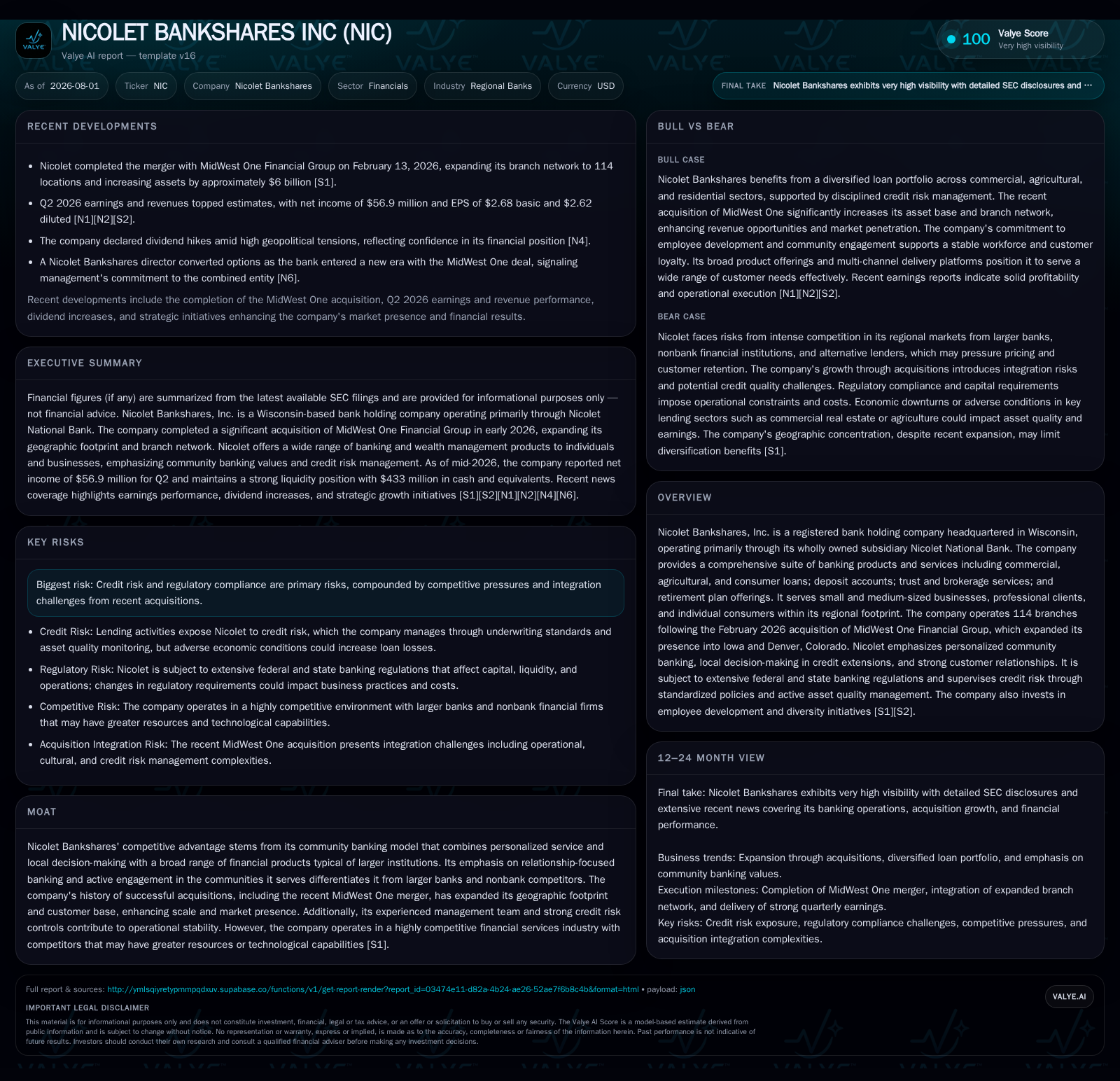
Nicolet Bankshares’ Q2 2026 results underscore the significant impact of its February acquisition of MidWest One Financial Group, nearly doubling its branch network and loan portfolio. The reported surge in net interest income primarily reflects loan volume growth, while heightened provisions for credit losses reveal cautious adjustment to evolving macroeconomic signals. This combination spotlights the company's challenge to blend its relationship-driven community banking ethos with a broader geographic footprint and more complex credit dynamics. Competitive pressures from larger banks and fintech remain, but Nicolet is leveraging its local underwriting and personalized service to maintain differentiation. Key operational markers in loan performance, deposit trends, and integration will be critical near-term indicators.
Q2 Highlights Reflect Scale Expansion Through Acquisition Integration
Nicolet Bankshares’ second quarter 2026 results concretely illustrate the growth step-change occasioned by its February acquisition of MidWest One Financial Group. The merger effectively doubled Nicolet’s branch count from 57 to 114 across five states including an extension into key markets in Iowa and Denver, Colorado [S1]. This expanded physical footprint underpins a surge in total loans outstanding—from approximately $6.8 billion at year-end 2025 (pre-acquisition) to a notably higher figure driven by the addition of MidWest One’s roughly $5 billion loan portfolio [S1], [S2]. Interest income for Q2 surged to $200.9 million compared to $117.6 million in the prior-year quarter, primarily reflecting this expanded lending activity. Correlated increases in interest expense (notably on deposits) also mark the higher funding requirements for the enlarged balance sheet [S2].
monitoring for signs of asset quality deterioration.
Blending Community Banking Values with Enlarged Geographic Scope
Nicolet positions itself distinctly as a community bank leveraging personalized service and local credit decision-making—the "local underwriting" hallmark—to differentiate against both larger banks and commoditized nonbank lenders [S1]. The company's challenge post-MidWest One integration lies in preserving this culture within an expanded entity operating across diverse regional economies.
Management retains emphasis on personalized relationship banking and local responsiveness despite an enlarged branch network spanning Wisconsin through Iowa into Colorado—states with varying economic drivers and regulatory environments [S1],[S23]. The expansion broadens the customer base beyond the core small- to medium-sized businesses typical of their original footprint to include governmental units and institutional customers served by MidWest One. Maintaining uniform service quality standards while scaling illustrates a balancing act common among regional banks acquiring peers for inorganic growth benefits.
Managing Credit Risk in a Growing Loan Franchise Amid Economic Uncertainty
A critical focus area revealed in Q2 disclosures is Nicolet’s approach toward credit risk control post-expansion. Implementation of discounted cash flow methods for allowance estimation reflects advancement beyond historical loss-rate models towards more granular expected credit loss accounting as mandated by CECL standards [S2], [S12].
The adjusted provision rates appear conservative given rising exposure concentrations—particularly heightened vigilance around commercial real estate loans which have scrutiny thresholds per regulatory guidelines when nearing multiples of tangible capital [S16]. While no immediate material non-performing asset spikes have been disclosed yet, stakeholders should watch upcoming efficiency ratios and allowance-to-loan balances for indication of credit stress ahead [S2]. This subdued but deliberate caution matches supervisory expectations given current competitive pressures that might induce relaxed underwriting elsewhere.
Competitive Position: Balancing Local Service Strengths Against Larger Banks and Fintech
Within regional banking peer groups, Nicolet resembles institutions like First Midwest Bancorp or Wintrust Financial that similarly straddle community roots with ambitions toward scaled offerings through acquisition-led expansion. However, unlike large national banks such as Wells Fargo or JPMorgan Chase—who enjoy superior technology platforms facilitating cost-efficient digital customer engagement—Nicolet faces higher incremental costs tied to physical branches and manual underwriting processes [S1].
Additionally, fintech entrants heighten competition especially among younger demographics favoring instant digital products over traditional branch-centric experiences. Although these nonbank competitors benefit from lighter regulations enabling innovative loan pricing or faster approvals, they lack Nicolet’s entrenched relationships within local business communities which remain important among owner-managed firms prevalent across Nicolet’s markets [S1]. The company’s wealth advisory arm also plays a role diversifying revenue beyond interest margins although such non-interest fees are currently additive rather than primary revenue centers [S1].
Growth Drivers: Cross-Selling, Deposits, Digital Enhancements, and Market Expansion
Beyond sheer scale gains via acquisitions like MidWest One—which brought ~$1 billion worth of new stock issued alongside assumption of assets—the strategy includes expanding deposit bases through reclassified reciprocal deposits consistent with peer benchmarks [S13], while incrementally growing organic lending pipelines via referrals within wealth and insurance networks housed under Nicolet’s subsidiaries [S1], [S2].
Investment in digital tools remains implied though not explicitly quantified; however, industry incumbents see modernization efforts as critical to maintaining operational efficiency amidst margin pressures due to rising funding costs reflected in expanding deposit interest expenses seen post-merger [$57.3 million vs $40.4 million prior year] [S2]. Leveraging technology could allow Nicolet to better achieve operating leverage benefits sought after expensive branch expansion.
Key Risks: Integration Execution, Credit Trends, Regulatory Compliance, and Market Shifts
Operational execution risk looms largest against potential cultural friction integrating two distinct legacy organizations amid concurrently elevated provisioning levels addressing uncertain economic factors partly emanating from concentrated agricultural exposures inherited through MidWest One's lending practices [S1], [S2]. There exists regulatory risk given extensive oversight regimes requiring adherence spanning capital adequacy requirements—being "well-capitalized" with tangible common equity thresholds—and compliance costs adding overhead burdens disproportionate to smaller regional peers lacking scale advantages enjoyed by nationwide banks [S1], [S16].
Additionally, macroeconomic shifts such as tightened monetary policies could compress net interest margins further if repricing spreads tighten while raising loan defaults pressure allowance sufficiency.
What Investors Should Watch Next: Loan Performance Signals and Integration Milestones
Upcoming quarterly reports should be scrutinized for leading indicators including shifts in non-performing assets ratio signaling early credit stress and trajectory of efficiency ratios reflective of successful integration synergy realization or cost overruns due to acquired branch network overheads [S2], [N1]. Progress on cross-selling penetration rates within newly acquired markets will demonstrate whether revenue enhancement potential translates into sustained earnings growth beyond balance sheet scale effects.
Moreover, deposit mix stability amidst evolving competitor pricing strategies remains crucial; net interest margin trends will help assess effectiveness managing higher funding costs seen since merger closure.
Financial Profile Discussion: Earnings Quality, Capital Adequacy, Balance Sheet Health
Balance sheet composition remains solidly capitalized with approximately $93 million total debt principally subordinated notes earmarked to bolster Tier 2 capital instruments supporting regulatory stringency compliance; excess liquidity persists given net debt negative positioning when subtracting substantial cash equivalents held [$433 million at last available snapshot] demonstrating ample buffer against short-term liquidity stress scenarios [F1], [S2], [S7].
This analysis synthesizes insights from Nicolet Bankshares’ recent filings highlighting strategic scale expansion intertwined with emerging operational complexities common among mid-tier regional bank consolidators competing against entrenched large institutions and nimble fintech challengers. Evolving credit risk management adapting newer CECL methodologies alongside measured provisioning signals healthy governance discipline seeking to underpin sustainable earnings growth through acquisitions reliant on execution effectiveness.
Disclaimer: This report is for informational purposes only and does not represent investment advice or research views regarding Nicolet Bankshares Inc.
Disclaimer: This is research-only, informational analysis and not investment advice. It may include AI-generated interpretation and general industry context. Always verify important details using primary sources.

Comments