
BrilliA Inc Faces Revenue Decline from Tariff and Geopolitical Pressures Despite Brand Expansion Efforts
The lingerie maker contends with US tariffs and European demand shifts while pursuing growth in Southeast Asia and sustainability initiatives.
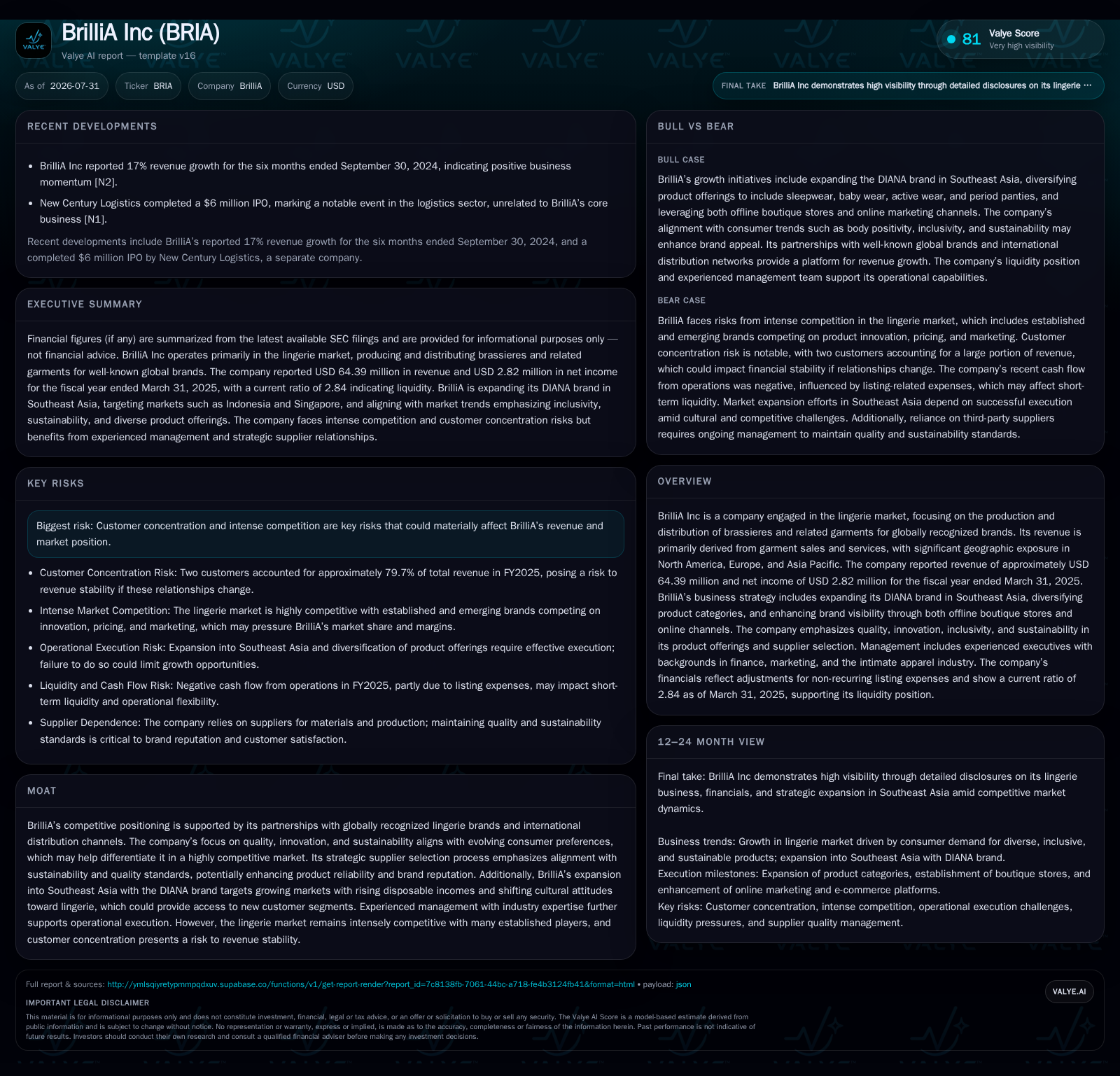
BrilliA Inc reported a 24% revenue decline in fiscal 2026, driven mainly by new US tariff measures on exports and weakening European demand amid geopolitical tensions. The company's gross margins contracted alongside lower volumes, although operational expenses rose due to investments in management and branding following its public listing. BrilliA’s business model focuses on contract manufacturing and distribution for global lingerie brands, emphasizing quality, innovation, and sustainability as strategic differentiators. Growth drivers include expansion of its DIANA brand in Southeast Asia and a diversified product mix targeting evolving consumer preferences. Key risks involve customer concentration, tariff volatility, and intense market competition. Liquidity remains adequate with a strong current ratio and positive operating cash flow in the latest period.
Recent Operating Update
BrilliA Inc announced its fiscal year 2026 results ending March 31, 2026, revealing a significant revenue decline of approximately 23.9%, down from $64.39 million in FY2025 to $48.99 million [S1][S2]. This drop is primarily attributable to newly introduced U.S. tariff measures impacting export competitiveness, leading customers—primarily large wholesale buyers—to defer or reduce order placements amid supply chain uncertainties [S1]. Additionally, export sales to Europe fell by around 17%, from $5.74 million to $4.79 million, reflecting weakened consumer demand linked to ongoing geopolitical tensions and economic instability related to the Ukraine conflict [S1]. These developments have materially altered BrilliA's near-term top-line outlook.
Business Model Overview
BrilliA operates within the intimate apparel segment, specializing in manufacturing brassieres and related garments predominantly for globally recognized lingerie brands [S1]. The company designs products but relies largely on contract manufacturers for production, monetizing primarily through wholesale sales complemented by service revenues such as sample preparation [S1]. Its diversified geographic exposure includes North America, Europe, and Asia-Pacific regions.
Revenue mechanics hinge on volume sold under wholesale contracts or direct-to-consumer (DTC) channels tied to brand visibility efforts [S1]. Volume fluctuations due to order timing or tariff-induced delays directly impact sales reported at point-in-time recognition. Cost of materials—primarily sourced fabrics—and contract manufacturing charges constitute major cost components; these scale with volume but are also influenced by input cost inflation and supplier negotiations
BrilliA emphasizes product innovation including inclusive sizing ranges and sustainable materials as value drivers aligned with evolving consumer preferences favoring comfort, fit, and eco-consciousness [S1]. The company supplements this via offline boutique stores and online platforms aiming to enhance brand visibility beyond wholesale reliance.
Industry Structure and Competitive Position
The global lingerie market is approximately $88 billion in size with a projected steady CAGR near 5.7% through 2030, fueled by rising disposable income particularly in emerging markets, growing millennial/gen Z consumer bases embracing body positivity, and increasing female purchasing power [S1]. However, the market is fragmented with intense competition from established players such as Victoria's Secret, Wacoal, and La Perla alongside numerous emerging brands.
Competitive dynamics prioritize brand reputation, product innovation around fit/comfort/materials (including wireless bras/seamless designs), sustainability practices, marketing reach (influencer collaborations/social media), pricing strategies addressing markdown pressures across retail channels, and channel mix optimization balancing wholesale vs DTC margins [S1]
BrilliA's midstream role focuses primarily on contract manufacturing coordination plus distribution partnerships concentrating on quality assurance aligned with international brand standards [S1]. Supplier selection is stringent regarding ethical sourcing/sustainability metrics helping differentiate product reliability and appeal.
Customer concentration poses inherent risks; roughly two customers represented about 67.6% of revenue in FY2026 compared with nearly 80% previously—trends indicating some diversification but still elevated dependency on few wholesalers [S6][S10]
Growth Drivers
Key growth catalysts for BrilliA stem from geographic expansion plans notably via its DIANA brand targeting Southeast Asia’s growing middle class consumers desiring modern lingerie experiences aligned with local cultural shifts toward body positivity [S1]. Scaling offline boutique presence alongside online ecommerce penetration aims to drive repeat purchases and elevate average order sizes.
Product category diversification extending into specialty bras including sportswear, bridal/maternity lines enhances portfolio relevance capturing broader consumer segments influenced by lifestyle trends [S1]. Innovation around sustainable fabrics is expected to increasingly resonate given environmental concerns among younger consumers.
Channel mix evolution leveraging digital marketing lowers customer acquisition cost relative to traditional wholesale-heavy models while supporting better full-price sell-through rates though it requires ongoing investments in marketing spend effectiveness [S1].
Risks / Watchpoints
Major risks threatening BrilliA’s business continuity include intensified tariff regimes especially affecting exports into the US which constitute a substantial portion of sales—a factor that has already triggered order deferrals undermining revenue predictability [S1]. Continued geopolitical instability dampens European demand prospects.
The heavy concentration among few customers limits pricing power leverage; loss or nonrenewal from any major client would result in material revenue shocks [S6][S10]. Additionally, volatile raw material pricing coupled with potential supply chain disruptions could increase costs reducing gross margins further.
Inventory management challenges emerge amid fluctuating demand causing markdown pressures that erode full-price sell-through percentages—particularly critical given fashion industry's short product cycles requiring high assortment freshness.
Elevated promotional intensity likely required to maintain competitive positioning may compress operating margins unless balanced by improved operational efficiencies or product differentiation.
What To Watch Next
Investors should monitor upcoming quarterly releases for early signs of recovery or continued softness in order volumes from key geographic regions affected by tariffs and geopolitical tensions [S2].
Progress on expanding DIANA’s footprint within Southeast Asia measured through boutique openings or online penetration rates can serve as indicators of diversification success [S1].
Changes in channel mix towards DTC sales will signal management’s execution efficacy on marketing ROI improvements impacting customer acquisition cost metrics.
Margin trends will be telling regarding ability to manage input cost inflation versus pricing power amid competitive forces; watch gross profit percentage trajectory closely along with inventory turnover measures if available.
Financial Profile Discussion
Counterbalancing financial resilience against identifiable risks such as concentrated receivables exposure demands close credit risk management vigilance given ~69% of trade receivables derive from two customers presently [S6][S25], underscoring the importance of broadening client base while maintaining stringent supplier-customer credit controls.
This analysis is based exclusively on information publicly disclosed by BrilliA Inc through SEC filings dated up to July 31st, 2026. It integrates company-specific disclosures with sector knowledge pertinent to lingerie/apparel industry dynamics without presenting investment advice or research views.
Disclaimer: This is research-only, informational analysis and not investment advice. It may include AI-generated interpretation and general industry context. Always verify important details using primary sources.

Comments