
Ingersoll Rand's Q2 Surge Highlights the Strength of Aftermarket and Life Science Expansion
Ingersoll Rand's latest quarterly outperformance underscores the resilience of its diversified industrial and life science portfolio, driven by robust aftermarket revenue growth and broader strategic execution.
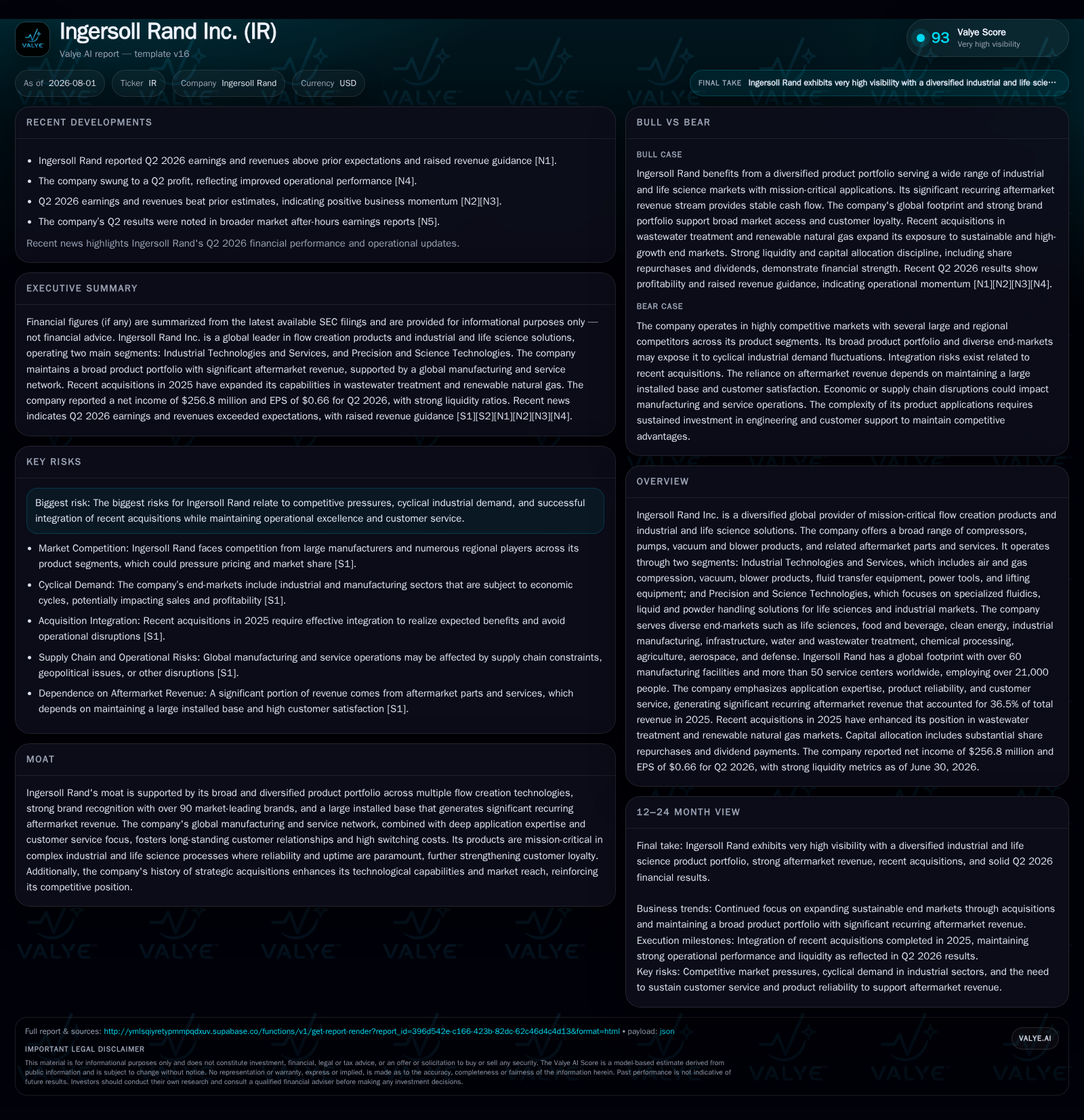
Ingersoll Rand Inc. reported Q2 2026 results that surpassed consensus estimates and raised full-year revenue guidance, reflecting the company's effective mix of new equipment sales and growing stable aftermarket income. Its two-segment business—Industrial Technologies and Services, and Precision and Science Technologies—continues to leverage a broad installed base, driving recurring parts and service revenues that cushion cyclical pressures in end markets. These results, supported by operational momentum and focused capital deployment, reinforce Ingersoll Rand’s competitive positioning amid industrial demand variability and ongoing integration of acquisitions.
Q2 Performance Beat Validates Strategic Mix of New Sales and Stable Aftermarket Revenues
The Industrial segment benefits from that installed base generating steady parts and repair demand accounting for more than one-third of total company revenue (36.5% in 2025) [S1]. This stable aftermarket cash flow reduces volatility typical of capital equipment cycles. Order backlog figures remain supportive without signs of softening, while high service contract renewal rates evidence strong customer retention grounded in application expertise [S2]. The blend of immediate point-in-time revenue from equipment sales with longer-term recurring revenues underpins operational momentum.
Value Creation Through Diverse Mission-Critical Equipment Catering to Industrial & Life Sciences Markets
Ingersoll Rand’s business model centers on designing, manufacturing, and servicing mission-critical flow creation products vital to complex industrial processes across sectors such as chemical processing, clean energy infrastructure, water treatment, food production, agriculture, aerospace, defense, medical devices, laboratory sciences, and pharmaceuticals [S1]. The company operates through two reportable segments:
Industrial Technologies & Services: Includes air/gas compressors, vacuum pumps, blowers, fluid transfer/load systems sold under multiple market-leading brands like Gardner Denver or Nash. These products cater mainly to industrial manufacturing customers requiring reliable operations under demanding conditions.
Precision & Science Technologies: Focuses on specialized positive displacement pumps, single-use powder handling systems for life sciences applications; niche product areas where precision dosing and contamination control are paramount.
This segmentation diversifies exposure across more cyclical heavy industries alongside higher-growth secular markets like pharmaceutical manufacturing. The installed base spread across over 60 global manufacturing facilities coupled with an extensive network of 50+ service/repair centers creates embedded high switching costs. Customers prioritize uptime given the high cost of operational disruptions; this fosters repeat business for spare parts consumables and maintenance services [S1].
Sales are realized via direct OEM relationships with end-users as well as through national and specialty distributors plus collaborations with EPCs (Engineering Procurement Construction firms), enabling both wide reach and customized engineered solutions [S1]
Competitive Moat Driven by Application Expertise, Installed Base Scale, and Global Service Network
Ingersoll Rand's competitive strength arises from a broad product portfolio featuring over 90 globally recognized brands distinguished by reliability and efficiency [S1]. Its deep application expertise enables tailored solutions critical to mission-sensitive environments. Such specialization inhibits competitor encroachment as customers weigh high switching costs against operational risks.
The significant installed base not only generates recurring aftermarket sales — a key margin driver — but also provides rich data insights for product innovation and customer support enhancements. This ecosystem effect fuels consistent service contract renewal rates that underpin recurring revenue stability even during industrial downturns [S1], [S2].
Peers like Gardner Denver or Atlas Copco offer comparable portfolios; however Ingersoll Rand’s blend across broad flow technologies combined with targeted life sciences solutions offers diversified end-market insulation compared to firms more concentrated in solely industrial compressors or fluid control (e.g., Parker Hannifin). Furthermore, its global footprint spanning six continents facilitates localized delivery critical for time-sensitive aftermarket services.
Growth Catalysts: Aftermarket Expansion, Life Science Penetration, and Innovation in Flow Technologies
Key growth drivers identified include:
- Expansion of the aftermarket service business which not only yields higher margins but also stabilizes revenue streams amid capital expenditure fluctuations in industrial customers.
- Increased penetration into life sciences markets through advanced fluid management products supporting pharmaceutical production scale-up driven by healthcare demands [S22]. Acquisition of Controlled Fluidics enhances this vertical specialization.
- Ongoing technological innovation in flow handling—improving energy efficiency, environmental compliance (e.g., cleaner compressed air systems), and digital monitoring—that appeal to sustainability-conscious end-users.
- Targeted acquisitions like Friulair extend the air treatment offering adding chillers/dryers that complement core compressors further broadening solution depth within Industrial segment [S21], [S22].
- Geographic diversification into emerging markets expansion reduces reliance on mature economies while tapping growing industrialization trends.
- Infrastructure investments relevant to clean energy transitions (water/wastewater treatment technology), aligning product development with global sustainability imperatives.
Maintaining capital expenditures around 2% of revenues enables investment in manufacturing capacity improvements without diluting free cash flow generation potential [S24]
Market Risks: Industrial Demand Cyclicality, Acquisition Integration Challenges, and Supply Chain Effects
Despite strengths, Ingersoll Rand faces typical sector risks including:
- Cyclicality inherent in capital goods exposed to industrial manufacturing activity variability could pressure new equipment volumes especially if macroeconomic headwinds intensify.
- Competitive pricing imposed by both regional low-cost producers challenging premium-brand positioning as well as established large OEMs necessitates continual innovation differentiation.
- Integration risk associated with recent acquisitions: melding acquired businesses culturally while retaining technological edge is resource intensive; any missteps may erode anticipated synergies or distract management focus [S21], [S22].
- Raw material cost volatility particularly steel/aluminum impacts input costs; although partially offset by pricing passed through contracts these inflationary pressures can squeeze margins transiently.
- Regulatory complexity across multiple jurisdictions imposes compliance burdens related to environmental standards or export controls impacting operating flexibility.
- Fluctuating demand for aftermarket services tied to customers’ maintenance deferrals during economic softening phases introduces top-line risk given the sizable share of parts/service revenue.
What Investors Should Monitor Next: Backlog, Renewal Rates, Pricing Power, and Margin Trends
Upcoming milestones relevant for ongoing assessment include:
- Monitoring order backlog trends by segment which provide visibility into near-term shipment activity critical amidst sector cyclicality.
- Service contract renewal rates as a proxy for customer satisfaction levels; sustained or improved renewals would reinforce confidence in recurring revenue durability.[S2]
- Pricing power evidenced through average selling price (ASP) movements amid raw material inflation indicates how effectively cost increases are absorbed or passed along.
- Margins profile particularly gross margin expansion driven by scale in aftermarket services versus new equipment sales mix changes will signal operating leverage achievement.
- Capital deployment signaling whether acquisitions continue to enhance technological breadth without overstretching balance sheet metrics.
- Geographic sales distribution shifts reflecting emerging market penetration progress versus mature market softness effects.
Financial Profile Discussion
As of June 30, 2026, Ingersoll Rand maintains a strong liquidity position with $1.17 billion in cash equivalents against total debt approximating $4.07 billion yielding net debt near $2.9 billion [F1]. The current ratio stands at a healthy 1.62 reflecting adequate short-term asset coverage over liabilities supportive of operational continuity [F1].
Capital expenditures totaled approximately $135.6 million in 2025 (~1.8% of consolidated revenues) with guided spending maintained around ~2% suggesting disciplined investment balanced with free cash flow preservation [S24]
Overall free cash flow generation near $1.22 billion in 2025 supports strategic priorities such as acquisition integration funding while sustaining shareholder return programs without jeopardizing core liquidity needs [S24], [F1].
This analysis synthesizes Ingersoll Rand Inc.’s most recent SEC filings alongside sector context to illuminate the translating impact of its diversified product strategy emphasizing aftermarket reliability combined with expanding life science relevance amid cyclicality risks typical for industrial manufacturing equipment providers. All facts cited strictly adhere to disclosed company information without attempting unsupported forecasts or subjective valuations.
Disclaimer: This is research-only, informational analysis and not investment advice. It may include AI-generated interpretation and general industry context. Always verify important details using primary sources.

Comments