
Edison International Advances Capital Investments While Managing Wildfire Liability Exposure
The company’s latest quarter highlights strategic capital expenditure adjustments aligned with regulatory transmission updates and evolving wildfire liability management.
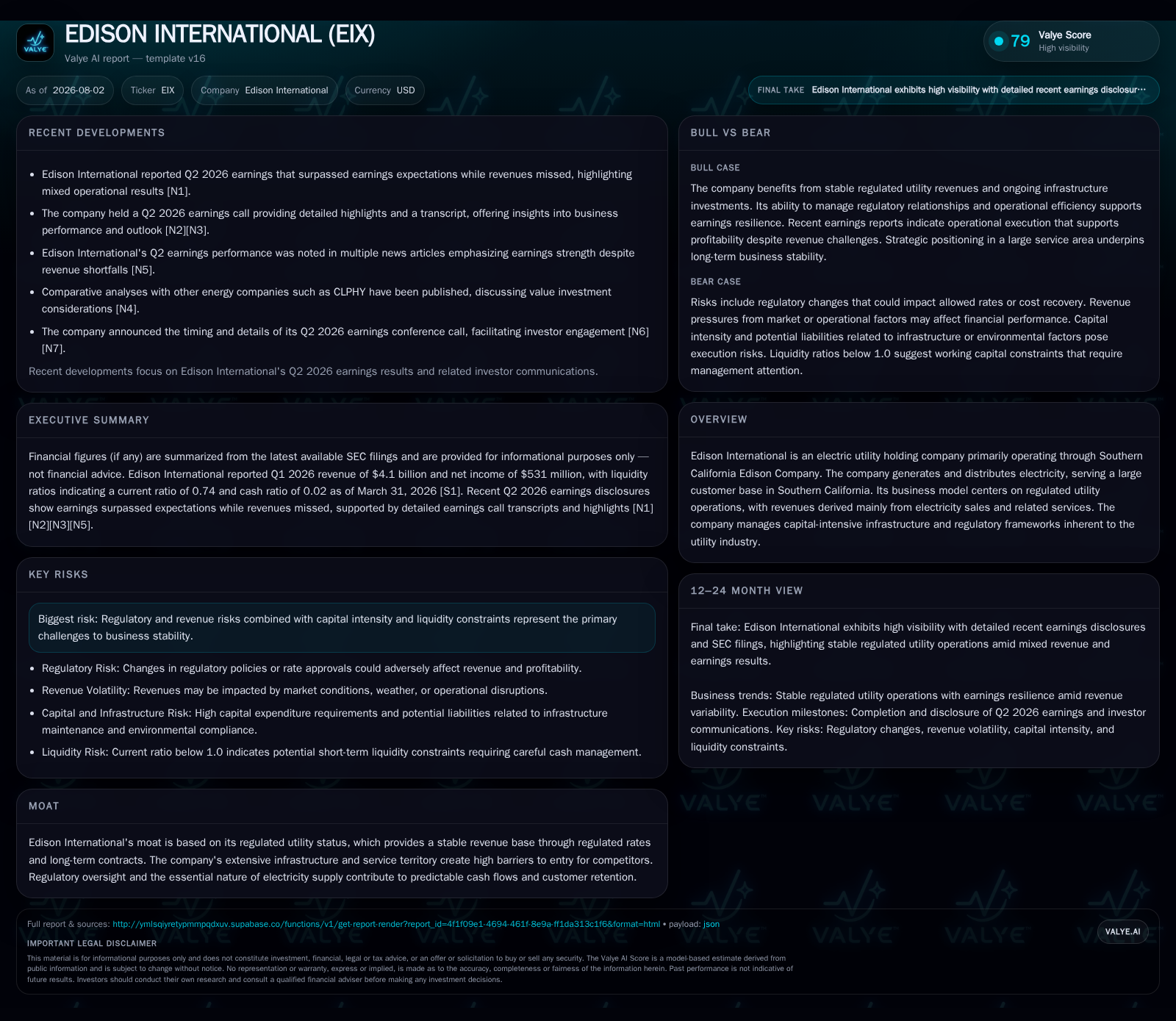
Edison International's Q2 2026 filing details a recalibrated capital investment program driven by CAISO’s approval of the 2025-2026 Transmission Plan, which reshaped Southern California Edison’s infrastructure projects and future rate base growth potential [S2]. The utility’s customer-funded wildfire self-insurance program, initiated in 2023, reclassifies wildfire-related claims as non-core items, reducing earnings volatility and improving core earnings quality [S2], [S7]. Additionally, the sale of the Trio subsidiary resulted in reclassification of associated operating losses as non-core, clarifying ongoing operational performance [S2]. Southern California Edison’s regulated electricity sales underpin revenue stability amid regional load demand trends and renewable integration mandates. Key risks include regulatory proceedings, capital execution challenges, and climate-driven liabilities within a capital-intensive framework supported by significant leverage [F1], [S2].
Regulatory-Endorsed Capital Plan Revisions Signal Strategic Infrastructure Shift
Edison International's Q2 2026 filing reveals significant adjustments in Southern California Edison’s (SCE) capital investment program following the California Independent System Operator (CAISO)’s approval of its 2025-2026 Transmission Plan [S2]. This plan removed or modified projects previously authorized under the 2022-2023 plan while introducing new transmission projects slated for construction by SCE. These changes directly impact SCE’s capital expenditure trajectory and consequently its rate base growth—a fundamental driver of future regulated returns.
Utilities like SCE derive stable revenue streams through regulated rates tied to an approved rate base comprising network assets essential for electricity delivery. Thus, shifts in project scope affect both the scale and timing of investment recoveries. The removal of certain projects constrains near-term spending but is offset by newly approved initiatives maintaining overall investment momentum. This dynamic underscores the regulatory risk-return interplay that investors must monitor closely ahead of CPUC rate cases setting allowed return on equity (ROE) parameters tied to evolving asset bases.
Wildfire Liability Management Enhances Earnings Stability Through Self-Insurance
A key financial development is SCE’s treatment of wildfire-related claims following its implementation of a customer-funded wildfire self-insurance program in 2023 [S2], [S7]. Under this framework, wildfire losses are funded through customer contributions rather than absorbed directly into operating results, effectively capping exposure.
Accordingly, wildfire claims insured by Edison Insurance Services (EIS) are classified mostly as non-core items, thereby excluded from core earnings calculations. This reclassification reduces earnings volatility caused by unpredictable wildfire claims and improves transparency around operational profitability. The utility also employs a liability cap calculated as 20% of the equity portion of its transmission and distribution rate base (excluding general plant/intangible assets) for relevant ignition years, providing a quantifiable financial limit on wildfire risk.
This approach not only reflects regional necessity given California’s wildfire history but also represents a strategic financial design that stabilizes cash flows while aligning cost recovery with customer rates.
Trio Disposition Clarifies Core Earnings Through Non-Core Reclassification
In Q2 2026, Edison International completed the disposition of Trio, a former indirect subsidiary whose business was immaterial to consolidated operations [S2]. Associated after-tax operating losses totaling $4 million were recast as non-core for the first half of 2026. No net tax benefit was recognized on this loss due to anticipated unrealizable tax benefits.
This reclassification exemplifies management’s discipline in isolating core ongoing earnings from discrete events or discontinued operations, enabling clearer analysis of operational performance. By excluding Trio-related losses from core earnings metrics, Edison International enhances comparability across periods amid portfolio simplifications.
Southern California Edison’s Regulated Operations Support Revenue Stability Amid Load Demand Dynamics
Southern California Edison remains the primary revenue engine under Edison International through its regulated electricity supply across approximately 50,000 square miles spanning Southern, Central, and Coastal California. Its customer base includes residential, commercial, and industrial segments offering stable demand profiles.
Compared with regional peers who face similar climate-related liabilities but differ in scale or service footprint dynamics (e.g., PG&E), SCE leverages ongoing infrastructure modernization investments designed to enhance resiliency and support renewables integration. These efforts underpin long-term revenue predictability through an expanding qualified rate base earning regulated returns.
Growth Drivers: Electrification Momentum and Renewable Integration Mandates
Edison International benefits structurally from population growth within California's populous regions served by SCE alongside rising electric load demand fueled by electrification trends—such as electric vehicle adoption and building decarbonization initiatives.
State-mandated renewable portfolio standards necessitate incremental procurement of clean energy sources supported by transmission upgrades authorized under CAISO plans. Grid modernization programs including smart grid deployments further enhance distribution efficiency and outage management capabilities.
While these secular tailwinds offer growth potential, they require substantial upfront capital investments subject to lengthy regulatory approvals. Consequently, rate base expansion—and hence allowed ROEs—progresses at a predictable but measured pace aligned with regulatory cycles.
Risks: Regulatory Proceedings, Climate Liabilities, and Capex Execution
Edison International operates amid ongoing CPUC regulatory proceedings with potential material impacts on allowed ROEs and cost recovery structures [S7]. Regulatory risk remains elevated given that permitted rates fundamentally govern revenue scales through protracted rate case processes.
Despite mitigation via self-insurance programs, climate-driven risks—especially wildfire liabilities—demand vigilant monitoring for changes in claim severity or regulatory frameworks affecting fund adequacy.
Execution risks persist for complex capital projects requiring timely completion within budget constraints. Delays or cost overruns could impair projected rate base additions or trigger regulatory disallowances impacting cash flow timing.
Balance sheet flexibility is constrained by approximately $40 billion net debt alongside liquidity ratios near a 0.74 current ratio at Q1 2026 end—reflecting typical short-term coverage levels for capital-intensive utilities managing large current liabilities [F1], [S2].
Near-Term Milestones: Rate Case Outcomes and Transmission Project Progress
Investors should focus on forthcoming CPUC rate case decisions establishing key parameters like allowed ROEs impacting Edison International's core utility earnings over successive periods [N2], [N3].
Physical progress on CAISO-endorsed major transmission projects serves as another critical indicator of execution capability underpinning future infrastructure-dependent revenue streams. Tracking adherence to announced timelines will signal potential risks or advances in capital deployment strategies.
Financial Profile Discussion: Substantial Leverage Supports Capital Intensity Amid Wildfire Risk Management
As reported through early 2026 filings extending into Q2 results, Edison International carries total debt approximating $40.3 billion offset modestly by $168 million cash equivalents resulting in net debt near $40.1 billion [F1]. This leverage level is consistent with substantial capital expenditures required for infrastructure upgrades funded partly through debt issuance balanced against regulated asset base expansions enabling cost recovery plus return generation under CPUC tariffs.
The transition to customer-funded wildfire self-insurance reallocates volatile claim exposures outside core operations improving predictability of earnings capacity and cash flow stability.
Overall financial positioning typifies large investor-owned utilities where significant upfront investments necessitate commensurate financing structures while maintaining liquidity buffers sufficient for operational resilience amid regulatory uncertainties.
Disclaimer: This analysis synthesizes publicly available information from Edison International's SEC filings dated July 30-31, 2026 alongside recent market commentary without issuing investment research views or forecasts.
Disclaimer: This is research-only, informational analysis and not investment advice. It may include AI-generated interpretation and general industry context. Always verify important details using primary sources.

Comments