
Solowin's Dual-Pillar Digital Economy Platform Expands with Bahrain Stablecoin License
Solowin Holdings advances global fintech infrastructure with notable growth in stablecoin issuance, AI services, and regulated platforms.
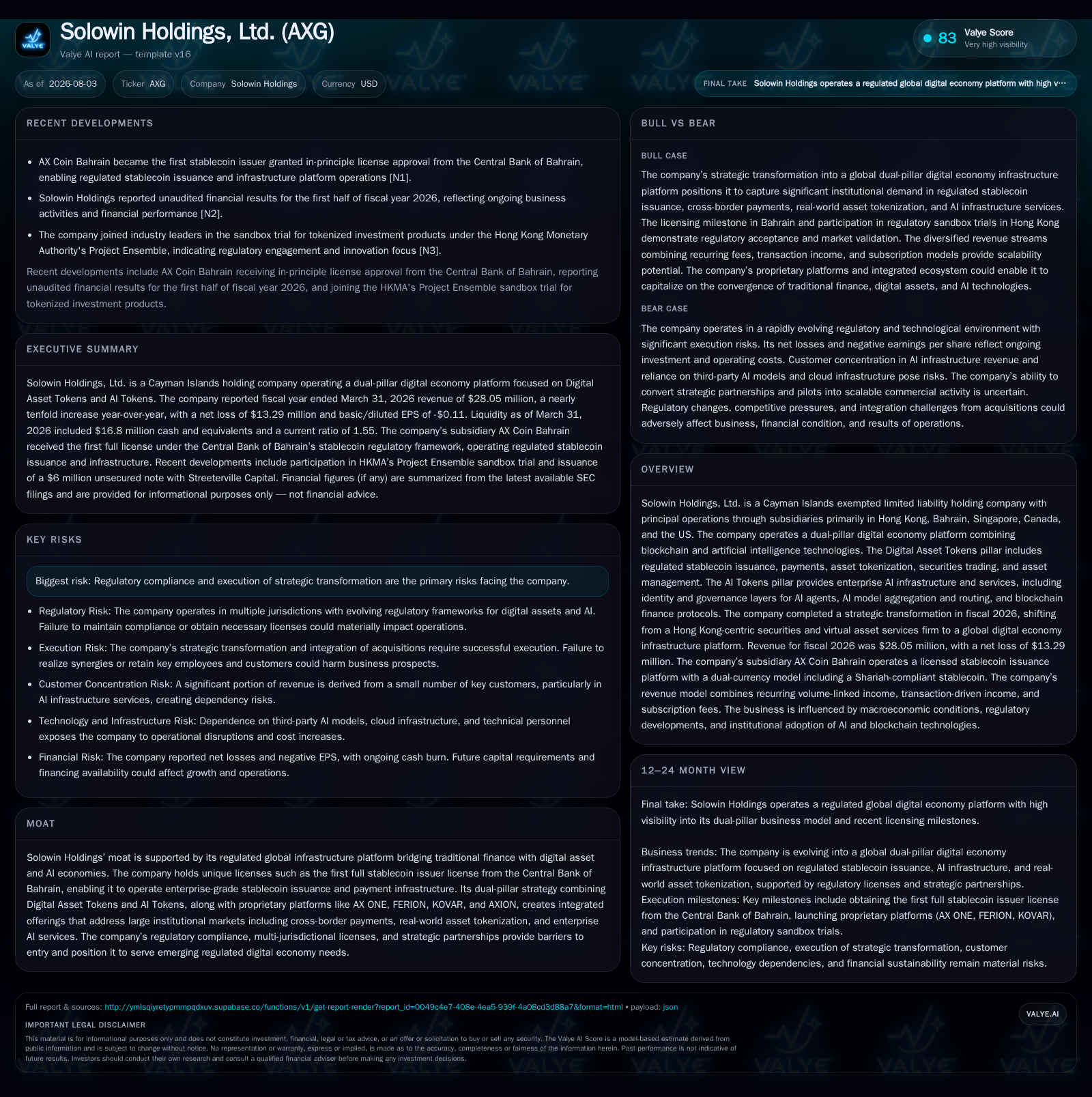
In fiscal 2026, Solowin Holdings completed a strategic transformation from a Hong Kong securities brokerage to a global fintech platform bridging regulated digital asset issuance and AI infrastructure. The company reported nearly tenfold revenue growth to $28 million, driven by stablecoin reserve yield, cross-border payment volumes, and AI enterprise usage. Its dual-pillar model—Digital Asset Tokens and AI Tokens—leverages multi-jurisdictional licenses including the world’s first stablecoin issuer license from the Central Bank of Bahrain. Despite escalating net losses due to investments in technology and compliance, Solowin is positioned as an institutional-grade provider converging traditional finance and emerging digital economies.
Latest Operating Developments
Solowin Holdings' latest quarterly filing (6-K dated June 2, 2026) outlines a significant capital raise structured as a $6 million unsecured pre-paid purchase agreement with monthly amortization payments and share issuance contingencies on missed payments [S2]. This infusion is intended to support working capital for ongoing expansion. While this is primarily a financing measure, it underscores the company's capital-intensive phase as it accelerates platform deployment globally.
More consequentially, Solowin’s 20-F filing for fiscal year ended March 31, 2026 reveals a fundamental strategic pivot finalized over this period: transitioning from a Hong Kong-focused securities brokerage to a globally regulated dual-pillar digital economy infrastructure provider combining blockchain-based digital asset tokenization with artificial intelligence-powered enterprise services [S1]. This transformation was catalyzed by the acquisition of AlloyX Group, marking entry into AI infrastructure.
Business Model Overview
Solowin’s business model centers on two main verticals. The Digital Asset Tokens pillar includes regulated stablecoin issuance (principally AXUSD and AXBHD), cross-border payment systems through its AX ONE platform, asset tokenization of real-world assets via FERION, blockchain protocol development for compliant decentralized finance (DeFi), securities trading facilitation, and asset management services [S1][S14]. Revenue here derives mainly from minting/redemption fees on stablecoins, fees on cross-border transactions processing through sovereign-compliant rails, reserve yield from backing assets held against tokens, and tokenization service fees tied to assets under administration (AUA).
The complementary AI Tokens pillar delivers enterprise AI infrastructure anchored by the KOVAR platform which aggregates external AI models while providing intelligent agent governance frameworks. This segment monetizes through model invocation fees (usage-based), subscription fees for infrastructure access, and professional service integration fees [S1][S7]. This dual-vertical setup enables cross-leverage — such as integrating AI-driven compliance tools within digital asset platforms — positioning Solowin as an innovator at the fintech-AI convergence.
Cross-selling between traditional wealth management/asset management businesses owned by Solowin's subsidiaries also produces diversified fee streams but remains secondary in scale compared to the emerging pillars.
Industry Structure & Competitive Position
Solowin participates in a tightly regulated fintech sector where multi-jurisdictional licensing is pivotal to serving institutional customers operating in digital assets and AI infrastructure [S1]. Its multi-license footprint includes full Hong Kong SFC licensing for securities brokerage & virtual asset services; licensed money services businesses in Singapore, US, Canada; plus Bahrain’s groundbreaking stablecoin issuer license — the first issued worldwide under CBB’s novel regulatory framework
This regulatory breadth creates significant entry barriers compared to unlicensed crypto firms or players limited to one jurisdiction. It aligns Solowin competitively with peers such as Circle or Paxos in stablecoin issuance, Ripple or TransferWise in cross-border payments integration with blockchain rails, alongside enterprise AI service providers like C3.ai for proprietary model aggregation system comparisons.
However, unlike pure-play exchanges or crypto-only firms like Coinbase or Binance, Solowin emphasizes compliance-first platforms targeting institutional treasury functions — notably in regulated stablecoins tailored for cross-border settlement — coupled with scalable enterprise AI governance.
Growth Drivers
Key rapid growth indicators are visible across KPIs:
- Revenue jumped nearly 10-fold year-over-year to $28.05 million fueled by scale increases across token issuance and platform transactions [F1][S1].
- The AX ONE payments platform successfully processed $226 million total payment volume by fiscal year-end indicating rising transaction throughput relevant for treasury use cases [S1][S10].
- FERION launched ten real-world asset tokenization projects reaching $52 million tokenized value underscoring demand for compliant asset digitization [S1].
- SOLOMON platform AUA leapt by 347% to nearly $849 million demonstrating broadening institutional asset custody/business expansion [S1][S10].
- Total trading volume combining stablecoins/fiat reached $1.04 billion (up almost fourfold) reflecting strong adoption among institutional market participants [S10].
- The granting of the first-ever full stablecoin issuer license under Bahrain's CBB enables Solowin not only product validation but also competitive legitimacy in Gulf Cooperation Council financial hubs and beyond [S1][S16].
- The AI pillar drives approximately 79% of revenue now emphasizing subscription plus usage fee models linked directly to active client count/intensity signaling robust monetization of enterprise-scale solutions [S7][S22].
These growth trends indicate structural expansion driven primarily by regulatory clarity enabling regulated dollar-backed stablecoins to supplant legacy correspondent banking corridors; simultaneously an uptick in demand for AI governance solutions reflects enterprises’ focus on compliance amid broadening deployments.
Risks & Constraints
Despite clear momentum, Solowin faces fundamental risks common to fintech/crypto firms undergoing transformation:
- Regulatory complexity looms large given differing standards across Hong Kong’s permissive virtual asset regime versus Mainland China’s prohibitive stance creating compliance risks surrounding Mainland-based clients despite HK licensing [S9][S23]. Abrupt enforcement actions could impair revenues or client access.
- Financial losses widened net loss by over 56% YoY to $13.29 million driven largely by rising operating expenses including AI cloud costs increase post-AlloyX acquisition; R&D ramp-up; staffing; share-based compensation; and intensified compliance spending illustrating capital intensity during scaling phases [F1][S9][S14]. Sustained unprofitability remains a caution.
- Customer concentration risk is material with top five clients generating above 70% of AI services revenue exposing volatility potential if any key relationships diminish or terminate usage abruptly [S22]. Diversification rests as a medium-term challenge.
- Operational dependence on third-party cloud providers for critical computing capacity introduces risk around cost inflation or service disruptions affecting uptime/reliability of core AI Token infrastructure [S22].
- Market volatility in both digital assets and institutional appetite poses cyclical uncertainty given reliance on transaction volumes for substantial fee income components.
- Intellectual property exposure exists across complex cloud-AI-blockchain integrations where infringement claims or data privacy breaches could disrupt business or create unforeseen liabilities [S18].
What to Watch Next
Near-term monitoring should focus on:
- Scaling total payment volume processed on AX ONE as indicator of accelerating adoption within cross-border treasury management channels.
- Circulating supply growth rates for AXUSD/AXBHD stablecoins globally post-Bahrain license approval are vital metrics directly impacting reserve yields and minting/redemption fee income.
- Expansion velocity of real-world asset tokenization projects via FERION reflecting industrial client traction beyond proofs-of-concept.
- Increase in number of active enterprise clients using KOVAR AI aggregation/routing services signifying strengthening recurring revenues.
- Operating leverage trends measured through evolving R&D efficiency versus admin cost growth indicating path toward profitability.
- Regulatory developments especially any shifts affecting operation scope in Mainland China or new requirements from US regulators that might constrain client onboarding or service offerings.
- Execution on capital structure management including repayment schedules related to newly issued pre-paid purchases providing liquidity cushioning without undue dilution pressure.
Financial Profile Discussion
As of March 31, 2026, Solowin held approximately $16.8 million in cash and equivalents against nominal debt reported at $5,000 suggesting negligible leverage and healthy liquidity albeit matched with rapidly expanding current liabilities totaling roughly $24.4 million resulting in a current ratio near 1.55—a balance indicative of manageable short-term obligations weighted against aggressively growing receivables/assets from expanded operations [F1]
The fiscal year closed with net losses increasing from $8.54 million to $13.29 million driven chiefly by investment outlays tied to launch-related technology enhancements (notably within Ferion and Kovar platforms), expanding workforce following AlloyX consolidation, plus compliance-related expense inflation characteristic of heavily regulated multi-jurisdictional operators seeking scale without compromising license standing [F1][S1][S9]
Revenue escalation nearly tenfold provides an encouraging top-line base validating capital deployment strategy but margins compression warrants close tracking amid continuing investment cycles prior to breakeven dynamics arrival expected later post-further client ramp-up.
Cash flow usage reflects operating losses with offsets from financing inflows increasing substantially via equity injections ($16.9M) plus convertible notes ($5M) during fiscal year underscoring dependence on external capital markets funding mixed near-term losses typical for transformative fintech companies pursuing global scale rapidly within tightly regulated environments [S4][S5][F1]
This analysis relies strictly on publicly disclosed SEC filings through August 2026 without speculative assumptions regarding undisclosed contracts or market share positions. No investment advice or price targets are provided herein.
Disclaimer: This is research-only, informational analysis and not investment advice. It may include AI-generated interpretation and general industry context. Always verify important details using primary sources.

Comments