
MasterBrand Expands Scale with American Woodmark Merger Amid Integration and Market Challenges
MasterBrand’s recent merger with American Woodmark significantly increases scale in cabinetry and home improvement, but integration execution and sector headwinds remain key factors.
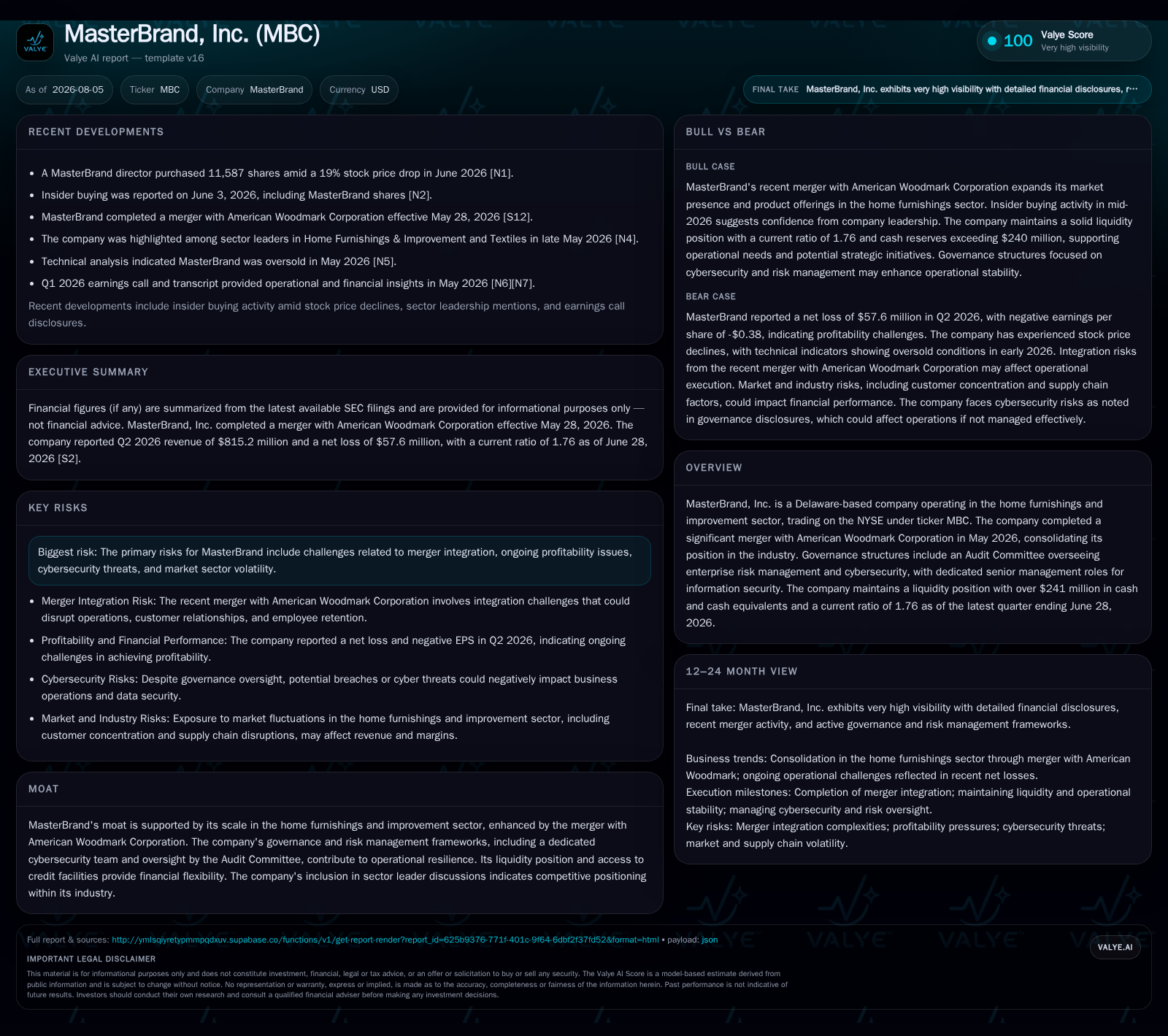
In Q2 2026, MasterBrand completed its merger with American Woodmark Corporation, consolidating two major players in the cabinetry and home furnishings sector. This transaction enhances MasterBrand's scale, strengthens its product portfolio, and broadens distribution channels amid a competitive home remodeling market. However, the company faces ongoing merger integration challenges, cyclical housing market volatility, and raw material cost pressures. Robust enterprise risk management and a solid liquidity position buffer operational risks. Key metrics to monitor include merger synergy realization progress, revenue growth trends in remodeling versus new construction, and margin stability under fluctuating input costs.
Recent Operating Update
MasterBrand's latest quarterly filing dated August 5, 2026 confirms the closure of its strategic merger with American Woodmark Corporation on May 28, 2026 [S2][S3][S20]. The merger expanded MasterBrand’s footprint as a leading manufacturer and distributor of cabinetry and related home improvement products. The transaction issued approximately 77 million MasterBrand common shares to American Woodmark shareholders at an exchange ratio of 5.15 shares per American Woodmark share [S20]. Importantly, MasterBrand secured regulatory clearance from the Federal Trade Commission earlier in Q2 without substantial conditions imposed [S26].
Operationally, MasterBrand now faces the complex task of integrating American Woodmark's manufacturing facilities, supply chains, sales channels, and workforce. Management highlights attention to seamless merger integration given risks related to retention of customers and suppliers as well as cultural harmonization [S24]. The company issued accompanying earnings releases on August 4 describing initial post-merger financial results and operational snapshots [S3][S7]. These filings emphasize merger synergies as a key near-term financial objective during macroeconomic headwinds impacting industry demand.
Business Model
MasterBrand operates primarily as a manufacturer and distributor specializing in cabinetry for residential applications—a core segment within the broader home furnishings and improvement market. Revenue generation stems from wholesale sales through contractor networks, homebuilders focused on new construction projects, plus retail channels serving remodeling customers. The company’s business model monetizes deeply in product design innovation combined with scalable manufacturing capacity to offer a spectrum of cabinetry styles ranging from economical stock solutions to high-end customized millwork.
The recent acquisition of American Woodmark enhances this model by adding complementary product lines, geographic reach into new distribution territories, expanded capacity utilization opportunities, and diversification across customer types [S1]. Additionally, MasterBrand’s ability to bundle installation services alongside cabinetry appeals to consumer segments seeking turnkey remodeling solutions—a rising trend driven by demographic shifts favoring home ownership improvements.
Margins fluctuate based on raw material costs (notably wood prices), labor availability impacting capacity utilization rates, and pricing discipline amid competitive pressures in wholesale distribution channels. Leveraging scale post-merger offers cost savings potential through procurement efficiencies and rationalization of overlapping administrative functions.
Industry Structure and Competitive Position
The cabinetry segment is concentrated among several major players including Masco Corporation and Fortune Brands Home & Security alongside numerous regional manufacturers. While retail giants such as Lowe’s or Home Depot facilitate wide distribution access for many suppliers—including MasterBrand—the sector is highly sensitive to cyclical housing market trends dictated by interest rates affecting new construction starts plus consumer renovation spending.
MasterBrand’s enhanced scale following the American Woodmark integration situates it as one of the largest pure-play cabinetry manufacturers in North America. This scale affords bargaining power over raw material suppliers (wood procurements) while enabling investment in product innovation pipelines tailored to evolving consumer tastes around eco-friendly materials or smart-home compatibility.
However, the combined entity must manage risks inherent to merger integration such as customer retention volatility if service continuity falters or supplier contract renegotiations disrupt supply chain fluidity. Competitive differentiation remains reliant on sustaining quality standards while controlling operating costs across multiple production plants.
Growth Drivers
Key growth drivers include expanding demand from increased remodeling activity buoyed by favorable demographic patterns emphasizing homeownership renewal rather than new builds alone. As mortgage rates fluctuate upwardly, new construction may slow whereas remodeling gains prominence.
Another lever is penetrative expansion into under-served wholesale markets through strengthened salesforce capabilities acquired from American Woodmark alongside channel diversification initiatives targeting specialty retailers or direct consumer engagement.
Product innovation—such as offering customizable cabinetry finishes or modular solutions compatible with smart home ecosystems—can also stimulate incremental revenue by capturing consumer preference shifts toward bespoke renovation projects.
Operational efficiency gains via supply chain optimization reduce cost basis permitting margin expansion even when mix shifts toward premium offerings less sensitive to commodity inflation.
Risks and Watchpoints
Merger integration stands out as the paramount risk: execution timing mismatches or unforeseen expenses could delay anticipated synergies described during deal announcement phases [S24]. Heightened cyber threats necessitate resilient enterprise risk management; MasterBrand’s governance overseen by both a technology-focused Audit Committee subgroup and seasoned information security executives mitigates this exposure but requires continuing vigilance [S1].
Raw material cost volatility—particularly lumber prices influenced by tariff policies or environmental regulations—may compress margins absent agile pricing responses or alternative sourcing strategies. Labor shortages impacting production throughput also pressure capacity utilization statistics critical for operating leverage.
Macro uncertainty surrounding housing financing conditions can suppress overall demand growth unpredictably while increasing competition from imports or lower-cost regional producers might erode pricing power.
Tracking customer retention rates post-merger alongside order backlog trends will provide early indicators of market acceptance for combined operations effectiveness.
What to Watch Next
Subsequent quarterly earnings reports will offer crucial updates on synergy progress metrics—operating income or cash flow gains attributed explicitly to integration efforts are priority indicators. Monitoring evolving housing market data aligned with company-reported backlog or bookings clarifies sectoral demand dynamics impacting revenue trajectories.
Additional disclosures about supply chain resilience initiatives or cybersecurity incidents may signal operational strengths or vulnerabilities ahead. Management commentary regarding capex allocation between upgrading production facilities versus new product development investments will hint at longer-term competitiveness strategies.
Regulatory developments beyond initial clearance could influence operational constraints particularly if environmental compliance rules tighten for wood sourcing or manufacturing emissions controls.
Financial Profile Discussion
As of June 28, 2026 quarter-end—the first full quarter post-merger—MasterBrand reported a robust liquidity position with $241.6 million in cash and cash equivalents complemented by current assets totaling approximately $1.06 billion against current liabilities near $604 million yielding a healthy current ratio of 1.76 [F1]. This liquidity cushion supports working capital needs during integration phases which typically heighten inventory levels and receivables temporarily.
While total debt figures referencing $1.02 billion are dated to December 2024 [F1], problematic leverage risks appear mitigated given recent incremental Term Loan A debt drawdown funding was used principally to retire pre-existing indebtedness at American Woodmark upon closing [S15]. Net debt proximate at roughly $778 million suggests balance sheet flexibility though monitoring leverage ratios aligned with EBITDA generation post-integration is advisable.
Operating income performance preceding merger stood at $119 million annually per last full fiscal data point ending December 2025 with net income just over $26 million reflecting reasonably slim margins typical of capital-intensive manufacturing sectors subject to raw material swings [F1]. Near-term margin compression from integration costs is likely but balanced by longer-term cost-saving expectations articulated by management.
Disclaimer: This is research-only, informational analysis and not investment advice. It may include AI-generated interpretation and general industry context. Always verify important details using primary sources.

Comments