
American Bitcoin Corp. Scales Mining Fleet and Treasury Amid Volatile Bitcoin Environment
Q2 2026 filings reveal sharp expansion in American Bitcoin Corp's mining capacity alongside rising Bitcoin reserves, reflecting a capital-intensive growth strategy amid sector volatility.
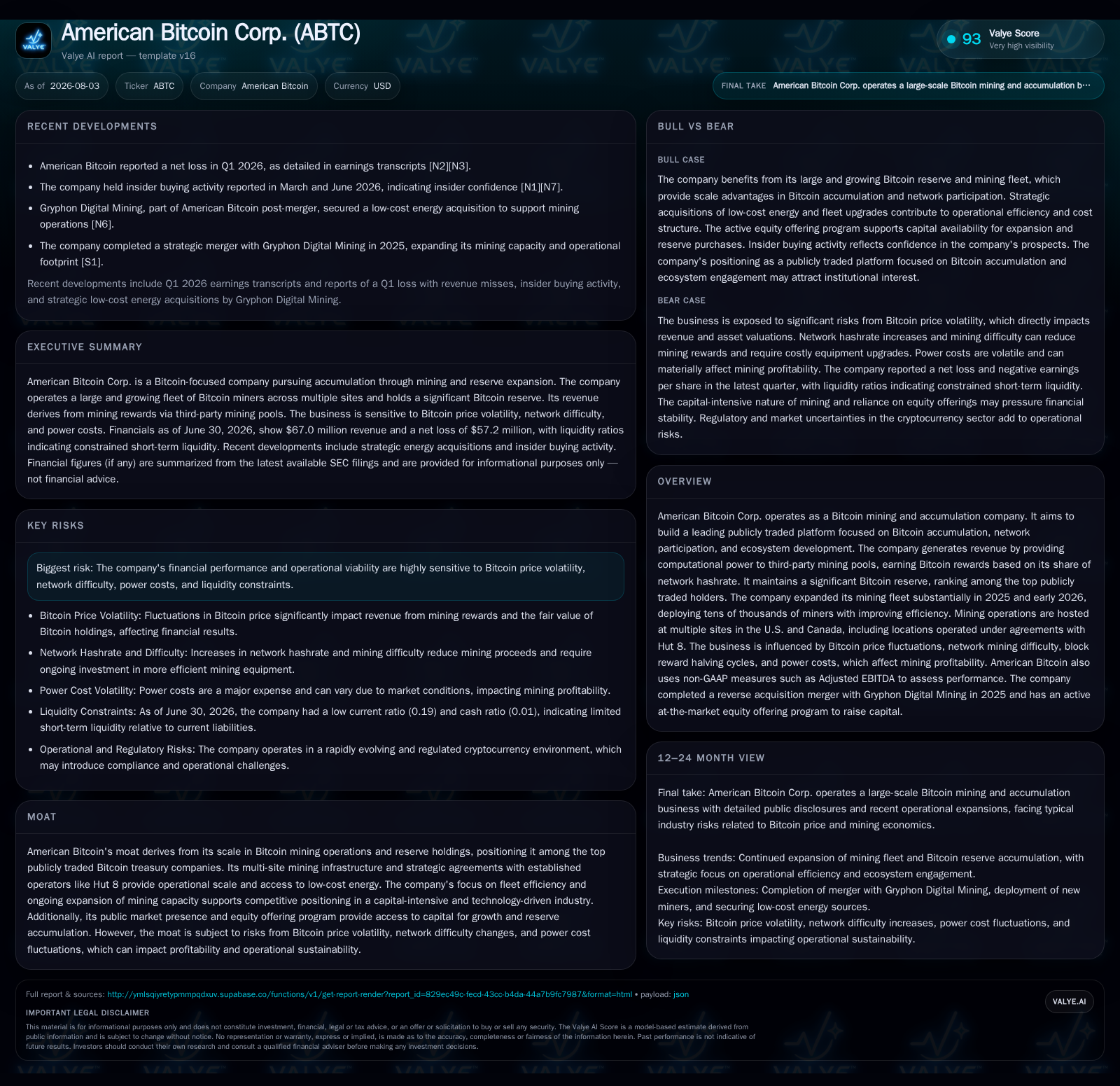
American Bitcoin Corp. has significantly increased its fleet size to approximately 89,000 miners, delivering an owned hashrate of about 28.1 EH/s and operational hashrate nearing 25 EH/s as of mid-2026. Concurrently, its Bitcoin treasury has expanded to position it among the top publicly traded holders. These developments stem from aggressive capital raising via its at-the-market equity program deployed towards mining hardware acquisition. Growth is tempered by key industry risks including Bitcoin price fluctuations, network difficulty adjustments, and power cost sensitivity, which will continue to shape operational profitability and investment pacing.
Quarterly Operating Surge Elevates Hashrate and Dollarized Treasury Metrics
The latest quarterly filing for the period ending June 30, 2026 documents a pronounced ramp-up in American Bitcoin Corp.'s (ABTC) mining capacity. The company now owns approximately 89,000 miners contributing about 28.1 exahashes per second (EH/s) of hashrate [S2], [S3]. Of these, roughly 59,000 units are deployed and operational on the network with an effective output near 25 EH/s [S1]. This growth tracks from substantial miner purchases executed in August-September 2025 and early 2026 totaling over 28,500 units representing nearly 18 EH/s before deployment [S1].
This expanded computing power translates directly into increased potential Bitcoin block rewards earned through participation in third-party mining pools where ABTC contributes computational power in exchange for proportional shares of mined BTC. On the accumulation side, the company’s Bitcoin treasury reached about 6,963 BTC as of late March 2026—up from approximately 5,401 BTC at the end of calendar year 2025—signifying a top-16 ranking among publicly traded miners by reserve size [S1]. This dual emphasis on scaling mining operations while aggressively growing BTC holdings illustrates ABTC’s strategic positioning as both an active network participant and a sizable digital asset holder.
Mining Efficiency Gains in Context: Balancing Power Costs with Growing Scale
Fleet efficiency remains critical in managing operational margins due to electricity consumption comprising a large portion of mining costs. As disclosed in the annual filing, ABTC’s average fleet efficiency registers about 16.0 joules per terahash (J/TH) across total owned miners with a slightly better ~14.1 J/TH among those currently operational [S1]. Such improvements reflect deployment of newer-generation ASIC hardware tailored to maximize energy performance.
Since power expenses vary widely based on geographic location and contract terms—factors that ABTC partially controls through multi-site mining facilities including partnerships with operators like Hut 8—the ability to deploy more energy-efficient miners provides operational leverage during fluctuating electricity prices. This efficiency gains support more sustainable cash flow continuity during periods of lower Bitcoin prices or rising network difficulty.
Strategic Revenue Model: Mining Rewards Tuned by Network Difficulty Cycles
ABTC’s revenue is predominantly derived from block rewards allocated by the Bitcoin protocol based on its share of aggregate network hashrate conveyed via mining pool participation [S1], [S2]. This model inherently subjects revenues to external forces beyond direct company control: notably the market price of BTC which affects realized revenue per mined coin; periodic block reward halving events that cut payout size approximately every four years; and dynamic network difficulty adjustments designed to maintain stable block times.
Consequently, revenue visibility remains challenging given cryptocurrency price volatility and increasing hashing competition that raises network difficulty over time. These factors underline why ABTC combines active fleet operations with long-term BTC accumulation strategy—to hedge short-term earnings swings with treasury asset appreciation potential.
Peer Benchmarking Highlights Fleet Scale and Treasury Rank Among Public Miners
Within the cohort of publicly traded Bitcoin miners like Marathon Digital Holdings and Riot Platforms—both recognized for their large-scale fleets exceeding tens of EH/s and sizable BTC treasuries—American Bitcoin’s scale places it competitively in mid-tier rankings [S1]. While not matching the largest operators in sheer volume yet, ABTC’s rapid fleet expansion coupled with near-7,000 BTC treasury aligns it closely with peers who similarly pursue combined operation plus asset holding models.
Equity market access differentiates ABTC’s growth capability: its sustained issuance under the at-the-market offering enables more continuous capital availability than some peers reliant on intermittent financing rounds or debt instruments.
Growth Catalysts: Capital Market Access Fuels Aggressive Fleet Deployment
Capital intensity characterizes Bitcoin mining due to ASIC hardware costs often scaling into millions per thousand units. Starting September 2025, ABTC launched its "2025 ATM" equity program allowing issuance up to $2.1 billion common stock from time to time [S1]. Since program inception through Q1/Q2 of 2026, ABTC raised over $350 million gross proceeds netting approximately $348 million after issuance costs primarily deployed toward hardware purchases supporting the rapid miner count surge [S1], [F1].
This constant capital influx enables prompt procurement timing during favorable market conditions for miner acquisition—key in avoiding delays from typical supply chain bottlenecks affecting peer miners globally.
Risks to Track: Cryptocurrency Volatility, Network Difficulty, Energy Cost Swings, and Operational Complexity
The filings reiterate typical industry risks impacting financial performance with notable sensitivity:
- Cryptocurrency price swings can dramatically alter revenue conversion values as mined BTC may lose or gain fiat value rapidly.
- Network difficulty escalations increase computational competition reducing rewards pro rata despite unchanged hash rate contributions.
- Electricity costs fluctuate by contract terms or regional rates; unhedged exposure can compress margins especially where power is sourced from volatile markets.
- Multi-site operations amplify complexity demands requiring vigilant uptime maintenance and hardware reliability assurances across geographically dispersed assets [S2], [S1].
These risk vectors necessitate ongoing mitigation strategies including diversifying energy sources or potential hedging mechanisms alongside optimizing miner deployment schedules.
What to Watch Next: Next Milestones in Targeted Hashrate Expansion and Treasury Accrual Pace
Future execution markers lie primarily in:
- Completion status updates on deploying recently purchased ASIC miners totaling over 11,000 units acquired early 2026 which will further lift total effective hashrate upon commissioning [S2], [S3].
- Quarterly reporting on actual mined BTC volumes as a clear KPI linking theoretical owned hashing power to realized reward capture.
- Monitoring capital raise totals under ATM offerings indicating continued ability to fund scaling initiatives requisite within capital-demanding sector economics.
These indicators will provide forward-looking signals on whether ABTC can sustain its trajectory amidst external volatility pressures.
Financial Profile Discussion: Liquidity Constraints Amid Current Asset/Liability Imbalance
As of June 30, 2026 balance sheet snapshots show constrained liquidity posture characteristic of rapid growth miners emphasizing capital raising over short-term liquidity buffers [F1]. Current assets approximate $25.74 million against substantially higher current liabilities around $136.67 million producing a tight current ratio near 0.19
Reported total debt stands low at approximately $4.9 million last reported year-end but net debt centers around $4.22 million when considering cash equivalents near $0.68 million [F1]. This limited leverage suggests dependence predominantly on equity raises via ATM programs rather than traditional indebtedness.
In sum, ABTC must continue strategic capital market engagements while balancing working capital demands inherent in large-scale ASIC acquisitions pending full deployment.
This analysis synthesizes evidence strictly from American Bitcoin Corp.’s SEC filings through August 3, 2026 without offering investment research views or speculative forecasts. The company operates within a rapidly evolving industry subject to pronounced cyclical factors impacting production economics and asset valuations.
Disclaimer: This is research-only, informational analysis and not investment advice. It may include AI-generated interpretation and general industry context. Always verify important details using primary sources.

Comments