
Boston Scientific Advances Cardiovascular Innovation Amid Portfolio Rationalization
Latest quarterly results reflect solid organic growth and strategic focus on high-potential segments despite emerging market challenges.
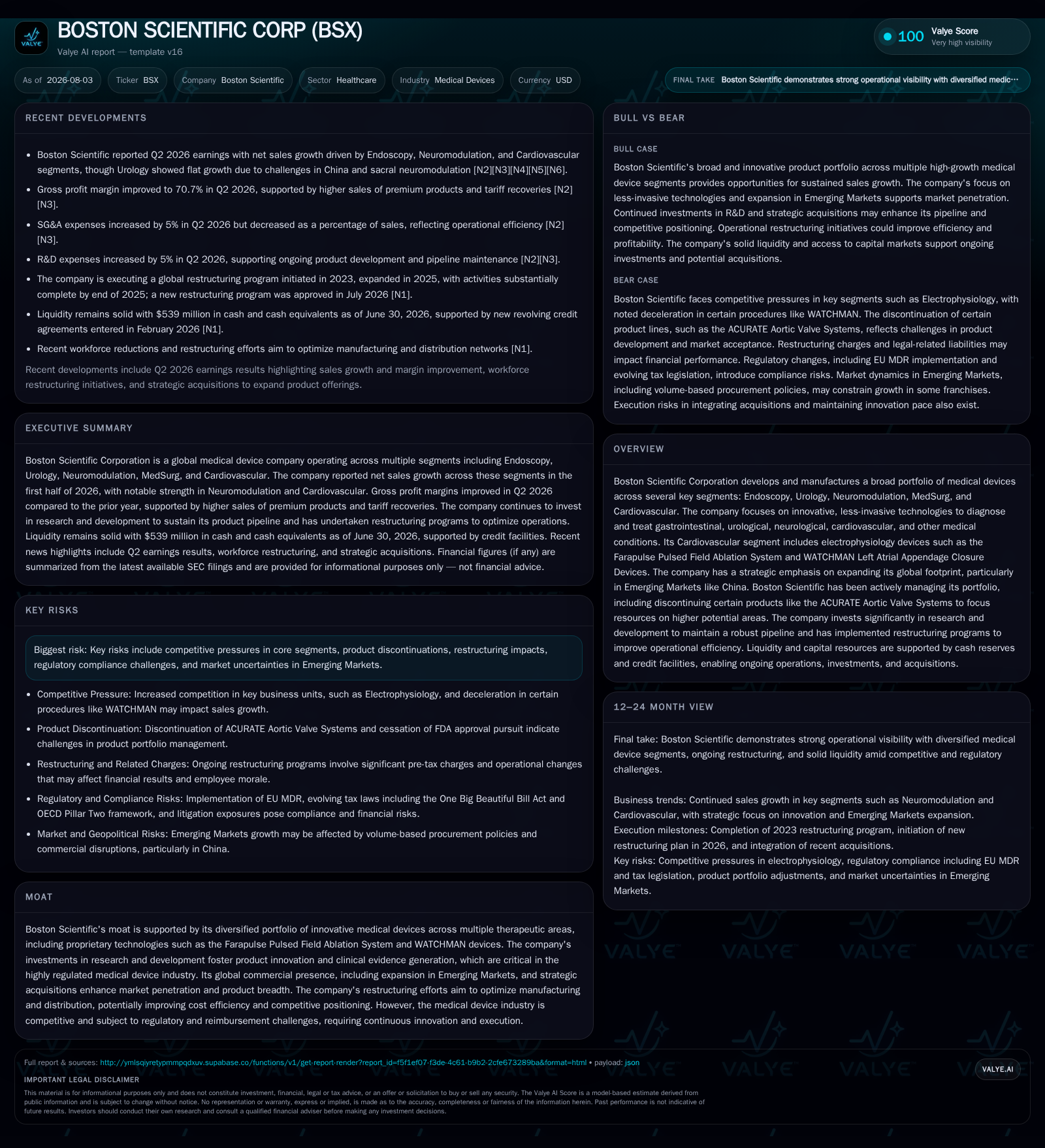
Boston Scientific’s Q2 2026 results highlight broad-based organic revenue growth across most business segments, driven by innovations in cardiovascular and neuromodulation devices. The company faces headwinds in its Urology segment due to volume procurement pressures in China. Strategic portfolio management, including discontinuation of lower-potential products and investments in R&D, underpin its efforts to strengthen competitive positioning globally. Emerging markets remain a key growth avenue, albeit with execution risks. Boston Scientific maintains strong liquidity and covenant compliance amid active debt management and restructuring initiatives.
Recent Operating Update
However, the Urology segment posted flat organic sales largely due to volume-based procurement policies in China that pressured stone management device volumes. This regional pricing dynamic highlights ongoing emerging market execution challenges despite strategic importance [S2]. The MedSurg segment achieved moderate 5.4% organic growth backed by core gastrointestinal franchises.
The company also announced a new global restructuring program aimed at optimizing the manufacturing network and reducing operational complexity following prior supply chain rationalizations initiated in their 2023 plan [S2]. This restructuring targets improved cost efficiency though near-term charges are expected
Business Model Analysis
Boston Scientific generates revenue primarily through the sale of innovative medical devices to hospitals and specialty clinics worldwide. Its diversified portfolio spans five core segments: Endoscopy, Urology, Neuromodulation, MedSurg, and Cardiovascular, each addressing distinct clinical needs with a strong emphasis on minimally invasive technologies.
Revenue mechanics involve procedure-driven consumption of implantable devices such as catheters for electrophysiology interventions or stents for GI treatments. Pricing is influenced by reimbursement frameworks established with payors predominantly in developed markets; emerging markets depend more heavily on government procurement programs which can compress margins.
R&D investment as a percentage of sales remains robust to maintain pipeline vitality—critical in an industry where regulatory approval cycles can last years [S1]. Boston Scientific’s focused attrition strategy—discontinuing lower-potential assets like the ACURATE Aortic Valve Systems—reflects disciplined portfolio management designed to prioritize resources behind proprietary platforms with higher commercial promise such as Farapulse PFA technology
Sales distribution combines a direct sales force deploying sophisticated clinical sales models—often requiring specialized training—with selective partnerships primarily in emerging regions.
Industry Structure and Competitive Position
The medical devices sector is highly regulated with significant barriers to entry including FDA clearance processes and global equivalents, creating a moat for incumbent innovators with clinically validated pipelines. Competitors such as Medtronic and Abbott Laboratories operate large diversified portfolios across overlapping therapeutic areas.
Boston Scientific differentiates itself through concentration on electrophysiology innovation alongside endoscopy solutions, building clinical evidence to embed its devices into standard procedural guidelines—a key switching-cost vector for healthcare providers.
Growth depends on penetrating procedural volumes globally while maintaining pricing power under reimbursement scrutiny. The company's expanding footprint in Emerging Markets is essential given slower growth saturation in mature geographies but entails navigating complex regulatory ecosystems and intense local competition.
Growth Drivers
Cardiovascular Innovation: Expansion of electrophysiology therapies including pulsed field ablation reduces procedure times and safety concerns compared to older ablation techniques. Adoption of WATCHMAN devices continues to grow due to stroke prevention benefits.
Emerging Market Penetration: Strategic investments improve access within China and other developing healthcare systems where rising chronic disease prevalence drives device demand despite pricing pressures. Volume procurement may compress pricing short term but scale gains offset this.
R&D Pipeline Strength: Investments targeting minimally invasive surgical instruments and integrated imaging enhance device utility in GI procedures; neuromodulation advancements address chronic pain management—a growing clinical priority.
Operational Efficiency: New restructuring program targeting streamlined manufacturing footprint is expected to enhance gross margin over medium term.
Risks and Watchpoints
- Emerging Market Pricing Pressure: Volume-based procurement policies particularly in China impact Urology revenues; sustainable growth here requires adaptive commercial models.
- Regulatory Delays: Complex global approval processes can postpone launches impacting sales ramps.
- Litigation Exposure: Product liability claims especially involving implantable devices carry unpredictable costs; ongoing IP disputes could affect future product commercialization or require royalty payments.
- Competitive Intensity: Rapid technology shifts require continuous innovation; peer companies aggressively develop alternative electrophysiology platforms or structural heart therapies.
- Execution of Restructuring Initiatives: Cost-saving programs entail risks related to workforce reductions or operational disruptions that could temporarily impair productivity.
What to Watch Next
Key upcoming milestones include monitoring quarterly segment revenue trends for signs of recovery or further pressure in Urology, particularly in Chinese operations; tracking regulatory approvals for pipeline products such as next-generation neuromodulation devices; assessment of restructuring cost impacts versus anticipated savings reported in forthcoming quarters; updates on clinical adoption rates of Farapulse technology relative to competitors’ ablation platforms; progress on geographic expansion especially within fast-growing Emerging Markets; eventual financial results post-Penumbra acquisition closure if it completes within planned timelines; and management commentary on supply chain resilience amid inflationary pressures.
Financial Profile Discussion
As of June 30, 2026, Boston Scientific held $539 million in unrestricted cash and equivalents alongside $7.97 billion in current assets against $6.43 billion current liabilities yielding a current ratio of approximately 1.24—indicating adequate near-term liquidity coverage [F1]. The company maintains a net debt position when offsetting cash balances against total debt instruments [F1].
Refinancing executed early 2026 included new revolving credit agreements providing ample undrawn facilities totaling several billion dollars plus access to capital markets via commercial paper issuance [S8]. Capital allocation prioritizes funding R&D efforts critical for innovation-led growth alongside opportunistic acquisitions within strategic therapeutic clusters exemplified by recent Nalu Medical purchase focused on chronic pain technologies [S13].
Overall financial flexibility appears solid supporting ongoing investments while managing legal liabilities prudently through reserves exceeding $200 million related primarily to litigation contingencies common across the sector [S5][S11]. Cash flow generation from operations remains essential given sizable expenditures on R&D and restructuring charges accrued during ongoing operational optimization phases.
This analysis is based solely on publicly available filings from Boston Scientific Corporation as of August 2026 without incorporating forecast data or proprietary information. It does not constitute investment advice but provides an informed perspective on operating performance within the context of medical device industry dynamics.
Disclaimer: This is research-only, informational analysis and not investment advice. It may include AI-generated interpretation and general industry context. Always verify important details using primary sources.

Comments