
Avista Corp Navigates Wildfire Disruptions While Advancing Long-Term Resource Planning
Avista’s Q2 2026 report highlights robust integrated resource planning and operational challenges from wildfires impacting its regulated utility territories.
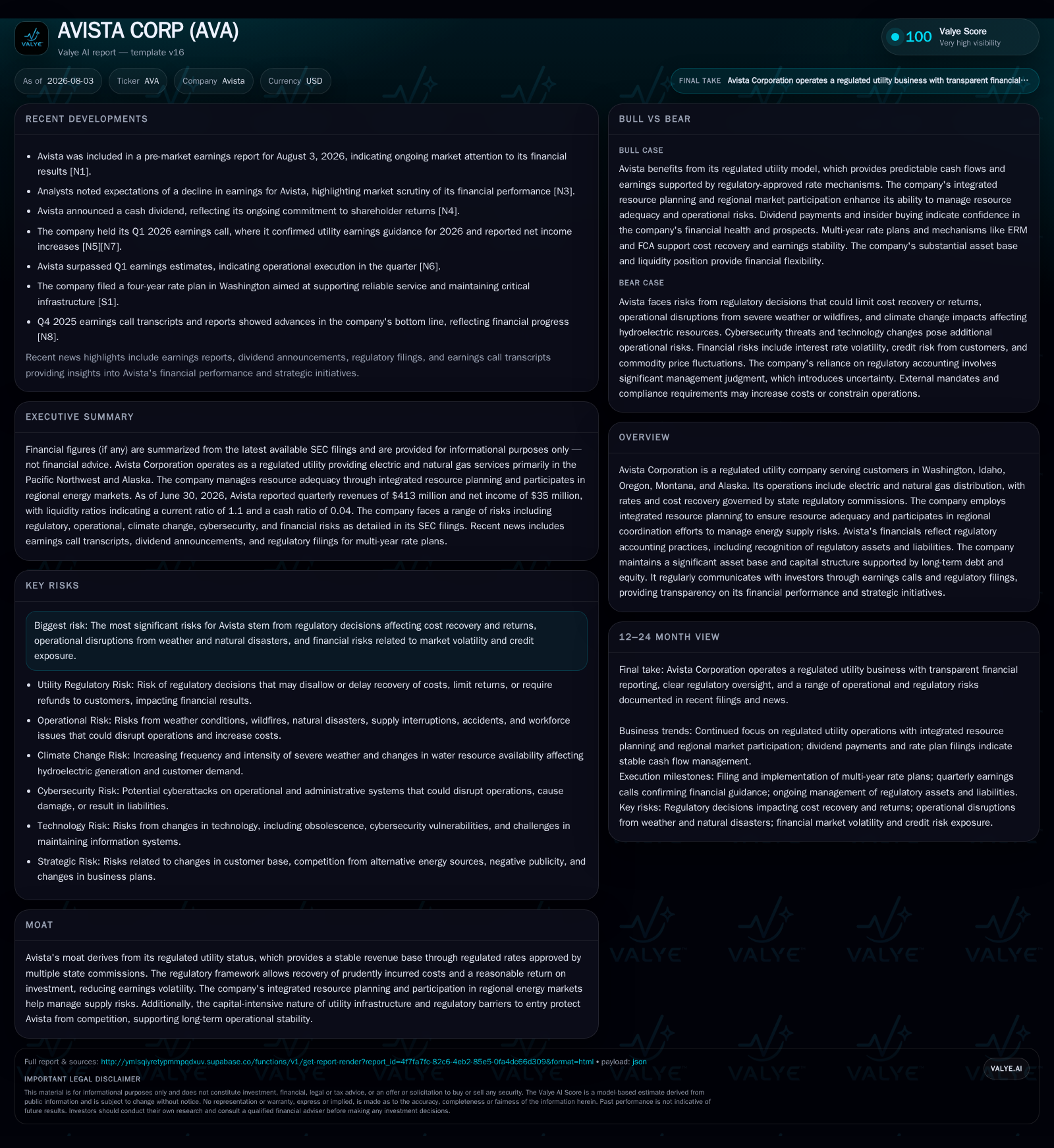
Avista Corporation’s latest quarterly filing underscores its ongoing commitment to integrated resource planning (IRP) that ensures reliable energy supply across its multi-state service areas. Recent wildfires in Spokane caused customer outages but were confirmed unrelated to Avista's infrastructure, illustrating the operational risks utilities face from natural disasters. The company’s regulated business model, grounded in cost-of-service ratemaking and stable rate base growth, supports steady capital investment aimed at meeting demand and regulatory expectations while managing environmental and market risks.
Latest Quarterly Update: Balancing Operational Challenges with Strategic Resource Planning
In its Q2 2026 filing, Avista Corporation detailed continued execution of its integrated resource planning (IRP) framework—a cornerstone for maintaining resource adequacy over a multi-decade horizon. Conducted every two years, the IRP incorporates updated assumptions on load growth, climate impacts, energy prices, and policy changes to guide procurement strategies and infrastructure investments well ahead of anticipated capacity needs [S2][S1]. This disciplined approach reduces execution risk by aligning capital deployment with forecasted demand.
The company faced immediate operational challenges as multiple wildfires erupted in early August within the Spokane area of its service territory. These events led to customer outages and evacuations but were explicitly not caused by Avista’s facilities or equipment [S3]. This incident underscores the inherent vulnerability utilities have to external natural disasters that can disrupt service continuity despite robust preventive measures. It also puts a spotlight on infrastructure resilience investments and emergency response readiness that are critical factors in regulatory assessments.
Business Model: Regulated Utility Framework Drives Predictable Revenue and Investment
Avista operates as a vertically integrated regulated electric and natural gas utility serving customers primarily in Washington, Idaho, Oregon, Montana, and Alaska through subsidiaries such as Avista Utilities and AEL&P [S1]. Its revenues are predominantly generated under state-regulated rates set on a cost-of-service basis designed to cover operating expenses plus an authorized return on invested capital (rate base).
This model provides earnings stability uncommon in competitive markets by enabling recovery of prudently incurred costs tied to infrastructure maintenance and expansion. The company targets approximately $17 million annually in capital expenditures for both 2025 and 2026 with moderate reductions projected thereafter [S1]. These investments support modernization efforts including transmission upgrades and distribution network enhancements aligned with growing demand.
Regulatory approval of rates factoring an allowed return on equity (ROE) is essential for financial health [S1]
Industry Context: Capital-Intensive Utilities Under Regulatory Oversight with Regional Coordination
Operating within the regulated electric and natural gas utility sector characterized by high capital intensity, Avista functions under stringent state-level regulatory oversight ensuring pricing fairness while supporting reliable service delivery. As a natural monopoly within defined territories, the company faces limited direct competition but must comply with regulatory mandates covering rates, service quality, environmental compliance, and infrastructure investments.
Avista actively participates in regional coordination mechanisms such as the Western Energy Imbalance Market (EIM) and western resource adequacy programs [S1]. These initiatives optimize generation dispatch across balancing authorities, reduce capacity shortfall risks through shared resources, and facilitate joint transmission projects that alleviate congestion constraints—factors increasingly important amid evolving grid demands.
Peers with comparable regulatory environments include Puget Sound Energy (PSE) and NorthWestern Corporation, which similarly employ integrated resource planning approaches within their operating regions.
Growth Drivers: Electrification Trends Supporting Demand Growth and Rate Base Expansion
The company benefits from demographic growth trends within its service territories alongside accelerating electrification across residential, commercial, and industrial sectors. In 2025, residential energy sales reached approximately 4.1 million MWhs compared to about 4.0 million MWhs previously, reflecting steady increases consistent with broader regional economic activity [S1]. Commercial and industrial consumption similarly expanded.
Ongoing capital expenditures underpin rate base growth crucial for future authorized returns. Investments focus on modernizing aging infrastructure while integrating renewable energy sources per IRP guidance. Participation in regional transmission expansions further enhances operational flexibility needed for higher renewable penetration while maintaining system reliability.
Risks & Watchpoints: Regulatory Sensitivities and Weather-Related Operational Disruptions
Despite revenue stability afforded by regulation, Avista remains sensitive to regulatory outcomes where unfavorable rate case decisions could constrain cost recovery or reduce allowed ROE, directly impacting profitability.
Weather-related disruptions remain a key risk vector—as demonstrated by the recent Spokane wildfires causing outages [S3]. Such events can inflict physical damage necessitating unplanned repairs while prompting scrutiny regarding investment adequacy in infrastructure hardening.
Volatility in wholesale power prices introduces cash flow timing risks despite existing mechanisms like deferral accounts or Energy Recovery Mechanisms designed to mitigate price exposure [S1]. Operational risks including cybersecurity threats and aging asset reliability also require ongoing attention balanced against capital allocation priorities.
What to Watch Next: Regulatory Proceedings & Capital Execution Metrics
Upcoming rate case decisions across key jurisdictions such as Washington and Idaho will be pivotal. Approvals influencing rate base size or allowed returns will materially affect earnings trajectories [S1].
Subsequent IRP cycles will reveal evolving resource acquisition strategies particularly around renewables integration and transmission projects driven by regulatory climate commitments.
Monitoring capital expenditure execution against forecasts is essential given potential delays from construction schedules or permitting processes noted previously [S1].
Additional indicators include retail customer counts trends or shifts in peak system demand amid ongoing electrification efforts providing insight into demand patterns informing long-term planning.
Financial Profile Discussion
As of June 30, 2026, Avista held $25 million in cash & equivalents alongside current assets near $715 million versus current liabilities around $650 million resulting in a current ratio of approximately 1.1—indicating adequate short-term liquidity [F1]. Total debt was about $1.54 billion netting roughly $1.51 billion after cash balances [F1], consistent with typical leverage levels for regulated utilities reliant on long-term debt financing supported by steady equity contributions.
Full-year 2025 operating income stood at $354 million on revenues approximating $1.96 billion reflecting stable profitability driven by regulated rate structures [F1]
Overall, Avista's financial position aligns with disciplined management practices characteristic of regional utilities balancing substantial capital demands against regulatory frameworks ensuring predictable returns.
Disclaimer: This analysis is based solely on publicly available information as of August 2026. It does not constitute investment advice nor an endorsement of any security position related to Avista Corporation.
Disclaimer: This is research-only, informational analysis and not investment advice. It may include AI-generated interpretation and general industry context. Always verify important details using primary sources.

Comments