
Nextpower Advances Solar Tracking Leadership with Integrated Hardware-Software Platform Amid Market Expansion
Nextpower's latest quarterly update underscores growing solar tracker shipments and software integration as key drivers in utility-scale solar technology.
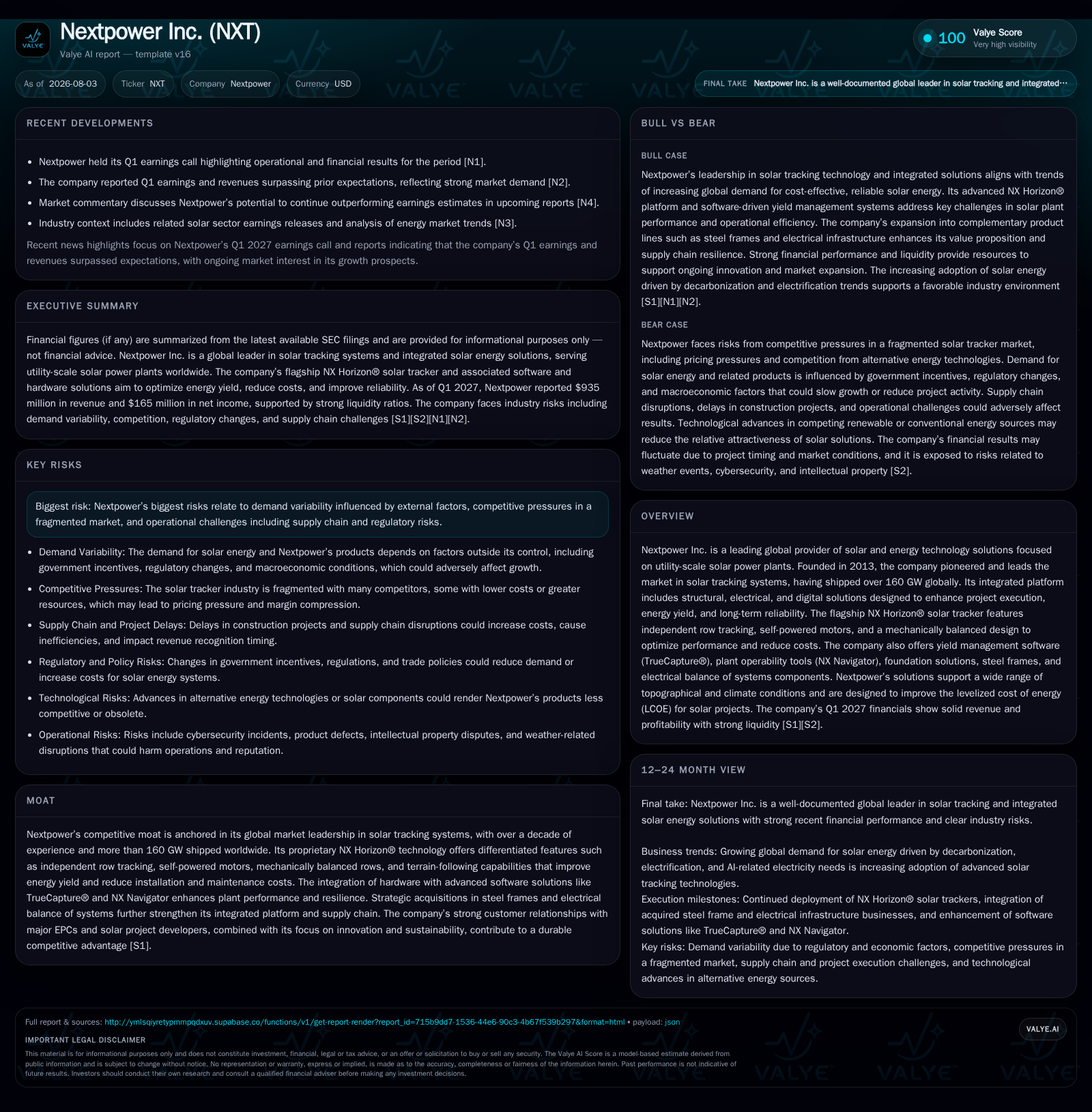
Nextpower Inc. solidified its position as a global leader in solar tracking systems in the Q1 2027 results, supported by over 160 GW of cumulative solar tracker shipments worldwide. The company’s proprietary NX Horizon® tracker technology combined with its TrueCapture® yield management software enhances energy yield and lowers installation and maintenance costs, reflecting a fully integrated platform strategy. While demand in mature and emerging markets sustains growth, risks from supply chain challenges and regulatory shifts remain key considerations. Financially, Nextpower reported strong operating income margins and maintains a healthy liquidity position with ample cash relative to liabilities.
Recent Operating Update: Q1 Fiscal 2027 Results
Nextpower's first quarter fiscal 2027 results (ended July 3, 2026) affirm steady momentum in both top-line growth and profitability with revenue hitting $3.56 billion and operating income amounting to $697 million [F1]. This margin strength reflects the company's ongoing success in scaling its solar tracker shipments alongside expanding adoption of its complementary digital software solutions across utility-scale solar projects [S2]. The earnings release on July 30 further highlighted that revenues and earnings surpassed analyst estimates [S3], confirming resilience despite sector cyclicality.
The shipment tally now surpasses the landmark of 160 GW globally [S1], emphasizing the widespread industry reliance on Nextpower’s flagship NX Horizon® solar trackers featuring independent row tracking and self-powered motors. This quarter’s results reinforce the durability of Nextpower’s value proposition—enhancing energy yield while simultaneously lowering total cost of ownership through ease of installation and operational robustness.
Business Model: Integrated Solar Tracker Hardware-Software Platform
Nextpower operates upstream in the solar energy supply chain as a leading supplier of structural and electrical equipment complemented by proprietary software to EPC firms, project developers, and plant operators focused on utility-scale photovoltaic (PV) systems [S1]. Revenue generation is anchored primarily on the sale of solar tracking hardware along with electrical balance-of-systems components such as steel frames and power conversion technologies. Additionally, recurring revenue streams emerge from software licenses for products like TrueCapture® (energy yield management) and NX Navigator® (plant operability tools), which embed artificial intelligence (AI) to optimize production under variable site conditions.
The core differentiator lies in NX Horizon®, touted as next-generation for its mechanical balancing that allows rows to move independently over diverse terrain, boosting real-world energy capture beyond linked-row or fixed-tilt competitors [S1]. This modular system integrates seamlessly with electrical infrastructure provided by Nextpower to reduce installation cycles—a critical KPI influencing project economics. Its integration with digital software platforms further drives down levelized cost of energy (LCOE) by continuously monitoring plant performance to preempt issues, manage yield degradation, and inform maintenance schedules.
By targeting large-scale solar developers and major EPCs as preferred suppliers worldwide, Nextpower leverages scale advantages in manufacturing efficiency and supply chain management while fostering high retention rates through technological lock-in effects [S1]. The company’s comprehensive warranty terms and focus on reliability underline its commitment to customer ROI.
Industry Structure and Competitive Position
The global solar tracker market remains fragmented but features clear leaders anchored by proprietary technologies addressing efficiency gains amid evolving market demands. Major peers across hardware include Array Technologies (specialized independent row trackers) and First Solar (who leverage integrated project development alongside hardware). Nextpower’s differentiation through an end-to-end platform combining mechanical innovation with AI-enabled software tools stands out versus firms concentrating solely on hardware or software alone.
This platform approach enables Nextpower to address multiple layers of project execution—from design simplification to operations optimization—and tackle geographic expansion barriers through adaptable products compatible with various climate zones from mature markets like the U.S. and India to emerging regions such as the Middle East and Africa [S1].
Growing utility-scale solar capacity is driven structurally by global decarbonization mandates coupled with rising electricity consumption in sectors including AI-powered data centers demanding reliable clean energy—a trend evident in Nextpower's recent commentary [N7]. However, competition persists not only from alternative solar tracker manufacturers but also emerging renewable segments offering different economics or integrated storage solutions.
Growth Drivers
Several factors underpin Nextpower's growth trajectory. The accelerating global transition toward renewable energy sparks continuous demand for efficient PV systems incorporating tracking technology which demonstrably increases energy yield compared to fixed-tilt arrays. Geographic expansion into high-potential but underpenetrated emerging markets provides avenues for new installations aided by adaptive product design [S1].
Moreover, rapid advances in AI integration within digital plant monitoring facilitate more accurate predictive maintenance and performance optimization—further compelling operator adoption of Nextpower’s TrueCapture® software suite [S1][S2]. Rising electrification trends underpin persistent electricity demand growth that utility-scale solar projects are poised to serve efficiently at declining LCOE levels.
Iteration cycles within product R&D support enhancements around autonomous operation capabilities (robotics/automation), aiming at shortening installation lead times—a key efficiency metric directly affecting EPC engagement decisions [S1]. Strategic acquisitions expanding steel frame capacity strengthen supply chain resilience to meet escalating volume needs [S16].
Risks and Growth Constraints
Despite optimistic demand fundamentals, several risks cloud execution. Demand variability stemming from government incentive fluctuations or policy uncertainty may compress near-term order pipelines affecting revenue visibility [S2][S15]. Competition remains intense across components suppliers; pricing pressures could arise if new entrants or lower-cost providers gain foothold especially in price-sensitive emerging regions where local content rules also complicate market entry [S25].
Supply chain disruptions affecting raw materials availability could delay shipments or increase costs amid ongoing geopolitical trade tensions impacting tariffs or export controls [S19][S29]. Technological obsolescence looms if competitors outpace Nextpower's innovation cadence or if newer renewable technologies disrupt conventional tracker economics [S15]. Additionally, cybersecurity risks pertaining to AI-enabled software products necessitate sustained investment in governance frameworks—the failure of which could harm reputation or result in costly remediation efforts [S11][S17].
Litigation involving intellectual property claims also poses potential operational distractions alongside possible financial liabilities that could impair margins [S10][S27]. Regulatory heterogeneity across countries adds complexity especially when expanding internationally given varying environmental standards, labor laws, tax regimes, or trade compliance burdens [S25][S29].
What To Watch Next
Key upcoming milestones to monitor include quarterly shipment volumes as a proxy for order backlog conversion rate reflecting EPC/developer activity levels. Adoption metrics for TrueCapture® software penetration will illuminate recurring revenue sustainability aside hardware sales. Enhancements announced around automation features or additional balance-of-system product launches could signal margin expansion potential.
Geographic footprint expansion progress into target regions like the Middle East/Africa offers insight into overcoming regulatory hurdles. Monitoring supply chain lead times will gauge whether manufacturing scale can keep pace without eroding service quality or profitability.
Financial guidance updates particularly on R&D investment levels tied to next-gen product development will reveal management's appetite for innovation-driven growth versus cost discipline. Any material legal proceedings updates should also be tracked given risk implications.
Financial Profile Discussion
As of the latest quarter ending July 3, 2026, Nextpower held a healthy liquidity position with cash & equivalents totaling approximately $1.21 billion against current liabilities of $1.13 billion, yielding a current ratio near 2.69 indicative of sound short-term financial flexibility [F1]. Total debt was relatively modest at $150 million based on available data dated March 2024 but no more recent debt figures have been disclosed explicitly; net debt is likely strongly negative given ample cash resources supporting operations without levered strain [F1].
Operating income margin stood near 20%, consistent with sustainable profitability trends balanced between capital-intensive hardware manufacturing and higher-margin software licensing offerings [F1]. Robust cash flow generation capability supports ongoing investments in R&D directed at advancing NX Horizon® enhancements plus digital platforms integrating AI/automation capabilities.
Overall financial health supports operational agility amidst material risks inherent to rapidly evolving geographic markets and technology landscapes.
This analysis synthesizes publicly filed information from Nextpower Inc.’s latest quarterly Form 10-Q filing dated August 3, 2026 [S2] along with annual report disclosures from May 19, 2026 [S1], supplemental event filings [S3][S16], and accompanying standardized financial metrics as sourced from companyfacts database snapshots [F1]. Industry framing contextualizes relevant operational KPIs pertinent to utility-scale solar technology providers without projecting specific investment outcomes.
Disclaimer: This is research-only, informational analysis and not investment advice. It may include AI-generated interpretation and general industry context. Always verify important details using primary sources.

Comments