
XPO Leverages AI-Driven Efficiencies and Network Scale in North American LTL and European Transportation
XPO’s Q2 2026 results demonstrate operational advancements powered by AI, network density, and a solid liquidity posture amid ongoing industry cyclicality.
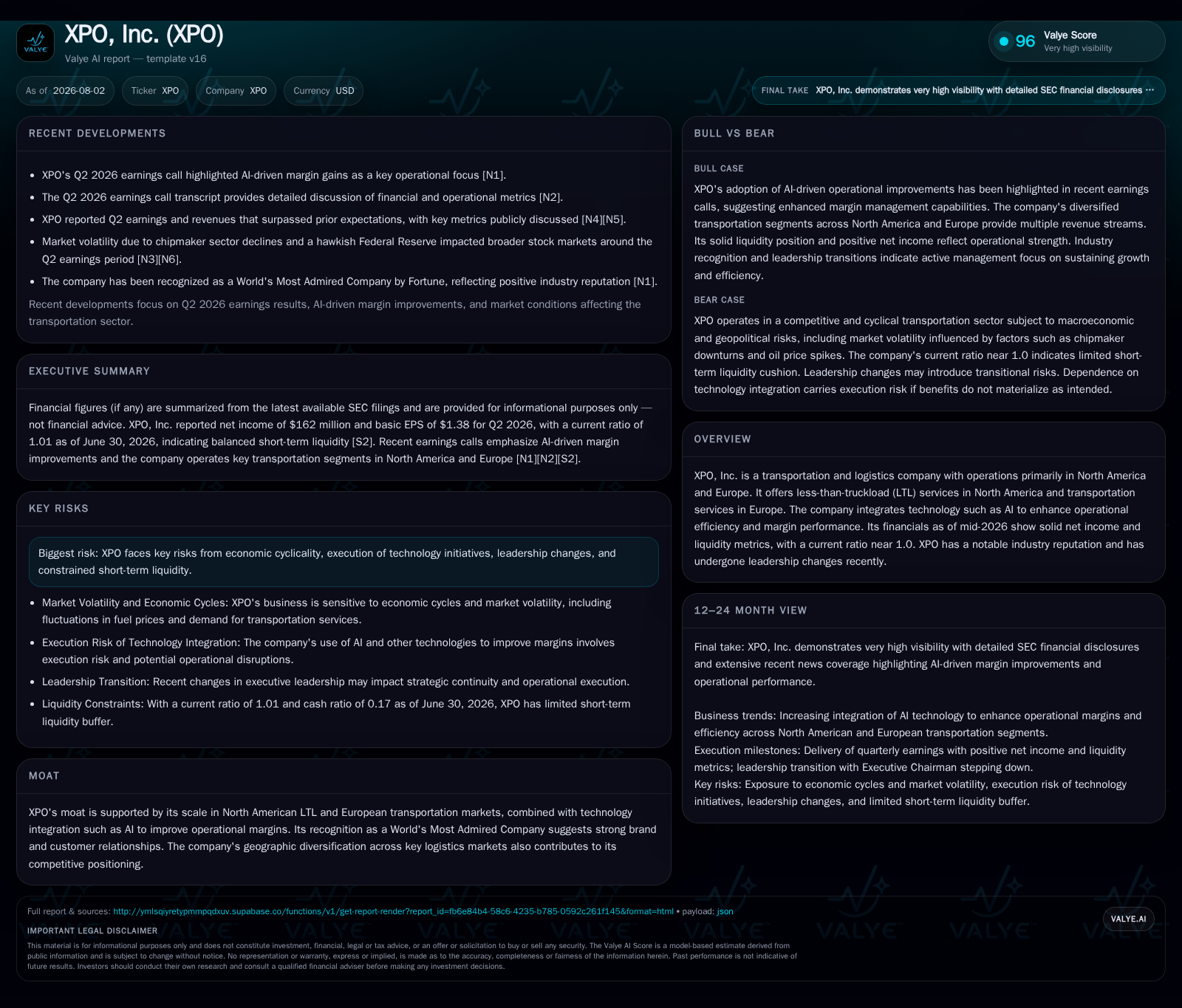
In its latest quarterly filing, XPO, Inc. highlights the growing contribution of artificial intelligence (AI) to its linehaul and pickup-and-delivery operations, enhancing profitability and operational efficiency. The company’s North American less-than-truckload (LTL) segment benefits from critical geographic density and significant excess door capacity, positioning it for margin expansion as freight volumes rebound. Its pan-European transportation platform continues steady performance despite currency headwinds. Financially, XPO maintains a balanced liquidity position with a current ratio near 1.0 and has actively managed debt refinancings to optimize interest costs. Challenges include economic cyclicality, labor cost pressure, and execution risks on technology initiatives.
Recent Operating Update
XPO's second quarter of 2026 filings reveal deepening impacts from the company's ongoing investment in artificial intelligence (AI) across its North American Less-Than-Truckload (LTL) operations. The company processed roughly 16 billion pounds of freight traveling approximately 784 million miles during the quarter, keeping daily linehaul movement steady at about 2.5 million miles despite market volatility [S23]. New AI-powered linehaul models have been deployed to reduce empty miles—long considered a major inefficiency in trucking—boosting load factors and optimizing trailer utilization through real-time decision-making algorithms. These advances extend into pickup-and-delivery routing innovations and service center labor productivity analytics leveraging real-time data at XPO's broad network hubs [S2].
Meanwhile, XPO’s European Transportation segment registered an approximate 11% revenue increase on a reported basis during Q1 2026; however, these gains were neutralized when adjusting for foreign currency fluctuations that positively skewed nominal growth figures—essentially signaling flat operational organic growth amid persistent macroeconomic uncertainties within Europe. The company maintains leadership positions across key geographies with differentiated offerings spanning full truckload brokerage to last-mile delivery solutions that provide some insulation from competitive pressures but remain subject to regional regulatory conditions and trade barriers impacting cross-border logistics efficiency [S10], [S17].
Business Model Nuances
XPO operates principally across two reportable segments: North American Less-Than-Truckload (LTL) and European Transportation services. The North American LTL business commands roughly a 9% estimated share of the $52 billion U.S. LTL market as of 2025—a notable scale advantage that supports extensive geographic coverage reaching approximately 99% of U.S. ZIP codes plus cross-border reach into Mexico, Canada, and the Caribbean [S14]. This dense network framework facilitates day-definite service commitments prized by shippers managing complex supply chains demanding predictable transit times.
Revenue arises primarily from transportation fees charged per shipment or by weight/distance metrics within contractual or spot arrangements with over 38,000 active shippers serviced through around 600 facilities spanning multiple countries [S2]. Pricing mechanics blend base charges supplemented by fuel surcharges indexed to prevailing diesel costs—fuel surcharge revenue rose notably consistent with inflationary pressures observed across transport services [S16]. The monetization strategy is enhanced through proprietary technology platforms that imbue route optimization and real-time labor management capabilities driving operational efficiencies.
The European Transportation cluster adds diversification benefits via specialized solutions tailored for consumer goods, trade industries, and industrial sectors with offerings ranging from dedicated truckload fleets to warehousing and multimodal freight forwarding solutions leveraging deep local market access in high-density areas like France, Iberia (Spain/Portugal), Germany, Italy, Scandinavia, Belgium/Netherlands/Luxembourg (Benelux), Switzerland, Austria/Central Europe/Balkans regions—allowing flexible response to shifting trade patterns within EU regulatory frameworks.
A notable underpinning competitive strength is XPO’s vertical integration components: its ownership of trailer manufacturing operations assures equipment availability reducing reliance on third-party suppliers amidst industry-wide capacity shortages—a critical advantage during cyclical capacity contractions—and its investment in commercial truck driver training programs provides workforce pipeline control mitigating tight labor markets commonly experienced across both continents [S14], [S17].
Cash flow management benefits from trade receivables securitization and factoring programs in Europe mitigating the longer customer payment cycles typical of B2B freight contracts thus improving working capital fluidity under volatile payment conditions while preserving operational funding flexibility [S2]
Industry Structure & Competitive Positioning
The LTL sector is characterized by significant fixed-cost leverage due to heavy investments in terminal infrastructure, fleet assets, technology platforms, and workforce necessary to sustain dense ZIP code coverage delivering high-frequency shipments reliably. XPO's scale—serving tens of thousands of shippers—and strategic excess capacity built into its door network (~30% above current usage) furnishes it an ability to capture profitable share as demand recovers post-freight recession phases witnessed since early pandemic disruptions[S14], even as competitors struggle with constrained fleets or limited footprint expansion.[
AI integration distinguishes XPO by optimizing linehaul mileage and dock operations faster than conventional planning methods increasingly used by peers lacking comparable data analytics sophistication or proprietary platforms such as FedEx Freight or Old Dominion Freight Line whose networks emphasize different geographic or service specialization.[
In Europe’s fragmented logistics landscape where multi-modal expertise is essential for competitive advantage given regulatory intricacies around cabotage rules or customs compliance post-Brexit exposure among others—XPO’s pan-European platform serves as a barrier to entry blocking smaller niche operators subject to inefficiencies or regulatory penalties.[S17]
Yet these markets face persistent risks: fuel price volatility affects operating margins given heavy diesel dependence; labor shortages elevate hourly wage rates squeezing profitability unless productivity gains offset rising costs; cross-border regulations can abruptly reshape tariff or transit procedures complicating route planning overheads; pricing power remains sensitive during contractionary economic cycles suppressing freight volumes globally [S1]
Growth Drivers
Growth prospects hinge largely on favorable structural trends as freight complexity rises globally:
- E-commerce proliferation drives greater parcelization feeding higher volume but potentially lower average shipment weights necessitating enhanced efficiency savings via route optimization AI technology.
- International trade velocity increases stimulate demand for integrated contract logistics solutions spanning warehousing through last mile enhancements boosting revenue mix quality.
- Outsourcing logistics decisions toward third-party providers bolsters contract longevity supporting recurring revenue streams beyond transactional spot market exposure.
- Investments targeting network densification expand customer reach within key corridors elevating market penetration potential while improving marginal cost performance.
- Regulatory shifts incentivizing efficient transportation modes could augment modal shift trends favoring LTL relative to full truckload or parcel segments under emission compliance costs escalation scenarios.
XPO’s commitment to technology innovation fortifies these drivers: newly introduced AI-based linehaul modeling directly contributes measurable margin uplift indicated during Q2 deployments; pilot routing advancements further enable service differentiation capturing incremental smaller-lot demands [S1]
Risks & Watchpoints
Several contingencies warrant monitoring:
- Economic cyclicality remains perhaps the most significant headwind: downturns reduce freight demand compressing load factors directly hitting margins.
- Labor dynamics create volatility: tight driver markets increase wage inflation risk while potentially restricting service quality if recruitment/training fall short despite company-run schools reducing but not eliminating scarcity exposure.[
- Execution risk exists for new technology initiatives where project delays or adoption challenges could delay anticipated productivity improvements undermining profitability targets.
- Cross-border regulatory environments may tighten unpredictably impacting both operating costs associated with tariffs/customs processes or imposing compliance complexities potentially increasing transit times eroding customer satisfaction levels.
- Debt load although actively managed remains material: maintaining covenant compliance during downturns requires sustained free cash flow generation with potential refinancing risks despite recent tranche extensions.
What To Watch Next
Key indicators will be:
- Further measurement of incremental margins attributable specifically to AI-powered operational improvements enabling clearer attribution of tech spend ROI.
- Trends in shipment volume changes especially tonnage vs. shipment count reflecting e-commerce normalization versus broader industrial freight demand cycles.
- Expansion or contraction patterns in door counts offering signals on capacity utilization trajectories aligned with demand forecasts.
- Progress updates on debt repayment schedules versus free cash flow reflecting financial flexibility improvements or capital allocation shifts including share repurchases announced recently.[S25]
- European segment operating margin trends adjusted for currency lasting effects providing insight into competitive positioning amid ongoing geopolitical trade uncertainties.
Financial Profile Discussion
As of June 30, 2026, XPO held $298 million in cash and equivalents against current liabilities approximating $1.79 billion yielding a current ratio close to parity at around 1.01—a standard liquidity benchmark signaling prudent working capital management given capital intensity inherent to logistics operations [F1], [S2]. The company's revolving credit facility remains robust with about $600 million available against a $600 million commitment maturing April 2030 providing substantial liquidity runway absent material disruptions.[S2]
This balanced financial profile underscores the importance of managing cyclical risks prudently without sacrificing scale expansion nor innovation investments that ultimately fortify long-term franchise value creation potential.
This analysis leverages data from XPO’s latest quarterly SEC filings combined with industry context relevant to transportation logistics services focusing on less-than-truckload networks and European integrated transport platforms. It offers an evaluative perspective aimed at understanding reported operational shifts within their broader strategic and industry dynamics without providing investment advice.
Disclaimer: This is research-only, informational analysis and not investment advice. It may include AI-generated interpretation and general industry context. Always verify important details using primary sources.

Comments