
Supernus Pharmaceuticals Advances CNS Portfolio and Merger Strategy with Robust Q2 2026 Execution
Strong Q2 performance supported by Sage acquisition integration and announced merger with Indivior reshapes Supernus’ CNS biopharma positioning.
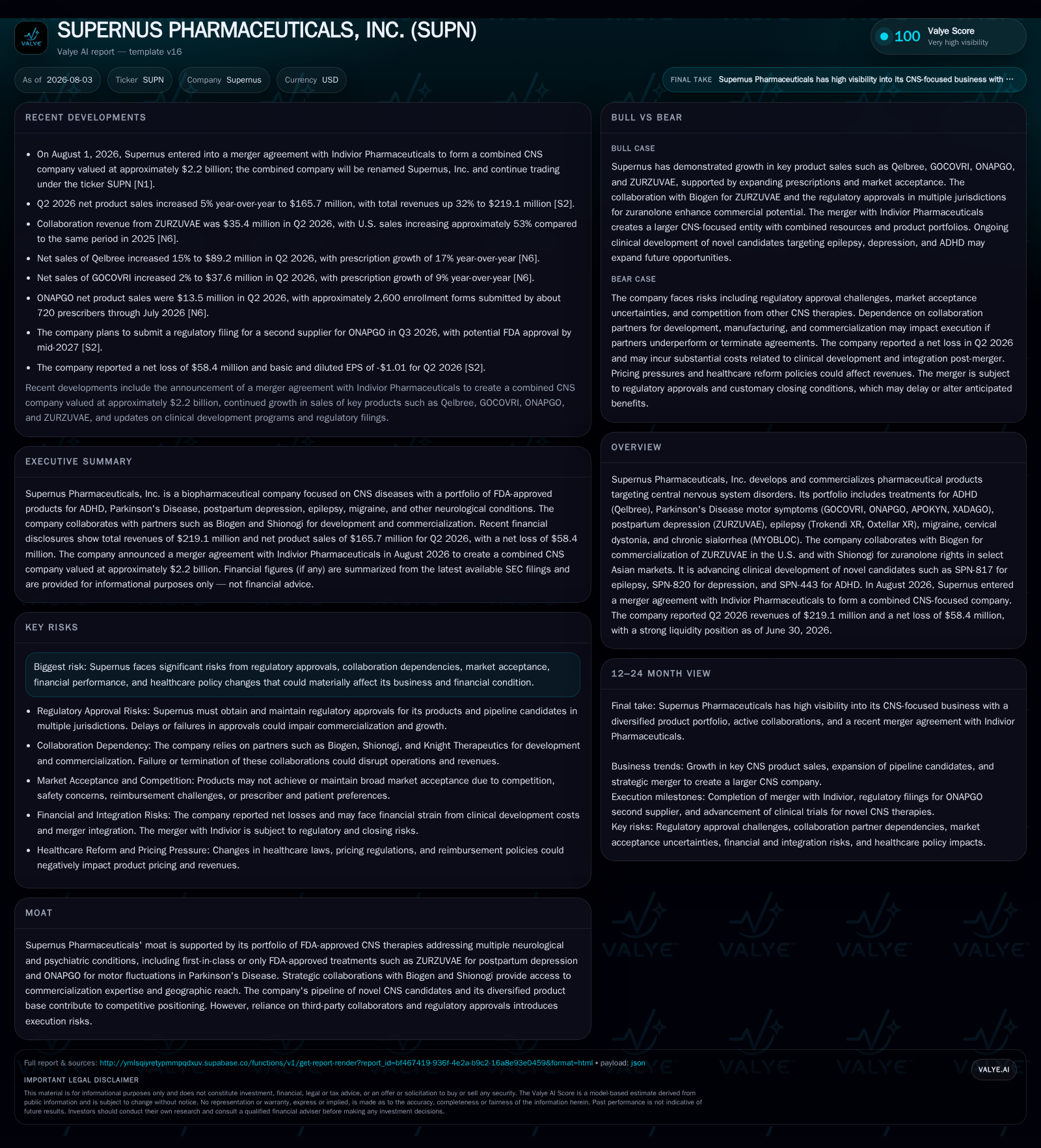
Supernus Pharmaceuticals reported Q2 2026 revenues of $219.1 million, driven largely by collaboration revenue from its Sage Therapeutics acquisition and robust royalty income streams. The company announced a definitive all-stock merger agreement with Indivior Pharmaceuticals to form a leading CNS-focused biopharma entity. While net losses increased due to intangible asset impairments and R&D spending, Supernus maintains strong liquidity and a diversified neuroscience portfolio spanning ADHD, Parkinson’s Disease, postpartum depression, epilepsy, and other CNS disorders. Execution risks remain around regulatory approvals and collaborator dependencies, but pipeline assets and strategic partnerships underpin growth prospects.
Recent Operating Update: Q2 2026 Performance and Strategic Merger Announcement
However, these top-line gains coincided with an operating environment marked by a net loss of $58.4 million in Q2 (annualized net loss details available through 2025 filings) [N3], primarily attributable to a $54.9 million intangible asset impairment charge linked to APOKYN—an asset previously licensed under the Britannia Supply Agreement—and increased amortization expense related to ZURZUVAE's intangible assets [S2]. The impairment suggests mounting challenges in certain portfolio segments that require alignment or potential restructuring. Additionally, elevated R&D investments emphasize ongoing commitment to advancing early-stage CNS candidates such as SPN-817 for epilepsy and SPN-820 for depression [S2].
On August 1, 2026, Supernus further reshaped its strategic outlook through execution of a definitive merger agreement with Indivior Pharmaceuticals in an all-stock transaction positioned as a merger of equals [S11][S12]. This consolidation aims to create a larger CNS-focused specialty pharmaceutical entity—combining complementary product portfolios, pipeline candidates, and commercialization expertise—to improve scale economies and accelerate innovation timelines within the highly regulated CNS biopharmaceutical sector [N6].
Business Model: Diverse CNS Portfolio Bridging Commercial Products and Novel Pipelines
Supernus operates predominantly in mid-to-late stages of the CNS pharmaceutical value chain: it commercializes FDA-approved therapies while actively developing novel drug candidates addressing unmet neurological and psychiatric needs [S1][S2]. Its approved therapies span multiple indications including ADHD (Qelbree), Parkinson’s Disease motor symptoms (GOCOVRI, ONAPGO, APOKYN via Britannia agreement), postpartum depression (ZURZUVAE acquired via Sage), epilepsy (Trokendi XR, Oxtellar XR), migraine, cervical dystonia, and chronic sialorrhea (MYOBLOC) [S1][S2]. This breadth diversifies revenue sources but also introduces complexity managing various regulatory approvals and payor systems across indications.
Monetization relies on net product sales plus collaboration revenue—primarily from Biogen's commercialization efforts for ZURZUVAE in the U.S., which constitute approximately half of the reported collaborative revenues—alongside royalties from licensees such as Shionogi for rights in select Asian markets [S1][S2]. Revenue drivers include product volumes influenced by clinical adoption rates; pricing dynamics governed by healthcare reimbursement landscapes; contract structures ensuring royalty streams; and milestone payments associated with pipeline advancement or geographic expansion [S1]. These factors collectively affect topline stability and gross margin profiles intrinsic to CNS therapeutics companies.
Strategic partnerships are integral: collaborations extend geographic reach beyond Supernus' direct sales capabilities while leveraging partner marketing infrastructure—critical given the complex payer environments characteristic of CNS drugs with varying coverage policies [S1]. Manufacturing is outsourced through CMOs under supply agreements like the Britannia contract governing APOKYN/ONAPGO production; however, these arrangements carry risks regarding supply continuity should termination or disputes arise without technology transfer support [S1].
Industry Structure and Competitive Positioning
Supernus operates within the biopharmaceutical subsector targeting central nervous system disorders—a domain characterized by chronic therapy requirements, stringent FDA regulations demanding extensive clinical trials often lasting years, fluctuating healthcare reimbursements sensitive to policy changes, and rapid innovation cycles demanding continuous pipeline renewal. Peer companies engaging similarly include Biogen (notable collaborator), Sage Therapeutics pre-acquisition status (now internalized), Indivior Pharmaceuticals (merger partner), Sage Therapeutics’ previous standalone executives who maintain networks within CNS space, Amphastar Pharmaceuticals on specialty pharma distribution side, and Sage Therapeutics peers focused on neurology pipelines.
Competitive differentiation hinges on a multi-indication neuroscience portfolio containing first-in-class or only-FDA-approved agents such as ZURZUVAE in postpartum depression—the first oral PPD therapy—and ONAPGO addressing Parkinson’s disease motor fluctuations [S1][N3]. This exclusivity provides moderate pricing power but competitors challenge this edge as alternative therapies emerge through generics or improved formulations.
Reliance on third-party collaborators exposes Supernus to execution risks particularly if partners alter focus or prioritize resources elsewhere—a common industry pitfall noted explicitly under risk disclosures related to collaborator dependency [S1][S19]. Regulatory approval uncertainties further compound risk amid evolving FDA expectations influenced by advancing scientific standards or shifting enforcement emphasis on compliance matters embedded within healthcare reform laws [S1][S19].
Growth Drivers
Several mechanisms underpin Supernus’ growth outlook:
- Pipeline progression: Clinical advancement of candidates SPN-817 for epilepsy; SPN-820 targeting depression pathways; SPN-443 for ADHD complements existing products potentially expanding market share or indications [S2][S7]. Pipeline success would diversify revenue beyond current blockbusters.
- Strategic mergers: The recently announced all-stock merger with Indivior is designed to consolidate complementary portfolios within CNS specialty pharma space—offering cost synergies via combined R&D efforts alongside broader commercial footprint [S11][N6].
- Collaboration leverage: Ongoing partnerships enhance geographic expansion beyond U.S., exemplified by Shionogi rights expanding zuranolone presence into Asian markets; Biogen's U.S commercialization powers accelerate uptake and payer access for ZURZUVAE variants [S1][S2].
- Regulatory environment: Favorable FDA designations supporting fast-track or priority reviews could reduce time-to-market for novel therapies helping accelerate transition from developmental stage to revenue-generating status.
- Increased CNS disorder prevalence: Demographic trends signal sustained demand increases particularly in ADHD treatments across pediatric to adult populations; neurodegenerative diseases continue growing burden amplifying opportunities for therapies addressing Parkinson’s motor symptoms or sialorrhea management.
Risks and Constraints
Supernus faces pronounced challenges inherent in CNS biopharma:
- Regulatory approval risk: Clinical trial failures or delays especially impacting late-stage candidates can impair pipeline viability given lengthy development timelines.
- Collaboration dependencies: Termination or underperformance by key partners like Biogen or Shionogi could disrupt commercial flows or impede geographic market penetration; supply chain risk exists due to reliance on suppliers without guaranteed tech transfer assistance under current agreements [S1].
- Intangible asset impairment: The significant impairment charge against APOKYN’s intangible asset signals valuation risk rare but impactful warranting monitoring whether this portends broader failures to satisfy commercial expectations [S2].
- Healthcare reimbursement pressures: Pricing scrutiny by payors may compress margins especially as generic competition erodes exclusivity since products like Trokendi XR lost patent protection recently; XADAGO exclusivity also approaching expiration likely challenging near-term renewals [S1][N3].
- Milestone payment obligations: Contingent payments from acquisitions such as Sage Therapeutics add financial commitments linked directly to achievement hurdles which if unmet could strain liquidity [S23][S20].
- Litigation exposure: Past legal proceedings tied to acquired entities impose potential cost burdens distracting management resources affecting operational focus.
What To Watch Next
Key milestones shaping Supernus’ trajectory over coming quarters:
- Completion timing and regulatory approval progression of SPN pipeline candidates will provide crucial directional clarity on future growth prospects.
- Integration progress post-merger with Indivior: operational synergies realization levels alongside retention of key leadership teams will be pivotal.
- Quarterly updates on collaboration revenue streams from ZURZUVAE commercial efforts reflecting market penetration pace.
- Monitoring any new impairment charges or goodwill adjustments signaling asset revalorization pressures.
- Regulatory decisions impacting marketed products’ label expansions or generic challenges influencing life cycle agendas.
- Liquidity trends adjusting capital allocation towards R&D versus potential external debt issuance connected with merger financing necessities.
Financial Profile Discussion
As of June 30, 2026, Supernus held a robust liquidity position comprising approximately $180 million in cash and cash equivalents supplemented by roughly $192 million in marketable securities along with restricted cash totaling $1.45 million—collectively amounting to about $373.5 million in readily accessible funds supporting operational needs including R&D costs and milestone payments [S2][F1]. This solid cash base provides cushion amidst ongoing net loss periods driven largely by intangible amortization accelerations ($25.3 million in Q2 alone) linked principally to the newly acquired ZURZUVAE asset from Sage Therapeutics plus impairment charges affecting earnings volatility [S2].
Despite carrying minimal debt exposure following repayment activity completed earlier years per previous disclosures—the last reported total debt figure remains dated at around $23.2 million but effectively negligible relative to cash reserves considering net debt approximates negative $157 million—financial flexibility remains intact allowing continued investment into innovation pipelines without immediate refinancing pressure [F1]. However, contingent liabilities from milestone commitments tied chiefly to acquisitions present discrete capital demands requiring prudent cash flow management over medium horizon timelines [S23][S20].
Maintaining positive operating cash flow proved challenging versus prior comparable periods reflecting heightened expenses linked predominantly to R&D intensification alongside higher selling general administrative spend essential for commercial deployments including new product launches like ONAPGO approved early 2025 phase-in activities [S18]. Effective capital deployment balancing growth investments against incremental losses will remain critical considering sector-wide trend toward sustained high R&D spend ratios amid competitive innovation races.
This analysis synthesizes publicly available SEC filings as of August 3, 2026 () complemented by contemporaneous news sources () without providing investment advice. It aims solely at informed assessment of Supernus Pharmaceuticals’ operating developments within the context of the central nervous system biopharmaceutical industry landscape.
Disclaimer: This is research-only, informational analysis and not investment advice. It may include AI-generated interpretation and general industry context. Always verify important details using primary sources.

Comments