
Seaport Therapeutics Advances Clinical Program Amid Robust Financial Position
Latest quarterly results and operating developments underscore progress in Seaport Therapeutics’ clinical-stage biopharmaceutical agenda, supported by solid liquidity.
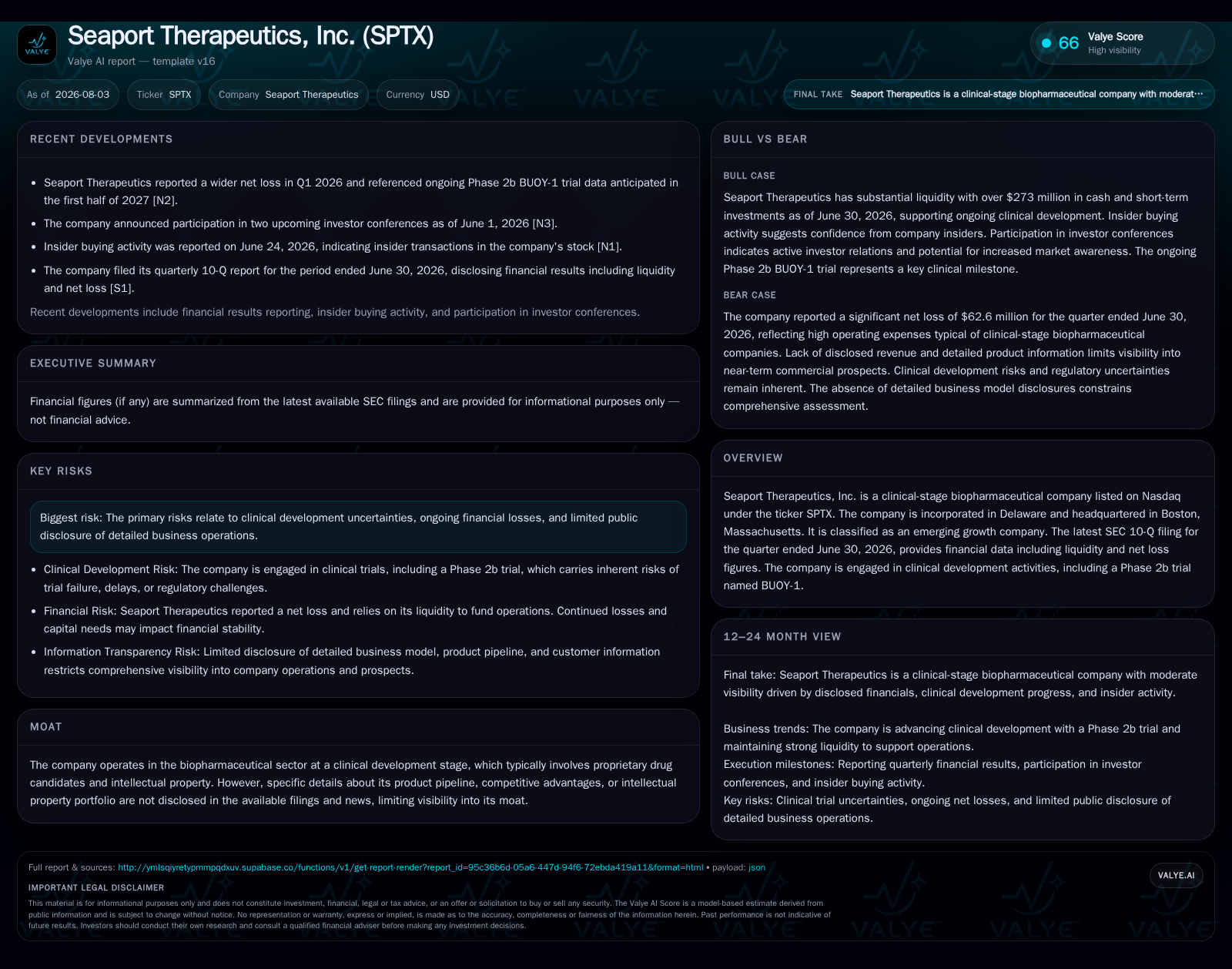
Seaport Therapeutics, a clinical-stage biopharmaceutical company, reported continued advancement of its Phase 2b trial BUOY-1 and maintaining strong financial health with a cash position exceeding $64 million as of June 2026. Despite ongoing net losses reflective of early-stage biotech norm, the company maintains a robust current ratio that suggests sufficient runway to support near-term clinical development activities. The absence of disclosed commercialization revenue shifts the focus to clinical milestones and regulatory progress as principal value drivers. Risks include typical clinical development uncertainties and reliance on capital markets for funding.
Recent Operating Update
Concurrent with clinical updates, Seaport's August 3, 2026, 8-K filing reaffirmed its emerging growth company status and reiterated the lack of product revenues, consistent with its startup-to-mid-cycle drug development profile [S3]. No new partnership agreements or licensing arrangements were announced in these filings, signaling a focus on internal R&D execution rather than external validation at this juncture.
Business Model Analysis
As a clinical-stage biopharmaceutical entity, Seaport’s revenue model currently hinges on milestone-driven value creation rather than sales or licensing income. The company funds operations predominantly through equity financing and potentially debt instruments until a product candidate reaches regulatory approval phases or commercialization opportunities emerge. This business archetype necessitates significant upfront investment in research and development activities encompassing preclinical studies through phased human trials.
The sole disclosed late-phase candidate is engaged in the BUOY-1 Phase 2b study—an inflection point that can validate mechanism of action and therapeutic efficacy compared to standard of care. Precision around enrollment pace and achieving safety/efficacy endpoints will serve as leading indicators for regulatory traction. Meanwhile, operational costs drive persistently negative earnings typical for this sector segment absent commercialization.
Limited disclosures on intellectual property strength or portfolio breadth constrain evaluation of Seaport’s moat; however, such intangible assets typically underpin competitive barriers if well-protected by patents. The absence of reported manufacturing scale-up initiatives suggests commercial readiness remains preliminary.
Industry Structure and Competitive Context
Seaport occupies a classic position within the early to mid-phases of the pharmaceutical value chain—a highly capital-intensive stage characterized by elevated development risk and uncertain regulatory timelines. Comparable peer groups include other emerging clinical-stage biotech companies progressing proprietary drug candidates through pivotal trials without current market-approved products.
Key differentiators within this space often derive from candidate molecule novelty, mechanism-related advantages versus existing therapies, trial design rigor (including adaptive endpoints), and engagement with regulatory authorities for accelerated pathways. In the absence of detailed competitor-specific data from disclosures, it is prudent to benchmark Seaport’s cash runway and trial advancement pace against typical industry averages where median Phase 2 durations range between one to two years depending on indication complexity.
Growth Drivers
The most immediate growth lever for Seaport remains successful execution and timely readouts from its BUOY-1 clinical study. Positive safety/tolerability profiles combined with clear efficacy signals could unlock subsequent Phase 3 initiation or strategic partnering discussions. Regulatory milestones—such as Investigational New Drug (IND) approvals or breakthrough therapy designations—would also enhance developmental momentum.
Complementary growth channels might emerge through expanding the therapeutic indication scope or leveraging platform technology advancements if applicable. Moreover, supplemental financing rounds inspired by encouraging data releases can extend cash runway enabling broader R&D investments.
Risks and Watchpoints
Seaport’s risk profile aligns closely with standard clinical-stage biotech challenges: unpredictable trial outcomes driven by patient response variability; prolonged enrollment timelines; potential adverse events impacting safety evaluations; and shifting regulatory landscape complexities.
Financially, despite having over $64 million in cash reserves as of mid-2026 [F1], the burn rate reflected in a substantial quarterly net loss underscores ongoing fundraising necessity beyond existing liquidity horizons absent partnering inflows. The risk of dilution or financing delays may influence operational continuity.
Absence of reported intellectual property disputes reduces immediate litigation concerns; however, patent validity remains a long-term watchpoint once commercial pathways develop.
Monitoring patient recruitment metrics and interim data releases within BUOY-1 will provide crucial real-time cues about progression risks. Additionally, market acceptance post-approval depends on differentiation from entrenched therapies—a factor not assessable given limited disclosure.
What to Watch Next
Key upcoming milestones include detailed BUOY-1 interim analyses that could validate primary endpoints or stimulate strategic collaborations. Regulators’ feedback cycles post-data submission will frame approval feasibility timing landscapes.
On financing fronts, any announcements concerning capital raises or partnership agreements would bear heavily on forward operational stability. Management commentary on manufacturing plans or expanded pipeline programs would further indicate maturation toward commercial readiness.
Investor attention should track insider trading patterns cautiously alongside quarterly updates for changes reflecting insider confidence levels [N1].
Financial Profile Discussion
Disclaimer: This is research-only, informational analysis and not investment advice. It may include AI-generated interpretation and general industry context. Always verify important details using primary sources.

Comments