
Krystal Biotech Advances Gene Therapy Commercialization and Pipeline Development in Q2 2026
Q2 results reflect growing commercial traction for VYJUVEK and ongoing investments in gene therapy platform pipeline.
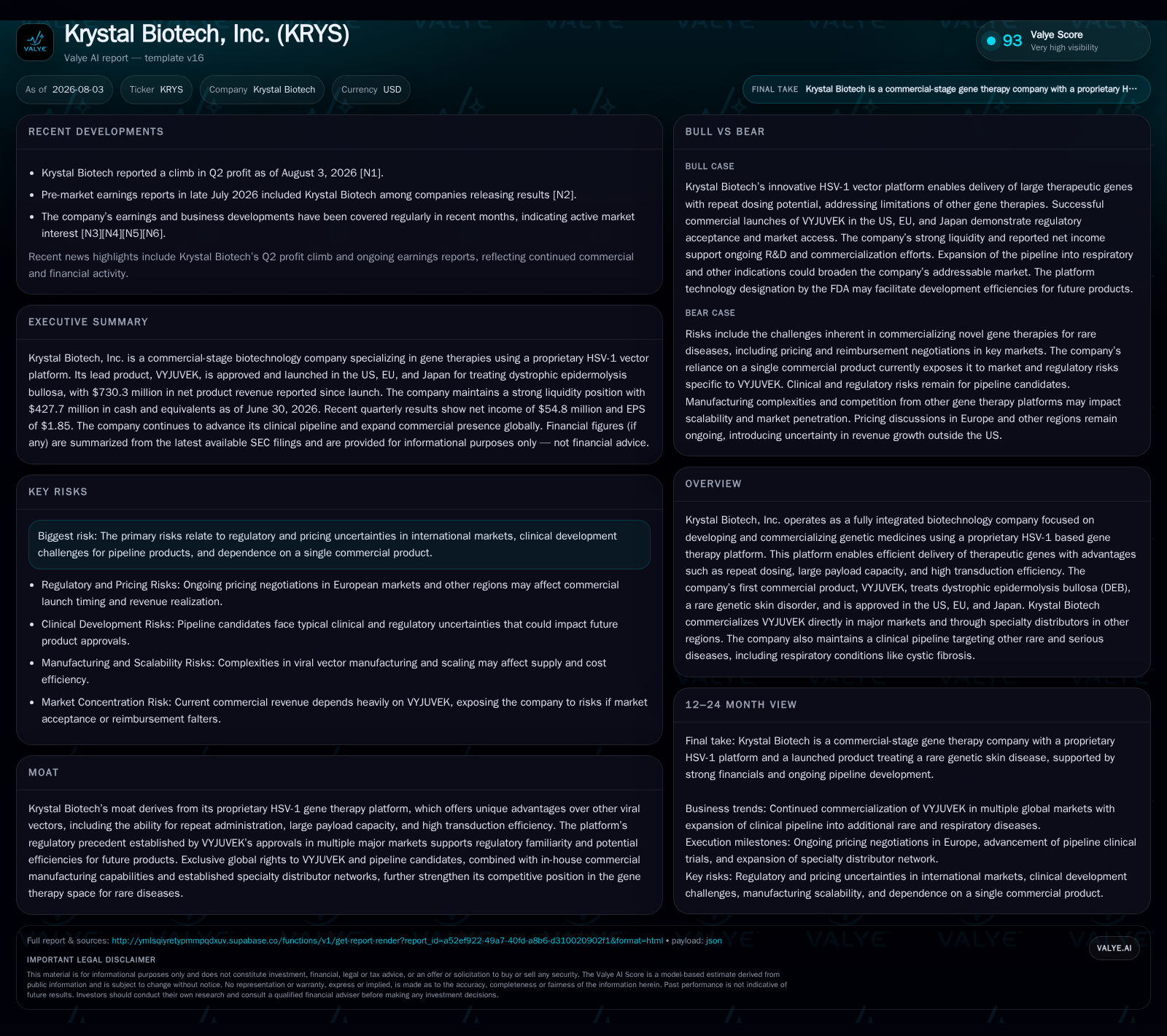
Krystal Biotech reported continued progress with its first commercial product, VYJUVEK, demonstrating expanding market launches and solidifying manufacturing capabilities. The company’s proprietary HSV-1 gene therapy platform underpins a pipeline targeting rare genetic diseases beyond dystrophic epidermolysis bullosa (DEB). The latest quarterly filing highlights sustained R&D focus and expanding specialty distribution, while financials show a strong liquidity position supporting clinical advancement.
Q2 2026 Operating Update Highlights
Krystal Biotech’s Q2 2026 filing dated August 3 confirms steady progress in the commercialization of VYJUVEK as well as sustained investment in its clinical pipeline [S2]. VYJUVEK, an HSV-1 vector–based gene therapy targeting dystrophic epidermolysis bullosa (DEB), continues its phased launch following multi-region regulatory approvals including the US, EU, and Japan [S1]. The company combines direct commercialization efforts in larger markets with specialty distributor partnerships in others to effectively reach the ultra-rare patient population [S1].
The report emphasizes the strategic importance of Krystal’s proprietary HSV-1 platform technology. This platform enables repeat dosing by leveraging HSV-1’s natural immune evasion properties—addressing a common limitation faced by alternative viral vectors that elicit neutralizing antibodies after one administration. Additionally, the platform supports delivery of larger transgene payloads essential for durable therapeutic protein expression in target cells [S1]. These attributes underpin Krystal’s competitive positioning within gene therapies for rare diseases requiring localized gene delivery.
Business Model Insights
Krystal operates as a fully integrated biotechnology company managing R&D through commercial-scale CGMP manufacturing to global product distribution. Unlike many peers that outsource manufacturing or focus solely on early development stages, Krystal owns dedicated facilities such as its ANCORIS plant in the US [S1]. This vertical integration improves quality control, reduces lead times critical for patient treatment continuity, lowers per-dose costs over time, and strengthens intellectual property protection.
Revenue generation primarily stems from sales of VYJUVEK to healthcare providers treating DEB patients [S4]. DEB is a rare monogenic skin disorder characterized by mutations impairing type VII collagen anchoring fibrils—a condition with significant unmet medical need. Orphan drug designation supports premium pricing; however, revenue growth depends on physician adoption rates, expanded patient diagnosis worldwide, payor coverage decisions, and geographic market expansion
Commercial channels include direct sales teams focused on specialist dermatologists complemented by partnerships with specialty pharmaceutical distributors abroad. This hybrid approach balances cost efficiency with effective market penetration across diverse healthcare systems.
Industry Positioning and Competitive Landscape
Within the biotechnology sector, Krystal competes among gene therapy developers focused on rare genetic diseases. Comparable players include bluebird bio (lentiviral platforms), uniQure (HSV-1 based vectors), and Regenxbio (AAV vectors) specializing in tissue-targeted gene delivery.
Krystal’s differentiation arises from the HSV-1 vector’s ability to enable repeat administration without eliciting strong neutralizing immune responses common to AAV-based therapies. Its immune evasive mechanism combined with larger payload capacity offers operational advantages particularly relevant for cutaneous disorders requiring sustained local expression [S1]. Peers using AAV vectors often face constraints on payload size or immunogenicity that limit dosing frequency or indication breadth.
Regulatory achievements such as FDA approval alongside EMA inspections resulting in European GMP certification demonstrate Krystal’s manufacturing credibility and scalability [S1]. Patent protection covering composition of matter and methods of use extends into major markets through at least 2036, providing a robust barrier against generic competition [S1].
Growth Drivers: Pipeline Progression & Market Expansion
Key growth catalysts include expanded commercial penetration of VYJUVEK supported by increased awareness and diagnosis of DEB globally, coupled with clinical advancement of pipeline candidates targeting additional rare diseases such as cystic fibrosis [S1]. Successful progression beyond DEB indications will reduce single-product dependency—a critical risk factor for emerging biotech firms.
Scale-up at the ANCORIS manufacturing facility remains central to meeting anticipated demand increases from broader indication launches or new products. Enhancing production capacity while maintaining quality is vital to preserving margins given fixed costs inherent in CGMP biologics manufacturing.
Regulatory milestones such as new IND filings or marketing applications outside current geographies will inform future growth prospects. Expanding specialty distributor networks is also prioritized to access fragmented patient populations internationally [S1].
Risks and Watchpoints
Operational risks include potential delays or failures in clinical development typical for novel gene therapies that could impact timelines or regulatory approvals [S4]. Pricing pressures from public payors aiming to contain healthcare costs may challenge reimbursement levels despite orphan drug status. Dependence on a single marketed product introduces volatility until pipeline diversification matures.
Manufacturing scale-up presents challenges involving quality control; disruptions could affect supply continuity given limited alternative sources due to proprietary technology [S1]. Intellectual property disputes remain possible within a competitive viral vector landscape.
Compliance with complex healthcare laws—including anti-kickback statutes and data privacy regulations across multiple jurisdictions—increases administrative burden and legal risk if not properly managed [S24][S23].
What to Monitor Going Forward
Investors should watch for regulatory progress on late-stage pipeline assets aimed at non-DEB indications. Patient adoption metrics for VYJUVEK outside North America will indicate commercial scalability. Manufacturing utilization rates will reveal readiness for volume expansion.
Financial disclosure trends around net product revenues specific to VYJUVEK sales volumes and R&D spending allocation between commercialization and innovation initiatives will provide insight into capital deployment priorities. Announcements regarding new specialty distributor agreements or partnerships will signal enhanced market access.
Management commentary on payer negotiations during earnings calls will clarify pharmacoeconomic positioning crucial for sustainable pricing models. Monitoring competitor developments in alternative viral vector technologies will help assess evolving competitive threats.
Financial Profile Discussion
As of June 30, 2026, Krystal Biotech held approximately $427.7 million in cash and equivalents against nominal total debt near $4.14 million based on prior period estimates [F1]. Current assets stood at roughly $1.06 billion compared to current liabilities of about $127 million, yielding a strong current ratio above 8x—reflective of substantial short-term liquidity supporting operational needs [F1].
Operating income last reported at $161 million (year-end December 31, 2025) alongside net income near $205 million demonstrates improving profitability aligned with commercialization scale-up [F1]. Capital expenditures have been directed toward CGMP facility enhancements balancing long-term capacity building with disciplined SG&A management relative to revenue growth.
This financial strength provides an ample runway for ongoing R&D investments including clinical trials without immediate capital raising requirements barring unforeseen strategic initiatives. Maintaining this position is critical given biotechnology's long development cycles coupled with evolving reimbursement environments.
This synthesis integrates recent SEC disclosures through Q2 2026 with sector context tailored for stakeholders evaluating Krystal Biotech’s advancement in gene therapy commercialization addressing rare diseases. It aims to clarify operating dynamics without offering investment guidance.
Disclaimer: This is research-only, informational analysis and not investment advice. It may include AI-generated interpretation and general industry context. Always verify important details using primary sources.

Comments