
Grand Canyon Education Leverages Integrated Services Amid Customer Concentration Risks
Grand Canyon Education’s stable revenue base from its dominant university partner is complemented by integrated service offerings that support student retention and cost reduction but faces risks from high customer concentration and regulatory pressures.
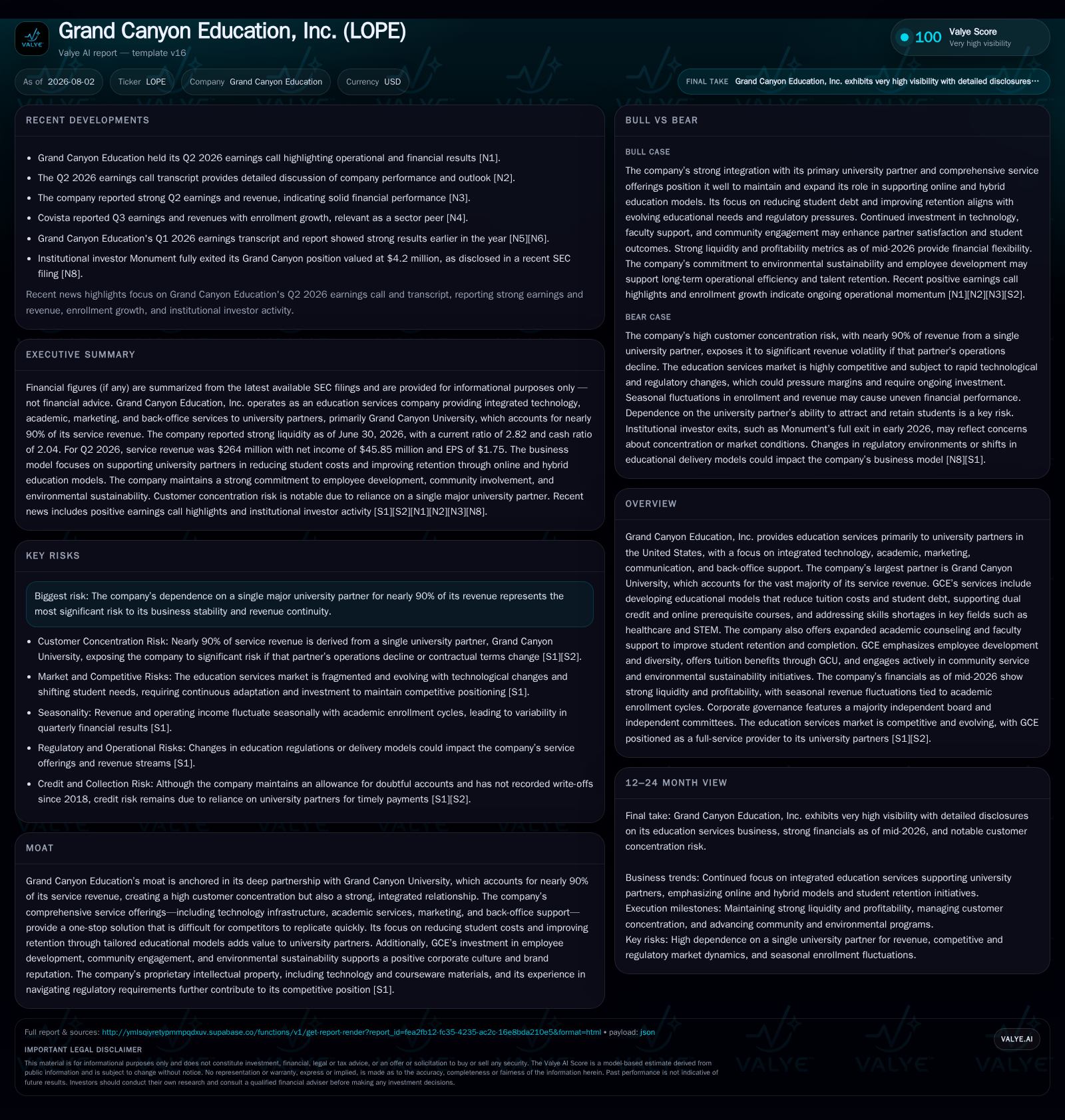
Grand Canyon Education, Inc. (LOPE) reported solid revenue and net income growth in Q2 2026 driven primarily by its longstanding service agreements with Grand Canyon University (GCU), which accounts for nearly 90% of company revenue. The company’s business model focuses on providing a comprehensive suite of technology, academic, marketing, and back-office services linked to tuition revenue share agreements. This integration supports student retention and affordability initiatives, particularly in areas addressing skills shortages such as healthcare and STEM. However, the heavy reliance on a single major partner poses concentration risk, while evolving regulatory compliance requirements for third-party servicers introduce operational challenges. Future monitoring should focus on enrollment trends at GCU, contract renewal dynamics, and technological platform adoption metrics.
Latest Quarterly Operating Update Reflecting Partner Dependency Dynamics
Grand Canyon Education's Q2 2026 filing highlights sustained top-line growth primarily driven by its dominant partnership with Grand Canyon University (GCU). The company's education services segment generates revenues under service agreements where it provides integrated technology, academic support, marketing, communication, and back-office services to university partners in exchange for a percentage of tuition and fee revenue [S2]. This high customer concentration is underscored by Grand Canyon University accounting for nearly 90% of total service revenue [S1]. In the six months ended June 30, 2026, net income increased to $121.2 million compared with $113.2 million in the prior-year period [S2], indicating operational leverage benefits within fixed-cost structures typical of service contracts tied to tuition flows.
The recurring pattern of enrollment seasonality affects quarterly results — lower summer enrollments reduce overall revenues but are partially offset during traditional fall terms [S17]. Despite these fluctuations, GCE maintained healthy profitability margins due to comprehensive control over multiple service functions bundled in long-term agreements. The company's recent event filing confirms no substantive alterations in contract terms or new major partner additions during the quarter but reiterates strategic emphasis on strengthening existing agreements [S3].
Integrated Service Platform Drives Student Success and Client Value Creation
Grand Canyon Education operates as a third-party servicer delivering an end-to-end suite of services encompassing educational technology infrastructure facilitating online program delivery; academic counseling designed to improve retention and completion rates; curriculum development aligned especially with dual credit programs that shorten degree timelines; faculty support; as well as marketing-driven enrollment management [S1]. This integrated platform enables GCU not only to optimize tuition revenue but also to engage novel educational models that aim explicitly to reduce overall student tuition costs and indebtedness — a differentiator within an industry historically critiqued for high tuition burdens.
Moreover, GCE's commitment to employee development—exemplified by its generous tuition benefits offering full tuition waivers for employees enrolling at GCU after three months' service—and active community engagement create an internal culture focus that supports quality service delivery [S1]. These employee development programs likely enhance operational effectiveness in areas such as academic counseling that directly impact key performance indicators like student retention.
This broad scope contrasts with traditional online program management firms (OPMs) which may focus more narrowly on marketing or course delivery outsourcing. By serving as a comprehensive operational partner embedded within university administration systems, GCE creates switching costs that reinforce customer stickiness.
Competitive Landscape Shaped by Strategic University Partnerships and Outsourcing Trends
The education services sector includes various peers such as historical online program management companies EmbanetCompass and Wiley Education Services as well as prominent providers like 2U offering modular outsourcing solutions. Grand Canyon Education distinguishes itself via a tightly integrated service stack combined with an exclusive emphasis on its marquee partner institution [S1]. Its competitors face pressures both from universities opting for in-house solutions to cut outsourcing costs as well as from other third-party specialists focusing on discrete services.
Regulatory frameworks governing third-party servicers impose ongoing compliance demands including ED-mandated audits under Title IV regulations [S1]. Failure to comply can lead to financial or reputational penalties affecting contracts. Such regulatory risk shapes negotiation dynamics with partner institutions potentially limiting pricing power amid rising competition. However, GCE’s established track record managing regulatory complexity offers some insulation compared to newer entrants lacking equivalent scale or experience.
Growth Catalysts in Online Education Expansion and Skills Gap Programming
Demand patterns favor providers like GCE who enable universities to accelerate adoption of hybrid learning models responding to evolving student preferences post-pandemic. The company’s engagement supporting dual credit prerequisite courses reduces time-to-degree completion—a material incentive for cost-conscious students seeking affordability through shortened educational paths [S1].
Additionally, GCE’s curricular efforts targeting critical skills shortages—particularly healthcare professions, STEM disciplines, and education sectors—align with national workforce development priorities enhancing partner relevance [S1]. The integration of marketing budgets employing data science-driven lead acquisition satisfies growing institutional needs for efficient enrollment funnel management [S2].
This positioning could enable incremental contract expansions or modest diversification into other universities over time; however, no material new partnerships were announced recently [S3]. Continued investment in proprietary educational technology platforms aimed at improving faculty support quality further reinforces competitive moats derived from content development intellectual property vested within the partnership ecosystem.
Customer Concentration Risk Remains Principal Vulnerability Amid Regulatory Demand
While the deep alignment with Grand Canyon University fosters consistent cash flows anchored to tuition share economics, it simultaneously concentrates financial exposure significantly [S1][S2]. Disruption risks linked to funding changes at GCU or termination/renegotiation of long-term service agreements could materially impair revenue predictability
Moreover, escalating regulatory scrutiny—specifically audits required for third-party servicers managing federal aid programs—introduces compliance costs potentially limiting earnings upside or complicating contract renewals [S1]. Any deterioration in regulatory compliance posture may translate into reputational damage affecting not only the company but also its university partners.
Price compression risks exist if competition intensifies among service providers bidding for university contracts or if institutions develop internal capabilities reducing dependency on external vendors [S1]. Monitoring renewal cycles closely alongside state/federal policy shifts impacting higher education funding is essential for assessing this vulnerability moving forward.
"What to Monitor": Enrollment Trends, Compliance Outcomes, Contract Renewals, Technology Adoption Rates
Key near-term indicators include tracking enrollment growth at Grand Canyon University — given its outsized effect on revenue under the tuition-linked fee model [S2][N1]. Improved student retention and completion metrics reflected through academic counseling efficacy would bolster contract defensibility.
Regulatory compliance audit outcomes will serve as critical barometers of operating risk management capabilities ensuring continued eligibility under Title IV third-party servicer requirements [S1][N2]. Announcements regarding amendments or extensions of master services agreements would materially influence concentration concerns.
Progress in advancing technology platforms—such as enhanced online courseware tools supporting faculty productivity or new analytics capabilities—would signal potential margin gains via operational efficiencies while supporting enrollment growth through superior student engagement mechanisms.
Financial Profile Discussion Focused on Liquidity Strength, Cash Flow Robustness, and Debt Leverage
As of June 30, 2026, Grand Canyon Education holds approximately $171 million in cash and cash equivalents against current liabilities near $118 million yielding a robust current ratio of about 2.82 — indicative of strong short-term liquidity able to cover obligations comfortably without refinancing pressure [F1][S2]
Operating activities generated solid cash flows consistent with net income increases; adjusted EBITDA remains a focal metric reflecting recurring profitability before non-cash charges such as share-based compensation totaling roughly $7 million over six months ending June 2026 [S2]. Capital expenditures are focused chiefly on property improvements and technology platform development capitalized per accounting standards implying ongoing reinvestment enhancing competitive differentiation [S2].
Total debt figures last reported at approximately $108 million (year-end 2020) suggest moderate leverage relative to liquidity positions supported by sustained free cash flow generation capacity mitigating refinancing risk in current macroeconomic conditions [F1]. This conservative financial posture facilitates strategic flexibility within a capital-intensive industry segment balancing content investments alongside human capital development commitments.
Disclaimer: This analysis is provided for informational purposes only without any investment research view or advice. It is based strictly on publicly available filings dated through July 30, 2026 ([S1], [S2], [S3]) supplemented by validated financial snapshots ([F1]) and sector knowledge applied qualitatively. Readers should conduct their own due diligence before making any decisions related to Grand Canyon Education or its peers.
Disclaimer: This is research-only, informational analysis and not investment advice. It may include AI-generated interpretation and general industry context. Always verify important details using primary sources.

Comments