
Agree Realty's Q2 2026 Operating Update Highlights Rental Income Stability and Strategic Capital Deployment
Agree Realty’s latest quarterly filing reveals sustained rental income growth supported by disciplined lease management, a diversified tenant base, and prudent capital allocation.
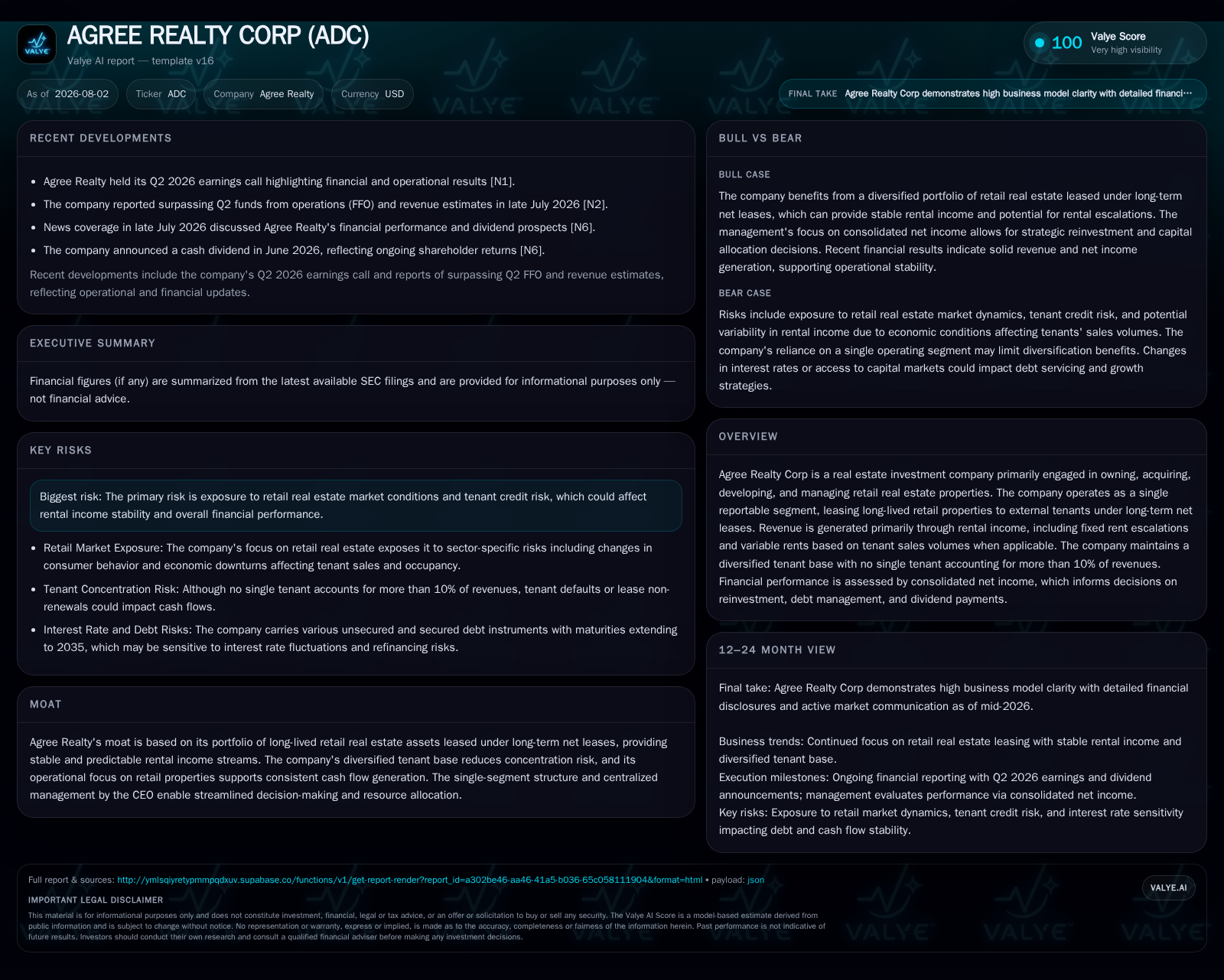
Agree Realty Corp reported robust net income growth for the first half of 2026, driven by same-store net operating income expansion and stable occupancy supported by long-term net leases with fixed escalations and sales-based rent components. The company’s tenant diversification strategy limits concentration risk, while capital deployment balances accretive acquisitions, selective development activity, and consistent dividend payments. Despite retail sector headwinds and interest rate pressures, Agree Realty maintains a conservative financial profile with manageable near-term debt maturities and liquidity buffers that underpin operational resilience relative to retail REIT peers.
Q2 2026 Operating Update: Strong Net Income Growth Anchored by Stable Rental Income
Agree Realty Corporation’s second quarter results demonstrate resilience in rental income generation amid ongoing retail sector challenges. Net income for the six months ended June 30, 2026 reached $117 million, up from $96.5 million in the comparable prior-year period, driven by improved cash flows from operations and same-store net operating income (NOI) growth [S2]. The company’s revenue model centers on leasing retail real estate under long-term net leases where tenants bear most property-related expenses such as taxes, insurance, and maintenance. This structure provides predictable cash flow streams insulated from many cost fluctuations [S1], [S2]. Moreover, planned fixed rent escalations embedded in lease agreements cushion revenue against inflationary pressures while supplemental rents tied to tenant sales volumes offer upside participation without significant downside exposure [S12]. These lease features collectively enhance rental income durability despite uncertainties facing physical retail.
Lease Portfolio Composition: Hybrid Rent Structures Support Revenue Stability
Agree Realty’s lease portfolio primarily consists of net leases combining base rents with tenant responsibility for operating costs—a common industry approach that transfers expense volatility away from the landlord [S12]. Leases typically include multi-year renewal options under substantially similar terms, providing occupancy continuity. Rent escalations are generally fixed or indexed to consumer price inflation measures, ensuring steady contractual increases over time. Additionally, certain leases contain percentage rent clauses that generate incremental income when tenants exceed gross sales thresholds. This hybrid approach balances stable minimum revenues with participation in tenant performance gains—a crucial factor in mitigating cyclicality inherent to retail real estate demand [S12]. While some properties impose limited cost responsibilities on Agree Realty, these represent a minority share of the portfolio.
Tenant Diversification Mitigates Credit Risk Amid Varied Retail Categories
The Company maintains a diversified tenant base with no single tenant accounting for more than 10% of total revenue, reducing concentration risk common in retail REITs [S1]. Geographic and category diversification further buffer against localized downturns or sector-specific challenges. Although management assesses performance on a consolidated basis rather than segmenting by geography or tenant type, stable occupancy levels inferred from consistent rent collections and NOI improvements suggest effective portfolio management and leasing activity supporting funds from operations (FFO) stability—an essential factor for dividend sustainability [N1], [N2].
Capital Allocation: Focused Acquisitions Complement Moderate Development Activity
Agree Realty prioritizes acquiring high-quality retail properties at accretive capitalization rates to fuel portfolio growth alongside selective development projects. Current capital expenditures reflect moderate development investments capitalized as properties under construction aimed at enhancing asset value or repositioning for higher tenancy demand over time [S9]. This disciplined capital stewardship preserves liquidity and financial flexibility necessary to fund acquisitions without excessive leverage build-up despite inflationary pressures affecting borrowing costs.
Competitive Positioning Within Retail REIT Peers
Compared to peers such as Realty Income Corporation (O) and Kimco Realty Corporation (KIM), Agree Realty exhibits operational discipline characterized by diversified tenants and proactive lease management fostering sustainable FFO growth [N1], [N2]. Its total debt approximates $3.85 billion as of June 2026 with about $12.5 million in cash reserves providing liquidity support for near-term maturities—a profile typical among mid-sized retail REITs emphasizing prudent leverage management [F1], [S14]. The Company's focus on retail assets leased under long-term contracts with rent escalations offers a competitive moat relative to sectors more exposed to consumer behavior shifts or economic cyclicality.
Risks and Watchpoints: Retail Market Dynamics and Interest Rate Sensitivity
Key risks include potential declines in tenant sales affecting variable rent components or increasing credit defaults despite diversification efforts [S2], [S12]. Continued e-commerce penetration poses structural demand risks for traditional retail spaces potentially impacting occupancy trends over time. Interest rate volatility also presents refinancing challenges given the sizable outstanding debt balance; however, fixed-rate unsecured notes and hedging strategies mitigate immediate exposure to rising borrowing costs [F1], [S14]. Lease renewal spreads will be critical indicators of tenant willingness to maintain or increase rents amid macroeconomic pressures. Regulatory changes related to property taxation or leasing frameworks remain potential but currently unmaterial considerations.
Liquidity Profile Supports Operational Stability
At quarter-end June 30, 2026, Agree Realty held approximately $12.5 million in cash and equivalents providing liquidity to meet near-term obligations alongside stable operating cash flows generated from its net lease portfolio [F1], [S2]. Management reported no conditions raising substantial doubt about the company's ability to continue as a going concern within one year based on current financial resources and contractual obligations outlined in the latest Form 10-Q filing [S2]. This liquidity position supports ongoing dividend payments while preserving capacity for opportunistic acquisitions or development spending.
Financial Profile Discussion
Looking ahead, maintaining occupancy rates above peer averages through effective lease renewals coupled with disciplined acquisition strategies targeting favorable cap rates will be vital for enhancing net asset value per share while guarding against margin pressure amid economic shifts.[S1],[N1]
This analysis synthesizes recent public disclosures without offering investment advice. It reflects observed trends in rental income stability driven by lease structures and capital management within evolving retail real estate sector dynamics.
Disclaimer: This is research-only, informational analysis and not investment advice. It may include AI-generated interpretation and general industry context. Always verify important details using primary sources.

Comments