
NCS Multistage Advances Pinpoint Stimulation amid Complex Well Trends and Competitive Pressures
Recent quarterly results underscore NCS Multistage's focus on innovation and geographic expansion in hydraulic fracturing completion tools.
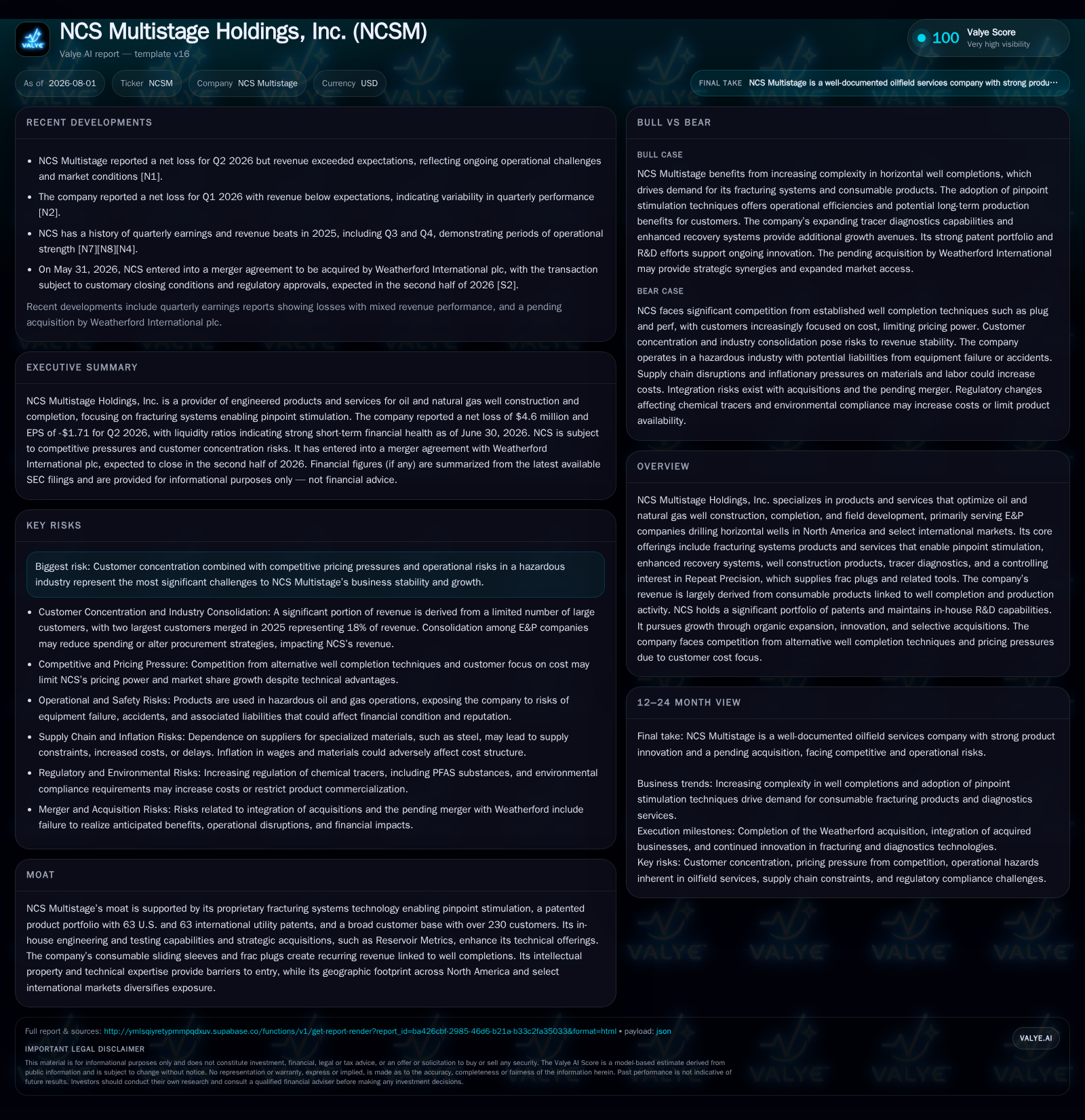
NCS Multistage Holdings, Inc. reported its latest quarterly operations highlighting steady adoption of its patented fracturing systems designed for horizontal well completions. The company leverages a robust intellectual property position with 63 U.S. and international patents to support consumable sliding sleeves and frac plugs tied to multistage fracturing demand. Despite industry cyclicality and customer concentration risks, NCS pursues growth through R&D-driven innovation, an expanding customer base exceeding 230 operators, and strategic selective acquisitions such as controlling interest in Repeat Precision. The competitive landscape remains challenged by alternative completion methods and pricing pressures, but pinpoint stimulation offers operational efficiencies that differentiate NCS in the well completion ecosystem.
Recent Operating Update
Business Model
NCS Multistage's recurring revenue model ties strongly to E&P activity levels as customers purchase consumable casing-installed sliding sleeves cemented inside wellbores and engage NCS for supervisory services during fracture stimulations [S1]. These consumables are integral enablers of the company's patented pinpoint stimulation approach—a method that individually stimulates each entry point into a formation. This process contrasts with conventional plug-and-perf or ball drop methods that dominate most unconventional completions. Through precise frac isolation assemblies and associated downhole equipment, NCS aims to deliver better proppant placement control and completion efficiency for operators seeking improved ultimate hydrocarbon recovery
Complementing this offering is NCS’s controlling interest in Repeat Precision LLC, which supplies composite and dissolvable frac plugs alongside setting tools and perforation guns critical for multistage completions. Consolidation of these operations bolsters vertical integration benefits by enhancing supply consistency and proprietary technology leverage [S1].
Furthermore, tracer diagnostics services deployed through chemical tracers provide reservoir characterization capabilities enabling customers to optimize subsequent well completions by better understanding fluid flow and inter-well communication at downhole level. This diagnostic service is positioned as a cost-effective tool to improve reservoir management decisions.
The monetization mechanics pivot heavily on volume-linked sales: as wells grow longer horizontally with more fracturing stages drilled per lateral section, the number of sliding sleeves or frac plugs needed increases proportionally. NCS’s patented product designs generate barriers to entry against competitors lacking equivalent IP protection or technical expertise. Licensing fees from intellectual property enforcement and settlements also supplement direct sales revenues.
Industry Structure and Competitive Position
Within the oilfield service subsector focused on well completion optimization, NCS occupies a niche between larger integrated players like Halliburton, Schlumberger, or Baker Hughes—which offer broad pressure pumping alongside completions—and specialized manufacturers such as Repeat Precision (in which NCS holds controlling interest) focusing narrowly on frac plugs.
Industry demand drivers revolve around upstream E&P capital allocations toward shale/tight plays requiring sophisticated multi-stage hydraulic fracturing. Horizontal drilling has become industry standard for accessing unconventional reservoirs with complex geologies where pinpoint stimulation techniques provide potential operational efficiencies over traditional completion methods.
NCS’s patent portfolio consisting of 63 U.S. utility patents plus equivalents internationally underpins its defense against direct replication by competitors while enabling licensing opportunities that diversify income beyond equipment sales alone [S6]. However, competitors continue developing innovative offerings targeting similar market segments with alternative casing-installed tools or enhanced recovery systems.
The company’s geographic footprint spans dominant unconventional basins in Canada (accounting for 58% of revenues in 2025), the United States (32%), plus select international markets like the North Sea and Middle East (~10%), providing some diversification but maintaining heavy reliance on North American E&P capital cycles [S7], [F1]. Customer concentration remains elevated; notably two large customers accounted collectively for approximately 18% of revenue post-merger in 2025 while the top five customers contributed about one-third of total revenue indicating moderate risk exposure if spending patterns shift unexpectedly or credit issues arise among large operators [S21].
Growth Drivers
Key drivers include ongoing trends toward longer horizontal laterals drilled by operators using more complex multi-stage fracture treatments per wellbore section, increasing unit consumption of NCS’s proprietary consumables like sliding sleeves and dissolvable plugs. Adoption momentum for pinpoint stimulation technology versus conventional plug-and-perf boosts market penetration potential, though this remains gradual given incumbents’ existing relationships with E&P companies.
Incremental R&D investments allow NCS to introduce innovative products enhancing operational reliability, reducing cycle times during completions, or enabling better reservoir isolation—each innovation representing an incremental wedge against alternative methods competing on price or simplicity.
Selective acquisitions complement organic growth by expanding technical breadth (e.g., integrating Repeat Precision’s machining services) or geographic reach into new shale plays or international arenas demanding high-specification completion products compliant with standards such as API or ISO certifications required overseas [S1], [S6], [S21].
Expanded service utilization rates through supervision personnel augment recurring revenue streams beyond equipment sales alone while tracer diagnostics represent an emerging niche supporting long-term asset optimization strategies favored by strategic E&P clients focused on maximizing recovery profiles within capital discipline [S1]
Risks and Constraints
Despite optimistic growth levers, NCS faces typical upstream sector cyclicality tightly coupled with commodity price volatility influencing E&P capital expenditure decisions. Sharp downturns could lead to deferred drilling programs directly reducing consumable product volumes sold.
Customer concentration risk is heightened given merged entities controlled nearly one-fifth of revenue recently; should these major players shift sourcing strategies or reduce spending materially it would significantly impact NCS’s topline stability due to limited diversification beyond a few large accounts currently.
Operational safety risks inherent in manufacturing frac plugs involving explosive materials present reputational and cost vulnerabilities if incidents occur. Supply chain disruptions affecting availability of raw materials like composites could constrain production capability amid peak demand cycles.
Competitive pressure persists from entrenched plug-and-perf providers offering less complex but widely adopted completion solutions creating hurdles for pin-point stimulation wider acceptance despite demonstrated efficiency gains.
Ongoing need for continuous innovation places pressure on R&D investment decisions balancing cost controls against pace of technology obsolescence; failure to innovate effectively risks eroding patented technological advantage.
Regulatory shifts governing hydraulic fracturing practices—especially across international jurisdictions where local compliance requirements vary—could impose additional certification or operational constraints limiting growth prospects outside core North American basins.
Inflationary pressures on input costs combined with foreign exchange exposure arising from revenues denominated predominantly in Canadian dollars expose margins to currency volatility risks adversely affecting financial performance despite robust operating current ratio near 4.3x reflecting strong short-term liquidity buffers at quarter-end June 2026 ($31 million cash vs $27 million current liabilities) [F1], [S2].
What To Watch Next
Key milestones include updates regarding further adoption rates of pinpoint stimulation reflected in reported utilizations or disclosed customer wins indicating market share movements vis-à-vis conventional alternatives. Watch also R&D announcements signaling new product introductions or improvements addressing known competitor gaps.
Integration progress related to prior acquisitions like Reservoir Metrics or Repeat Precision will signal synergy realization while capital expenditure levels by major North American shale operators remain a reading gauge for underlying end-market demand strength impacting tooling consumption patterns.
Monitoring customer payment trends among large accounts is critical given past warnings over credit risk concentration affecting cash flow stability. Regulatory developments pertaining to fracturing chemical composition disclosures or export controls governing production equipment represent external watchpoints influencing future deployments internationally.
Financial covenant compliance within the revolving asset-based loan facility should be observed for indications around financing flexibility given restrictive covenants potentially limiting operational agility during downturns.[S4], [S5]
Adoption acceleration in select international basins alongside evidence of compliance with specified industrial standards could drive geographical diversification mitigating overarching regional concentration risks documented currently.[S21]
Financial Profile Discussion
At quarter ending June 30, 2026, NCS exhibited a healthy liquidity profile with cash and equivalents totaling $31.3 million against current liabilities of $27.5 million resulting in a robust current ratio exceeding 4.27x reflecting efficient working capital management amid industry volatility [F1], [S2]. Total debt data shows approximately $24.3 million outstanding from earlier periods; net debt adjusted for cash reflects a slight net cash position enhancing balance sheet resiliency.[F1]
Operating income recorded at $10.54 million year ended December 31, 2025 underlines profitability scaling supported by growing fracturing stage intensity per well [F1]
The company remains subject to several restrictive covenants attached to its asset-based lending arrangement restricting actions like incurring new indebtedness without lender consent potentially constraining strategic flexibility but reflecting typical financing structures for oilfield service firms confronting cyclical demand swings.[S4], [S5]
Free cash flow generation tied closely to operational leverage effects from scaling equipment sales combined with incremental supervision/service utilization will be key metrics to track next reporting cycles reflecting ongoing execution capability amid fluctuating upstream capex environment.
This analysis is based exclusively on publicly filed SEC material dated through July 31, 2026 ([S1]–[S29]) supplemented by current quantitative disclosures ([F1]) without inclusion of speculative projections or undisclosed corporate information.
Disclaimer: This is research-only, informational analysis and not investment advice. It may include AI-generated interpretation and general industry context. Always verify important details using primary sources.

Comments