
Proto Labs Advances Digital Manufacturing with Strategic Growth and Operational Efficiency
Proto Labs' Q2 2026 results highlight effective execution of its hybrid manufacturing expansion and AI automation, reinforcing its leadership in digital manufacturing services.
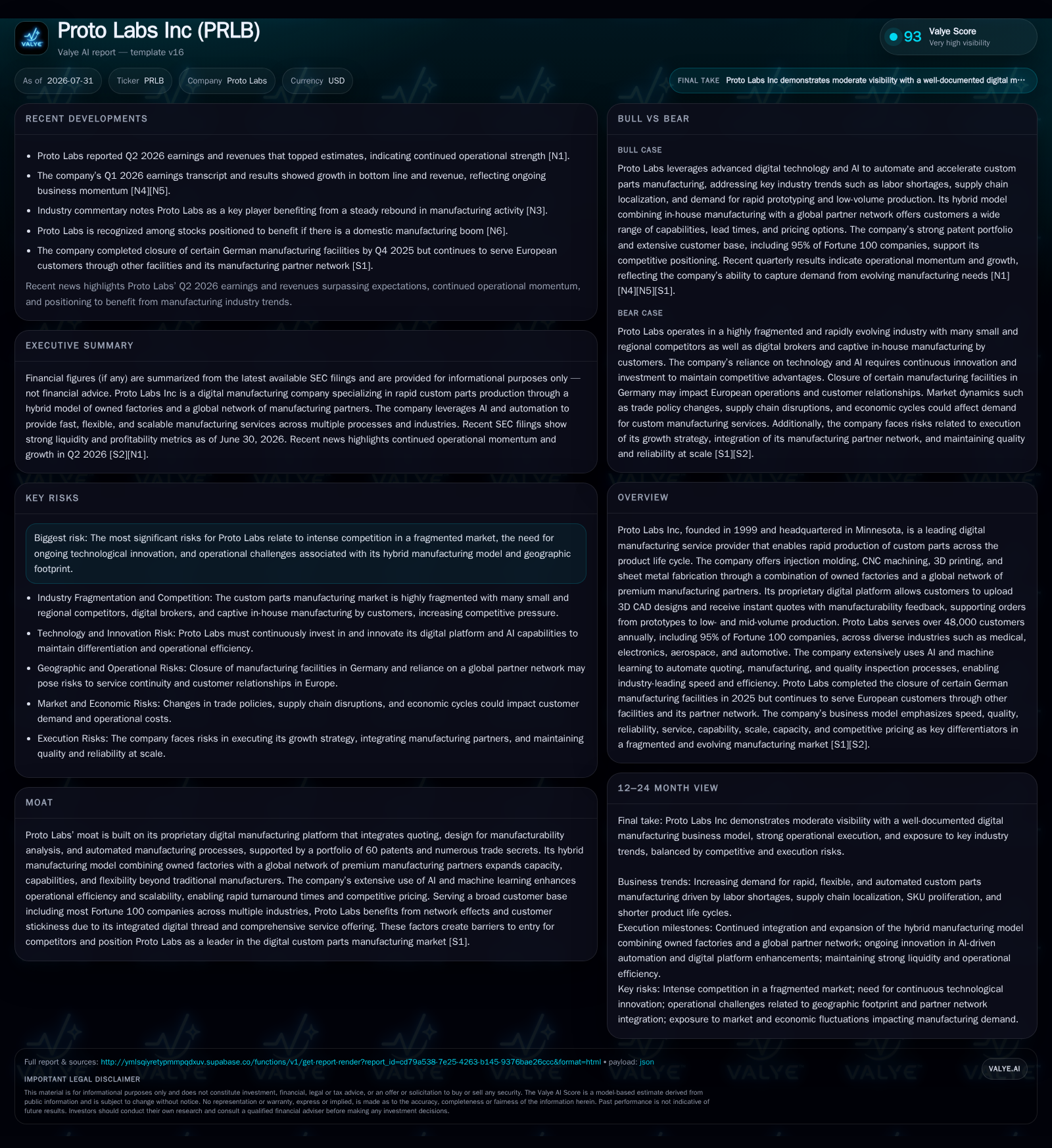
In Q2 2026, Proto Labs delivered revenue and earnings exceeding estimates, supported by increasing automation and customer-led production growth. The company leverages a proprietary digital platform integrating AI-driven quoting and manufacturability analysis with a hybrid fulfillment model blending owned factories and a global manufacturing partner network. This has enabled Proto Labs to scale efficiently while offering rapid prototyping to low- and mid-volume production across diverse industries. Despite intense competition in a fragmented market, Proto Labs’ broad IP portfolio, platform integration, and extensive Fortune 100 customer base underpin a durable competitive position. Watchpoints include continued innovation rollout, expansion of partner network capacity, and operational metrics such as quote-to-order conversion and lead times.
Q2 Operating Momentum Signals Reinforced Growth Trajectory
AI-Enabled Automation Driving Scale in Hybrid Manufacturing Operations
At the core of Proto Labs’ differentiation is its proprietary digital platform that integrates automated quoting powered by AI-driven manufacturability analysis with sophisticated order routing algorithms built on machine learning datasets from millions of parts produced historically [S1],[S5],[S21]. This automation reduces manual intervention in quotation generation — which traditionally is labor-intensive in custom parts manufacturing — leading to improved quote-to-order conversion rates and faster customer decision cycles. The company leverages this technology to route production intelligently between owned factories (“Factory”) that ensure rapid turnaround for standard processes like injection molding or CNC machining and a global network of vetted premium manufacturing partners (“Network”) that extend capacity reach with diverse process options [S7],[S10]. The hybrid model balances capital efficiency against service breadth; it mitigates the constraints typical of asset-heavy manufacturers who face challenges scaling rapidly without proportionally increasing fixed costs.
This integrated AI-powered workflow combined with the digital thread — a seamless data stream capturing each stage from CAD upload through final delivery — also enhances quality control consistency and batch traceability. The automation provides competitive advantages by enabling Proto Labs to offer industry-leading speed at scale while maintaining process reliability demanded by high-end customers across regulated sectors such as medical devices or aerospace components [S15].
Digital Platform Integration Fuels Superior Customer Experience
Proto Labs’ online interface allows customers to upload complex 3D CAD designs directly into the system where instant quotes accompanied by constructive manufacturability feedback are generated. Customers can interactively modify parameters such as quantity or finish and immediately observe impacts on pricing and lead time — delivering transparency rare in traditional contract manufacturing [S15]. This frictionless experience drives higher customer stickiness evidenced by high retention rates per management commentary. Moreover, their comprehensive offering spans multiple manufacturing processes including injection molding, CNC machining, 3D printing (additive manufacturing), and sheet metal fabrication — facilitating customers’ entire product lifecycles from prototyping through low- to mid-volume production without vendor fragmentation [S7],[S10].
The broad capability coupled with nearly universal penetration into Fortune 100 firms creates network effects: large customers exploit consistent performance across multiple divisions or product lines while startup clients benefit from improved access to sophisticated production methods previously only available at scale or high cost. This ecosystem effect strengthens barriers against smaller niche competitors operating solely in localized geographies or single processes.
Industry Fragmentation Meets a Fast-Moving Innovator
The digital custom manufacturing industry remains highly fragmented globally with thousands of small- to mid-sized shops varying widely in capability [S17]. Competition ranges from traditional machine shops offering localized services to rapidly growing digital platforms aggregating partner networks. Proto Labs competes also with captive in-house operations at large OEMs that insource certain functions for speed or confidentiality reasons.
To sustain leadership against these varied players requires constant technological innovation. Proto Labs holds around 60 patents plus additional trade secrets covering process methods for both subtractive (e.g., CNC machining) and additive manufacturing approaches alongside proprietary quoting software algorithms [S1],[S21]. This IP base establishes credible deterrence against imitation while supporting ongoing advancements like integrating newer materials or refining AI models for faster quoting accuracy.
However, rising commoditization pressures risk margin compression especially if new entrants replicate core automation capabilities cheaply or if customers increasingly source via broader marketplaces offering lower price points at the expense of integrated service quality. Maintaining pace with evolving technologies such as advanced resin formulations for additive parts or alternative fabrication methods is imperative for long-run competitiveness.
Expanding Production Capacity to Match Evolving Customer Needs
Proto Labs pursues deliberate production expansion aligned tightly with strategic customer demand signals rather than broad capital expenditure sprees [S1]. Their hybrid factory-network structure enables adding incremental capacity through partner onboarding supplemented by selective upgrades internally where proprietary expertise yields highest returns on investment. Such expansions focus heavily on growing higher-margin low- to mid-volume production business beyond purely prototype work.
This shift responds to market trends favoring outsourced flexible volume manufacturing supporting pilot runs or limited series production rather than committing upfront to mass tooling investments. By capturing this segment more fully through tailored capabilities (e.g., tighter tolerances / advanced materials), the company anticipates margin enhancement driven by operational leverage while deepening customer relationships through lifecycle engagement.
Sustaining Moat Amid Technological Intensity and Competitive Pressure
The company's moat rests not only on its technological assets but importantly on operational execution embedding these technologies at scale across multiple geographies via its partner network [S1],[S8]. Protecting intellectual property through patent defense complements ongoing R&D investment necessary to refresh technology stacks amidst rapid industry advances including AI tooling enhancements.
Challenges remain scaling platform reliability globally while ensuring consistent premium-quality standards amongst third-party manufacturers who vary regionally in sophistication levels. Dependence on these external partners introduces operational risk should disruptions occur or deviations from quality protocols arise unexpectedly.
Continued patent portfolio growth enhances negotiation positioning but requires legal vigilance given risks of infringement claims or patent expirations diluting exclusivity windows impacting long-term competitive advantages.
Growth Drivers: New Markets, Materials, and Customer Segments
Growth catalysts stem from accelerating adoption of digital manufacturing workflows by engineering product developers seeking agility in prototyping timelines balanced against increasing outsourcing appetite for low- to mid-volume production runs typically ill-served by conventional suppliers.
Emerging end markets like medical devices demand rapid customization under regulatory scrutiny — areas well suited to Proto Labs’ digitally integrated quality controls. Similarly aerospace applications require complex geometries matched by additive processes complemented by robust CNC finishing—all facilitated within Proto Labs’ multi-process environment.
Expanding material palettes (e.g., liquid silicone rubber) supplement traditional plastics/metals offerings allowing adaptation to evolving product feature demands while broadened industry coverage enhances cross-selling opportunities driving average order size increments over time.
Risks: Competition, Platform Scalability, and Partner Dependence
Despite strengths, key risks persist including intensified competition fueled by lower entry barriers afforded by software tools enabling quoting automation replicable across regional operators or new platform entrants [S1],. Falling behind technologically could erode market share particularly if competitors exploit breakthrough materials or novel fabrication techniques inaccessible within Proto Labs’ existing framework.
Scaling challenges involve ensuring platform uptime resiliency amid surging transaction volumes spanning multiple regions while upgrading AI models concurrently—failures here could impair customer experience materially.
Partner network reliance exposes operational variability risks stemming from geographic supply chain disruptions or quality inconsistencies requiring robust governance frameworks.
Raw material price volatilities affect profitability especially when contract pricing lags underlying cost shifts; additional macroeconomic uncertainties around regulatory changes also introduce execution hazards necessitating adaptive risk mitigation procedures.
What to Watch: Execution Metrics and Innovation Pipeline
Key near-term milestones include monitoring quote-to-order conversion improvements reflecting enhanced AI model effectiveness alongside continued reductions in order lead times evidencing improved capacity utilization across Factory plus partner network fulfillment channels [S2]
Customer retention rates provide early signals of combined platform stickiness amid intensifying rival offers. Incremental launch cadence for innovations expanding printable materials sets an important innovation pipeline benchmark potentially unlocking adjacencies within fast-growing verticals.
Operations teams must demonstrate ability to scale order processing throughput seamlessly during peak load windows without service degradation underscoring progress toward leveraging technology investments fully.
Financial Profile Discussion: Liquidity Strong, Investment Focused
As of Q2 2026 quarter-end, Proto Labs holds approximately $128 million in cash and equivalents versus minimal outstanding debt (~$149 thousand best-effort figure), resulting in an exceptionally healthy current ratio near 3.64 which provides substantial liquidity headroom to fund strategic initiatives amid uncertain macroeconomic environments [F1],[S2].
This balance sheet flexibility supports ongoing capital allocation priorities concentrated on upgrading core systems to increase automation breadth within quoting/manufacturing workflows alongside selective factory enhancements aligned with expanding key customer programs. Low leverage preserves capacity for opportunistic investments enabling responsive scaling without raising immediate refinancing concerns.
Profitability metrics have trended positively consistent with operating margin improvements driven partly by expanded operational efficiencies realized through AI deployment contributing to sustainable free cash flow generation potential.
This analysis synthesizes recent SEC disclosures alongside firm-level operational developments providing an integrated assessment of Proto Labs’ positioning within the dynamic digital custom manufacturing sector. While growth trajectories appear favorable owing to technology-enabled scalability paired with comprehensive service coverage spanning prototyping through production stages, vigilance remains essential concerning competitive innovation pace and global execution complexity inherent in hybrid fulfillment models.
No financial advice is intended herein; this report is prepared solely for informational purposes grounded strictly on filed disclosures and documented news reportage.
Disclaimer: This is research-only, informational analysis and not investment advice. It may include AI-generated interpretation and general industry context. Always verify important details using primary sources.

Comments