
Grupo Simec’s Volume-Driven Recovery Highlights Geographic and Product Mix Strength
Increased shipments offset price pressures in Q2 2026, reflecting resilience amid industry headwinds.
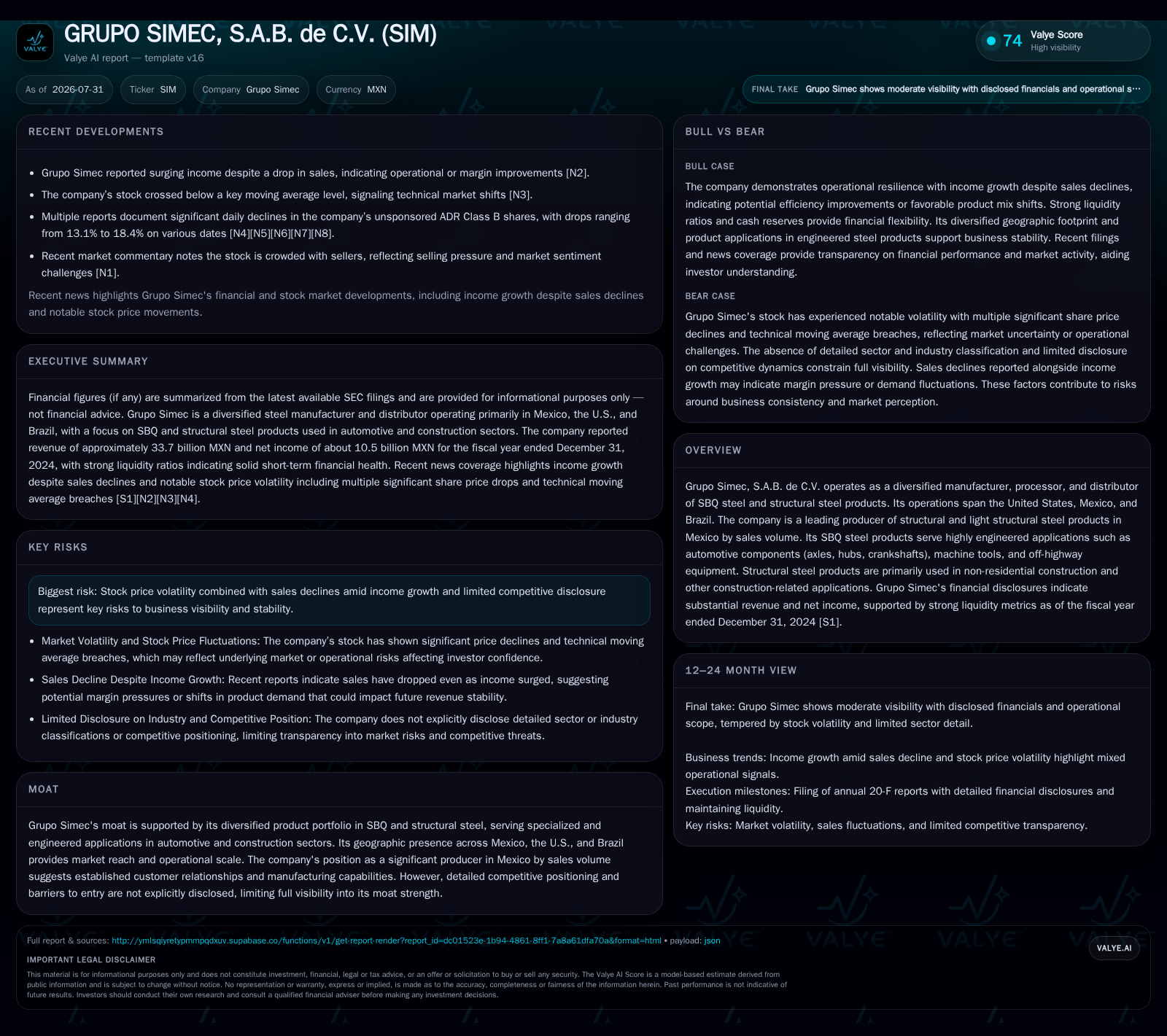
Grupo Simec reported a 9% rise in net sales for the first half of 2026, driven by a 16% volume increase despite a 6% fall in average steel product prices. The company’s diversified footprint across Mexico, Brazil, and formerly the U.S., coupled with a strategic shift toward higher margin SBQ products, supports operational resilience amid cyclical steel sector challenges. Cost of sales rose moderately with volume growth, while gross margin improved slightly due to better productivity control and cost discipline. Grupo Simec’s strong liquidity and low debt underpin its ability to weather raw material cost volatility and demand cycles inherent to steel manufacturing.
Recent Operating Update: Shipment-Led Revenue Growth Amid Pricing Pressure
Cost of sales for the first half rose by around 8%, from Ps.11.2 billion to Ps.12 billion year-over-year, driven mainly by elevated shipment volumes rather than input cost inflation; the cost of sales as a percentage of net sales remained stable around the mid-70%s [S3]. This suggests effective operational management focused on productivity gains amid fluctuating raw material costs—a critical KPI in steel manufacturing given scrap metal and ferroalloy price volatility.
The company also reported stable selling, general and administrative expenses with some improvement in gross margin percentage points from prior quarters, supporting modest profitability improvements despite challenging steel price dynamics across North America and Latin America.
Business Model: Diversified Steel Production Focused on Higher-Value SBQ Products
Grupo Simec operates as a diversified producer, processor, and distributor specializing in specialty bar quality (SBQ) steels alongside structural steel products tailored primarily for highly engineered automotive components—such as axles, hubs, crankshafts—and machine tools plus off-highway equipment [S2]. This SBQ segment offers differentiated value compared to commodity structural steels prevalent in rebar or light structural markets serving non-residential construction sectors.
The firm generates revenue by selling these steel products directly to industrial manufacturers within automotive supply chains as well as construction firms requiring structural components. Volumes shipped and realized prices drive revenue dynamics; both are influenced heavily by sector cyclicality—auto production cycles and infrastructure/construction investment trends—as well as global steel commodity pricing.
Grupo Simec’s exit from U.S.-based steelmaking operations in August 2023 marked a pivot to concentrate capacity within Mexico and Brazil where logistical advantages via strategically located plants reduce freight costs relative to competitors lacking regional presence [S1]. This geographic footprint enables competitive cost structures crucial for maintaining margins given their limited pricing power in commodity-market-influenced segments.
Industry Structure and Competitive Positioning
Operating primarily within the midstream tier of the steel value chain, Grupo Simec faces competition from integrated producers like ArcelorMittal globally and mini-mill operators such as Nucor or Gerdau regionally. Its SBQ product line distinguishes it somewhat by targeting less commoditized applications requiring technical expertise and quality certification—features that potentially support slightly better margin profiles relative to commodity rebar or structural steel producers.
However, Grupo Simec acknowledges limited pricing influence owing to high competition levels across both Mexican markets and broader North America; pricing is tied closely to global supply-demand balances impacting scrap metal sourcing costs [S1]. The company's strategy emphasizes product mix optimization toward higher-margin SBQ outputs where feasible while adjusting overall production volumes in response to demand signals—a response common among peers aiming to mitigate exposure to oversupplied commodity segments.
Logistics efficiency stemming from plant locations near key industrial zones in Mexico supports service levels to major automotive clusters while enabling exports into Southern California—a relevant market for select structural products—offering freight-cost advantages over distant competitors lacking local presence.
Growth Drivers: Volume Expansion Supported by Market Diversification
The robust shipment gains observed through H1 2026 reflect incremental recovery in end-markets such as automotive manufacturing rebound post-disruptions alongside steady construction activity particularly within non-residential sectors targeting infrastructure upgrades [S3]
Additionally, ongoing efforts to grow SBQ product lines aligned with industry trends favoring lighter yet stronger automotive components position Grupo Simec favorably amidst technological shifts in component engineering requiring advanced steels [S2]. Geographic diversification between Mexico and Brazil spreads risk exposure while capturing growth opportunities across emerging Latin American markets experiencing industrial expansion.
Strategic investments continue at production facilities enhancing capacity utilization metrics without excessive capital intensity relative to peers—implicitly facilitating leaner cost bases crucial amidst raw material price volatility [S4,S8]
Risks / Constraints: Cyclicality, Input Price Volatility, Margin Pressure
Despite positive shipment momentum, Grupo Simec's reliance on cyclically sensitive markets such as automotive manufacturing subjects it to macroeconomic risks that can swiftly impact orders volume or pricing power amid downturns [S1]. Additionally, volatile scrap metal prices pose cost uncertainties since raw materials constitute a significant share of total cost of sales; this tension is accentuated given Grupo Simec’s limited ability to pass through all input price increases promptly due to competitive pressures.
Furthermore, cessation of U.S. steelmaking reduces geographic diversity but also eliminates operational scale advantages previously held; how effectively the company manages Brazil-Mexico production integration will be relevant going forward.
Limited publicly disclosed details on exact market share or customer contract specifics create challenges assessing moat durability—though reported leadership by volume within Mexico signals entrenched customer relationships which may confer some stability under normal conditions.
What To Watch Next
Tracking quarterly shipment volumes remains critical for gauging sustained demand recovery momentum alongside price realization trends across SBQ versus commodity product lines. Monitoring cost inputs specifically scrap metal procurement costs relative to finished goods pricing will illuminate margin trajectory.
Additional capital expenditure announcements aimed at capacity upgrades or efficiency gains could signal growth ambitions supported by improving market fundamentals.
Given Grupo Simec's financial profile nearing mid-2026—with substantial cash reserves exceeding Ps.29 billion MXN at end-2024 and conservative current liabilities relative to current assets indicating strong liquidity—the company's balance-sheet health will be important for funding operational initiatives without resorting to excessive leverage [F1,S3]
Regulatory developments impacting trade tariffs or energy costs could notably affect competitiveness given regional focus.
Financial Profile Discussion
Debt levels appear manageable with no prominently disclosed high-cost borrowings or refinancing pressures noted recently; absence of financial assets marked as fair value investments points toward conservative treasury management focusing on cash equivalents invested in short-term instruments preserving liquidity without speculative exposures [S3,S8]
This financial flexibility supports continued investment into plant upgrades required for maintaining competitive technology standards within SBQ specialty steels manufacturing—particularly crucial given growing demands for stringent quality adherence in automotive supply chains.
This analysis synthesizes Grupo Simec’s recent operating disclosures combined with industry-standard KPIs emphasizing shipment volume growth balanced against persistent price compression characteristic of structural metals manufacturing sectors serving automotive and construction end-markets. The company leverages geographic concentration plus product diversification toward higher-value-added SBQ steels positioning it reasonably well despite macroeconomic cyclicality risks common across integrated steel producers regionally.
Disclaimer: This is research-only, informational analysis and not investment advice. It may include AI-generated interpretation and general industry context. Always verify important details using primary sources.

Comments