
Ruanyun Edai’s Transition to Smart Campus Services Reshapes Revenue and Margin Dynamics
Ruanyun Edai Technology is shifting from legacy K-12 education products toward AI-enabled campus services and international expansion, driving revenue growth but compressing gross margins amid higher operating costs and liquidity constraints.
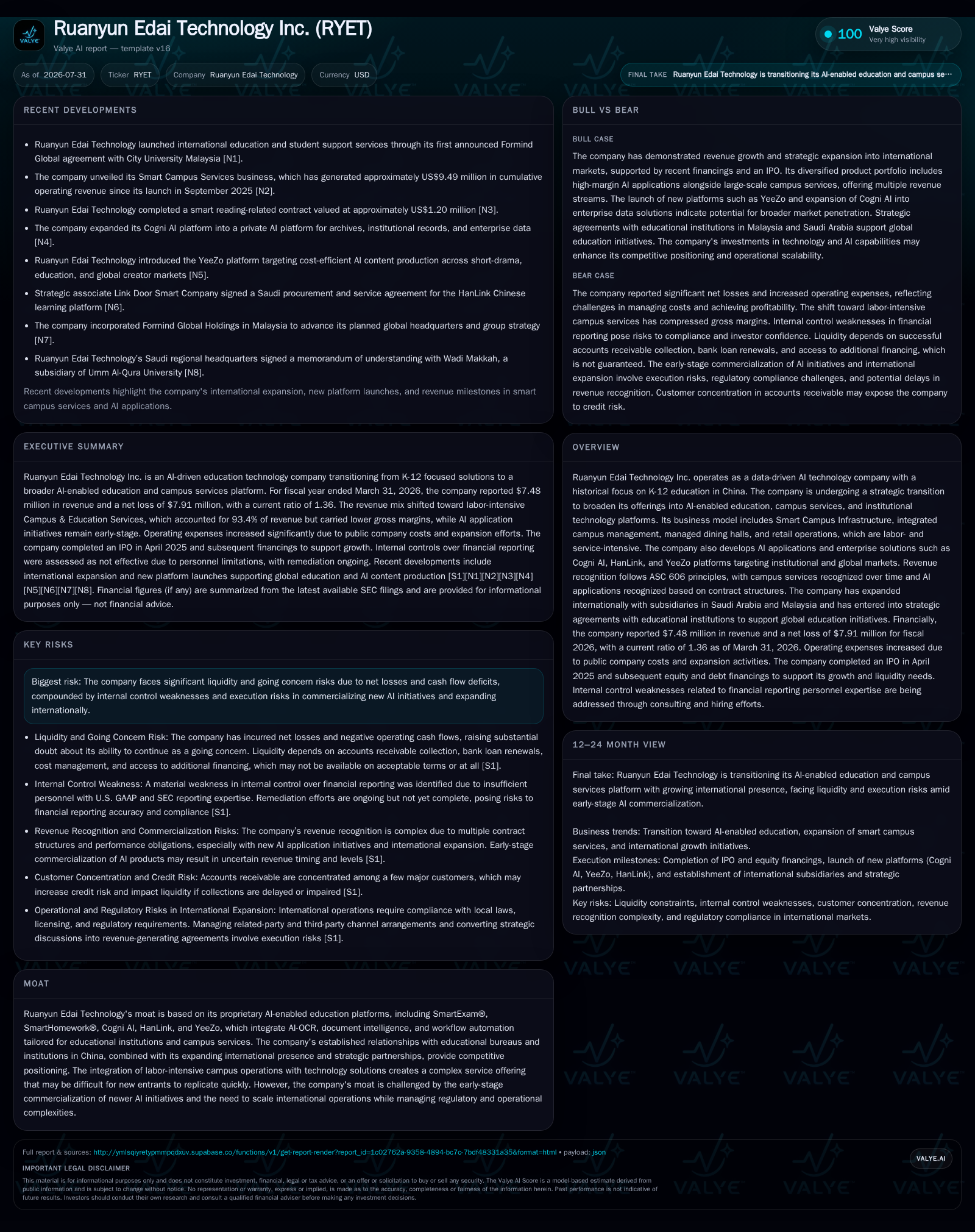
Ruanyun Edai Technology Inc. reported fiscal 2026 revenue growth driven by its strategic pivot to Smart Campus Services and related labor-intensive campus operations, which now contribute the majority of revenue but at significantly lower margins than its legacy AI education products. The shift toward service-based revenue has introduced new working capital challenges, higher public company compliance costs, and pressures on profitability, reflected in a net loss of $7.9 million for fiscal 2026. Expansion into international markets via subsidiaries in Saudi Arabia and Malaysia marks an early-stage transition that requires careful execution amid regulatory and operational complexity. Liquidity remains a concern despite recent fundraising and bank credit lines, with management emphasizing cost controls and receivables collection as key focus areas.
Recent Operating Update
products [S1].
Concurrently, the company has augmented its organizational structure post-IPO by expanding sales, marketing, compliance, and administrative teams necessary for navigating the complexities of public company operations and international market entry [S1][S6]. Selling expenses more than doubled year-over-year to roughly $3.9 million (52% of revenue) owing primarily to international marketing initiatives and business development efforts tied to new customer acquisition for Smart Campus Services [S6]. General and administrative costs rose nearly threefold to $4.5 million as the company absorbed legal, audit, investor relations, IT infrastructure deployment, and personnel costs associated with scaling as a Nasdaq-listed entity [S6].
Despite moderation in research & development spend to approximately $0.78 million (about 10% of total revenue), ongoing investment remains critical as Ruanyun Edai continues developing proprietary artificial intelligence applications such as Cogni AI and YeeZo platforms targeting institutional clients [S7][S23]. These newer high-tech solutions operate at higher segmental gross margins (~62%) but represent a still early stage in commercialization with limited contribution to overall revenue currently [S19][S24].
Business Model Overview
Ruanyun Edai operates at the intersection of education technology software solutions and labor-intensive campus management services. Historically centered on K-12 online assessment products like SmartExam® and SmartHomework®, it is transitioning toward an integrated "Smart Campus" model combining intelligent infrastructure management with operational services encompassing dining hall management, student life support, facility oversight, and vocational training programs [S1]. This hybrid approach leverages proprietary AI technologies including advanced optical character recognition (AI-OCR), document intelligence engines, data analytics algorithms optimized for learning assessment accuracy (claimed internal rate ~97%), and workflow automation tools tailored for institutional customers [S1].
The company monetizes through a mix of SaaS licensing fees for its AI-powered educational platforms, managed services contracts for ongoing campus operations delivery requiring significant human capital deployment, and contractual licensing or usage fees linked to enterprise AI applications [S1]. Revenue recognition follows ASC 606 standards; longer-term service contracts generally lead to revenue recognized over time while software or platform license fees tend to be recognized based on contract terms [S23][S24]. The shift toward more service-heavy Smart Campus deployments implies a more variable working capital profile due to payment timing differences inherent in service settlements versus upfront software sales.
Strategically, Ruanyun Edai’s moat derives from its integrated technology-service offering that may raise switching costs for clients dependent both on AI-driven educational tools and embedded campus operational systems. Its proprietary platforms - including cognitive assessment engines like SmartExam®, enterprise workflows via YeeZo, language learning testing with HanLink - form an ecosystem difficult for new entrants lacking scale or specialized AI expertise [S1]. Established relationships with Chinese education bureaus buttress client retention while recent moves into international markets such as Southeast Asia seek diversification beyond China’s increasingly regulated K-12 sector [N2][S1].
Industry Structure and Competitive Position
The education technology sector blend represented by Ruanyun Edai incorporates digital content providers (akin to peers like Pearson plc or Cengage Learning), SaaS education platforms (Chegg Inc., Instructure), alongside campus service managers analogous to operators like Blackboard Inc. Its strength lies in hybridizing AI innovations with physical managed services—a less common configuration.
This complex value chain positions Ruanyun as both platform vendor and campus operator servicing institutions’ digital transformation needs along with employee/student experience enhancements via student-life offerings. Yet this breadth introduces operational complexity: competing against specialized SaaS purveyors demands continual technological improvement while scaling labor-intensive facilities services risks margin compression.
Internationally, expansion faces regulatory hurdles around foreign ownership licensing in education markets plus localized product adaptation needs complicating cross-border rollout timelines [S1][N2]. Risk also emanates from entrenched domestic competitors benefiting from scale or government favor in China’s evolving education landscape.
Growth Drivers
Key growth catalysts include accelerated adoption of AI-assisted learning analytics among educational institutions seeking precision-tailored student outcomes; heightened demand for comprehensive smart campus infrastructure supporting operational efficiency; institutional investments prioritizing digital transformation; and an increasing emphasis on enhancing student-life experience through managed services.
Further impetus stems from international partnerships exemplified by agreements like the one announced with City University Malaysia enabling market entry into English-language education ecosystems leveraging Ruanyun’s AI language testing via HanLink [N2]. Such channels help mitigate direct market-entry friction.
Expansion into enterprise AI application verticals beyond pure education—such as document intelligence automation through Cogni AI—may unlock future higher-margin opportunities once scale matures; however current impact remains minimal [S17][S19]. Investment in R&D talent (~20% of workforce) underpins product innovation needed to sustain competitive differentiation [S7][S10].
Risks and Watchpoints
Internally, unresolved material weaknesses exist within financial reporting controls posing risks for accurate SEC compliance disclosures and financial statement integrity; remediation underway via specialized consultants but full resolution not confirmed as of July ’26 filing date [S20][S24].
Cybersecurity remains a governance priority following a notable data leakage event in 2023 incurring regulatory penalties ($200k RMB fine) requiring implementation of remediation protocols per Chinese cyberspace authorities; no further material incidents reported during fiscal ’26 but future threats could impair reputation or disrupt operational continuity given sensitive educational data handled [S1]
International rollout challenges encompass adaptation to varying local regulations/licensing regimes impacting ability to monetize overseas operations rapidly; dependence on channel partnerships heightens execution risk especially where commercial traction is nascent [N2][S17].
Customer adoption rates along with contract renewal success remain pivotal variables affecting revenue visibility amidst early-stage market penetration efforts.
What to Watch Next
Investors should monitor quarterly updates for evidence of improving gross margins signaling scaling benefits or shifts back toward higher-margin AI Application line contributions beyond nascent stages.
Tracking accounts receivable trends relative to revenue can illuminate working capital health amid evolving settlement patterns driven by service exposure.
Progress reports on international subsidiary commercialization activities – particularly pipeline conversion metrics or signed agreements – will provide clarity on overseas opportunity viability.
Management’s execution on internal control remediation will affect financial reporting transparency and investor confidence going forward.
Additional fundraising initiatives under existing equity purchase agreements could alter liquidity posture; announcements around banking credit renewals or alternative financing will also be pivotal liquidity markers.
Finally, any disclosures related to cybersecurity incident prevention or breaches remain important from operational risk perspectives.
Financial Profile Discussion
However, recurring negative operating cash flow trends underscore structural challenges until scale benefits materialize or higher-margin revenue streams grow sufficiently.
Disclaimer: This analysis is intended solely as an informational review based on publicly available SEC filings and news sources without offering investment research views or advice.
Disclaimer: This is research-only, informational analysis and not investment advice. It may include AI-generated interpretation and general industry context. Always verify important details using primary sources.

Comments