
Pacific Booker Minerals’ Morrison Project Struggles Underscore Regulatory Hurdles in Canadian Copper-Gold Exploration
Pacific Booker Minerals continues to face permit rejections and strained Indigenous relations, challenging progress on its Morrison copper-gold project despite ongoing technical reassessments.
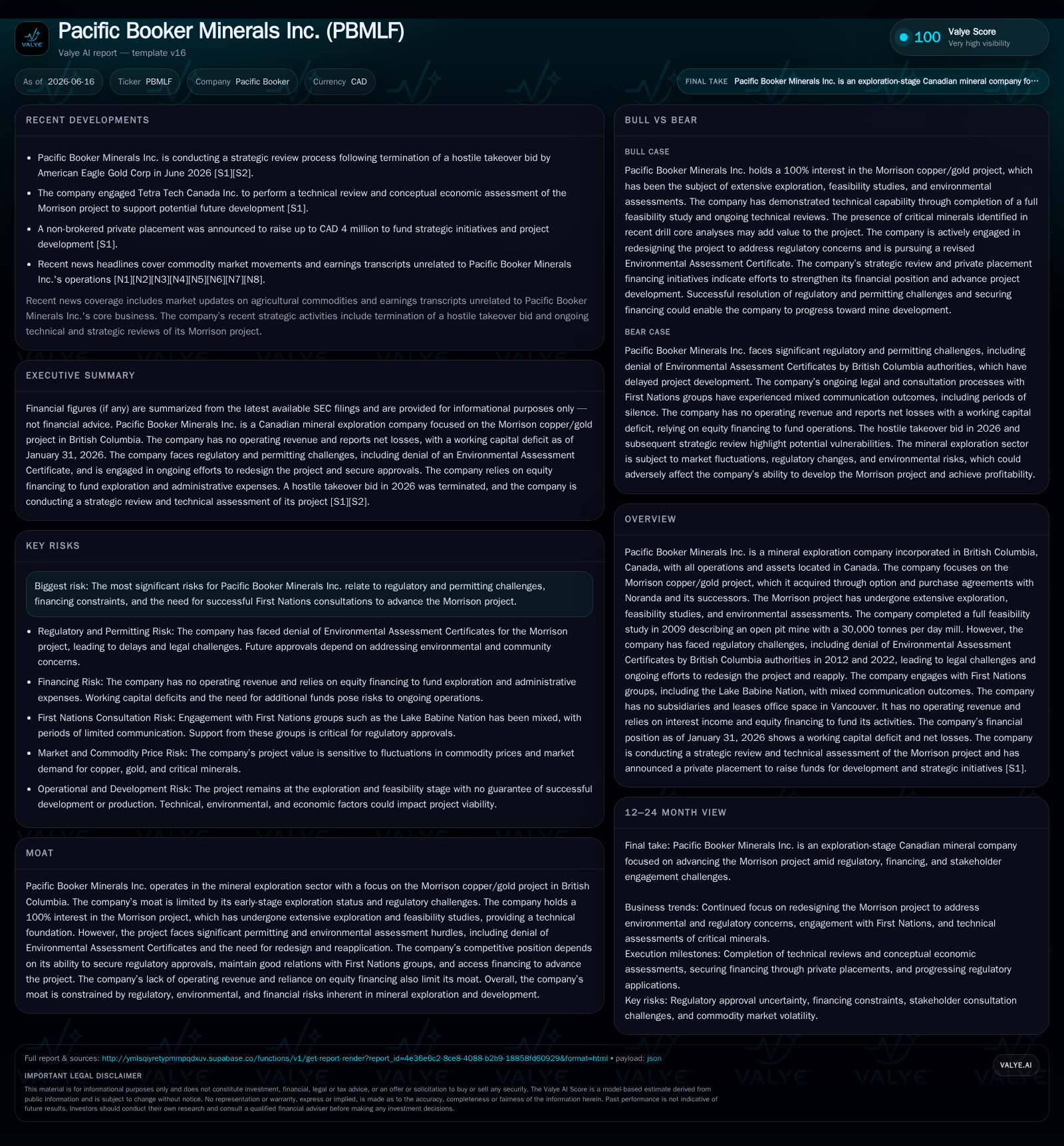
In its latest June 2026 filings, Pacific Booker Minerals reaffirmed the persistent regulatory gridlock surrounding its flagship Morrison copper-gold project in British Columbia. The company remains stalled by the government’s refusal to grant an Environmental Assessment Certificate (EAC) and the Lake Babine Nation’s refusal to engage meaningfully, effectively granting them veto power over project advancement. While technical reassessment efforts and a non-brokered private placement to raise $4 million are underway, financing risks and uncertain Indigenous consultations continue to weigh heavily on the firm’s development prospects. These hurdles reflect broader challenges faced by junior mineral explorers in navigating BC’s complex permitting regime.
June 2026 Operating Update: Regulatory Logjam Endures
Pacific Booker Minerals’ most recent SEC filings in June 2026 ([S2], [S3]) reinforce the stagnation plaguing the Morrison copper-gold project regarding regulatory approvals. Despite persistent efforts to redesign the project to address prior environmental concerns and submit new applications for an Environmental Assessment Certificate (EAC), the province of British Columbia has yet to grant approval. The government’s rejection of the EAC originally submitted culminated in a directive that a redesigned proposal now requires endorsement from the Lake Babine Nation (LBN), an Indigenous group whose explicit consent has become effectively mandatory for progress.
The company reports ongoing unsuccessful attempts to engage LBN representatives; this lack of cooperation has placed a de facto veto power into local Indigenous hands. Pacific Booker is now pursuing legal avenues against both provincial authorities and LBN to overcome this impasse ([S1], [S14]). This operating update starkly illustrates how regulatory inertia compounded by fractured Indigenous relations constrains advancement for junior explorers reliant on environmental certification as a gating factor.
Overview of Pacific Booker's Exploration-Focused Business Model
Pacific Booker Minerals operates exclusively in mineral exploration, targeting copper and gold resources at its wholly owned Morrison property located in British Columbia ([S1]). The company acquired full interest through a series of option agreements initially entered with Noranda (later Glencore). The core strategy revolves around methodical resource definition via drilling and geological analysis followed by technical feasibility studies to validate economic viability.
Notably, Pacific Booker conducted comprehensive feasibility analyses culminating in a 2009 study delineating a large-scale open pit operation processing approximately 30,000 tonnes per day. However, without critical environmental permits such as the EAC, actual mine development remains unattainable. Consequently, Pacific Booker does not generate operating revenues but funds exploration work and environmental assessment processes primarily through equity issuances ([S1]).
This incremental build-up model places significant value on milestones linked to advancing environmental approvals and securing community support, particularly from First Nations stakeholders. Until such thresholds are met, value realization depends largely on market recognition of project potential.
Industry Backdrop: Navigating British Columbia’s Permitting Environment
British Columbia's mining sector features rigorous permitting regimes designed to ensure environmental protection and Indigenous participation. Obtaining an Environmental Assessment Certificate involves extensive baseline studies, third-party reviews, public consultations, and adherence to evolving provincial policy standards ([S19], [S22]).
Junior explorers like Pacific Booker often face protracted timelines due to contested assessments of ecological impact (e.g., water quality, fish habitat), especially in sensitive areas proximal to Indigenous territories. The requirement for meaningful consultation—and increasingly, free prior informed consent—from First Nations groups injects both legal complexity and political risk. In Morrison's case, despite data suggesting manageable negative impacts under prior submissions ([S23]), unresolved objections have stalled approvals.
Historical rejection of PBM’s EAC applications in both 2012 and 2022 exemplifies common challenges juniors face balancing exploration aspirations against multi-stakeholder environmental scrutiny within BC’s jurisdiction.
Competitive and Peer Industry Context in Copper-Gold Exploration
Within Canadian junior mining circles specializing in copper/gold deposits, Pacific Booker occupies a typical upstream role focused primarily on resource delineation rather than production. Peers similarly navigate financial dependencies on equity markets alongside regulatory bottlenecks within BC's mining framework.
Compared with other juniors engaged on analogous projects nearby, PBM's extended permitting gridlock is unfortunately reflective of regional trends whereby Indigenous engagement effectiveness substantially influences timelines (). Unlike some competitors who establish collaborative partnerships earlier with indigenous communities or align their designs proactively with environmental priorities, PBM faces setbacks exacerbated by fractious relations with LBN.
Capital structures generally consist heavily of equity issuance amid operating losses across peers; maintaining investor patience requires demonstrating progress along key milestones such as drill results, permit advancements, or strategic alliances.
Key Growth Drivers Centered on Project Redesign and Permit Approvals
The primary pathways unlocking value for Pacific Booker hinge upon three interrelated milestones: successful project redesign leading to EAC issuance; improved relations culminating in substantive agreements with the Lake Babine Nation; and raising sufficient equity financing.
Recent initiatives include engaging third-party consultants for updated technical reviews aimed at Preliminary Economic Assessment-level analysis incorporating modern metal price forecasts ([S9]). Such work supports credible permit reapplications by addressing previously cited environmental concerns.
Concurrently, management aims to remediate community engagement failures by proposing innovative environmental management partnerships emphasizing involvement of LBN representatives directly overseeing impact control measures ([S14]). Achieving consensus here could neutralize one of the most significant veto points currently blocking progress.
Lastly, proactive private placements—such as the June 2026 CAD 4 million non-brokered offering—are designed expressly to secure capital necessary for continued exploratory work underpinning resubmissions while funding general corporate expenses ([S5], [S7]).
These drivers collectively shape clear KPIs: timely permit rulings post-redesign submission; documented improvements in indigenous dialogue or formal agreements; drill meters completed or resource updates supporting economic assumptions; and cash flow sustaining exploration continuity.
Risk Factors: Legal Disputes, Financing Constraints, and Indigenous Relations
Pacific Booker's most salient risks stem from external dependencies beyond operational control. The cumulative refusals from governmental authorities to issue EACs enforce strict regulatory compliance but also embed uncertainty threatening project viability ([S1]).
The legal contest looming against the government agencies and Lake Babine Nation reflects ultimate friction points that if unresolved could result in complete write-down of invested capital—as no mining development can proceed without those certificates or cooperative community engagement ([S1], [S14]).
Also embedded is commodity price volatility affecting long-term economics—although currently less direct due to absence of production—plus unmitigated risks relating to uncertain property titles given incomplete surveying typical at early stages ([S1]).
Milestones to Watch: Environmental Approvals and Financing Developments
Upcoming developments pivotal for observing trajectory shifts include:
- Submission timeline for reworked EAC application incorporating site redesign efforts complete by mid-2026 based on consultant inputs ([S9]).
- Updates or breakthroughs in Lake Babine Nation engagement potentially via mediated sessions or formalized dialogue frameworks ([S14]).
- Closing status of June 2026 non-brokered private placement targeting CAD 4 million which will influence near-term operational funding capacity ([S5], [S7]).
- Release or publication of Preliminary Economic Assessment following technical advisory board reviews that could recalibrate investment narrative ([S9]). Monitoring these triggers will clarify if the entrenched regulatory-logjam may begin unwinding or if further delays extend existing barriers indefinitely.
Financial Position and Funding Outlook
Pacific Booker relies exclusively on equity infusions to finance exploration advances and administrative overheads since no revenue streams exist at this stage ([S1]). Post-fiscal-year announcements indicated intent for further capital raises through non-brokered placements totaling CAD 4 million aimed at stabilizing working capital ([S5]). Nonetheless, any delays or shortfalls in equity markets pose existential solvency risks given ongoing operating losses.
It does not constitute investment advice or research views._
Disclaimer: This is research-only, informational analysis and not investment advice. It may include AI-generated interpretation and general industry context. Always verify important details using primary sources.

Comments