
Altex Industries Faces Cash Flow Challenges Without New Producing Asset Investments
Operating primarily as a holding company with non-operating interests in onshore oil and gas, Altex’s financial sustainability hinges on strategic acquisitions or ventures generating operational cash flow.
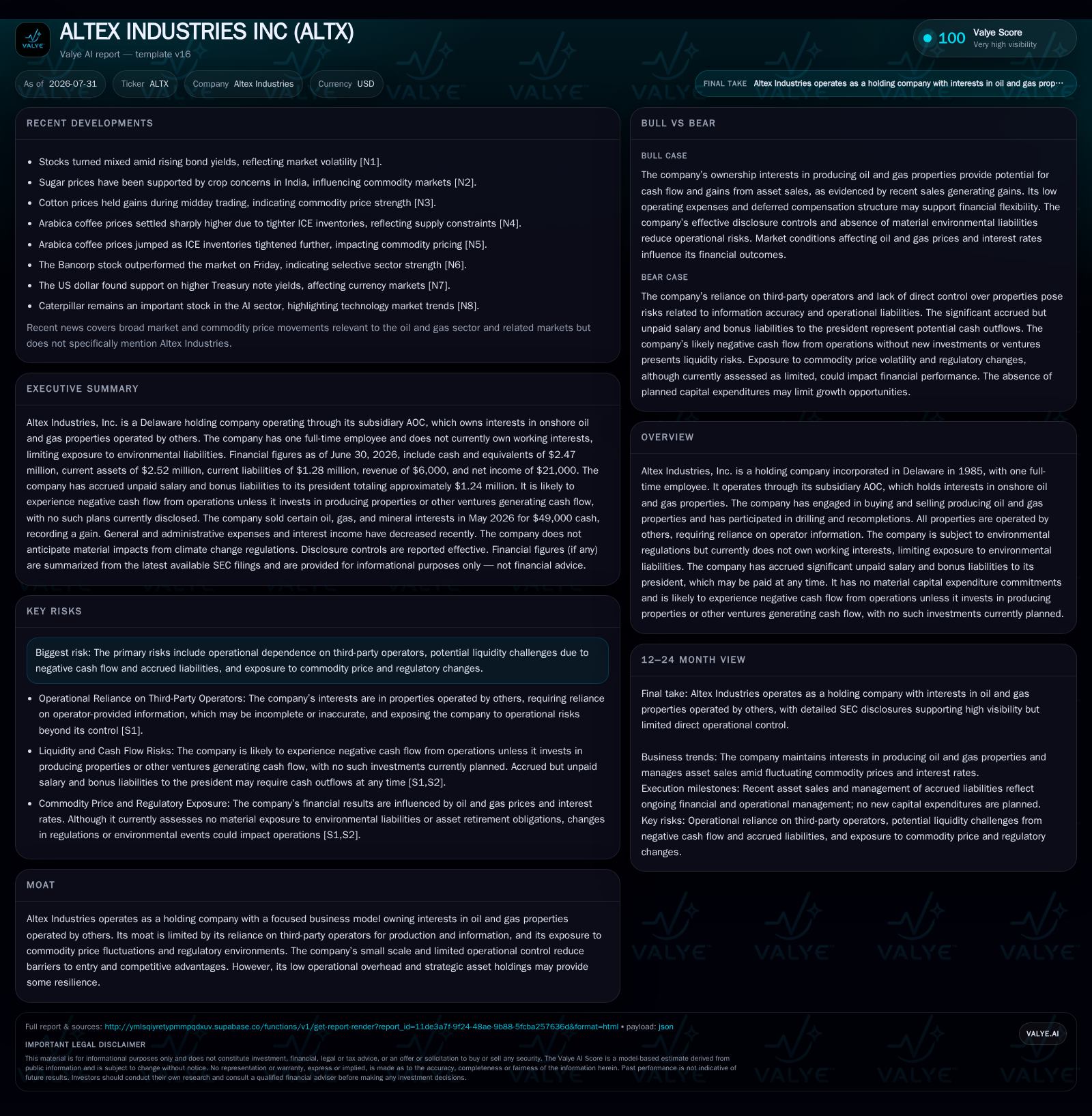
Altex Industries operates mostly through its subsidiary AOC, holding interests in producing oil and gas properties operated by third parties, limiting its operational control but exposing it to commodity price volatility and regulatory risks. Its latest quarterly filing confirms ongoing negative cash flow from operations absent new investments in producing properties or ventures with reliable cash flow. The company carries accrued salary and bonus liabilities to its president, adding liquidity risk, while maintaining minimal capital expenditure commitments. Its niche role as a small holding entity constrains scalability and competitive differentiation in the upstream E&P sector.
Recent Operating Update
Additionally, effective May 1, 2026, Altex completed a modest divestiture of certain oil, gas, and mineral interests in Utah and Wyoming for $49,000 cash. Since these assets carried a zero-dollar basis on the books, the entire amount was recognized as a gain on sale [S2]. This transaction is notable more for liquidity management than for operational growth.
The company carries accrued but unpaid salary and bonuses totaling approximately $1.235 million owed to its president—expenses deferred as per his election but potentially payable at any time—representing a financial obligation that could strain liquidity if called upon [S2]. Despite this liability and consistent negative operating cash flow absent new producing asset investments, Altex’s cash & equivalents remain at about $2.47 million with a current ratio near 2x as of June 30, 2026, providing short-term balance-sheet resilience but limited buffer without revenue-enhancing actions [F1][S2].
Business Model Analysis
Altex Industries functions principally as a holding company structured around its wholly owned subsidiary AOC which owns interests exclusively in onshore oil and gas properties situated across states such as Utah and Wyoming. These holdings are primarily non-operating interests; all producing properties are managed by third-party operators rather than by Altex directly [S1][S19]. This model means that while Altex benefits financially from hydrocarbon production volumes through revenue streams tied to commodity sales executed by operators selling into refiners and pipeline systems, it remains exposed to counterparty risk regarding production reporting accuracy and operational reliability.
Revenue generation for Altex hinges upon receipts from its share of produced oil and gas sales less operating expenses incurred by the operators [S1][S19]. Because it does not control field operations or sales logistics—including potential interruptions if downstream purchasers like refineries go offline—the company’s revenue profile is volatile and indirect compared with vertically integrated upstream operators. Moreover, Altex must rely heavily on reported operator data to assess production volumes and field performance but cannot independently verify accuracy or timing of such disclosures
Monetization derives from working interest distributions post-operator processing costs; however since Altex does not own working (operating) interests but rather non-operating stakes (likely net profits interests or similar), it avoids direct responsibility for environmental liabilities or asset retirement obligations (AROs) associated with full operator roles. While this limits predictable long-term liabilities relative to peers owning working interests at substantial percentages of fields under development or production, it also restricts control over cost management levers that typically drive margin expansion in E&P firms.
Financially, the company’s expenses reflect low administrative overhead consistent with minimal corporate staff (one full-time employee) but include significant accrued compensation expense related to management deferrals. General administrative costs have fluctuated mainly due to recognition timing of bonuses tied to the president’s employment agreement rather than scaling operational expenses typical of active operators [S2][S1]. Interest income has declined recently consistent with falling interest rates applied to liquid reserves.
Industry Structure and Competitive Position
Positioned within the upstream Oil & Gas Exploration and Production industry, Altex belongs to a niche class of holding companies acquiring and managing non-operating interests in producing assets. Unlike integrated independents or majors who operate their wells directly with substantial control over drilling schedules, capital deployment decisions, production optimization practices, and reserve replacement initiatives, Altex defers all operational execution to contracted operators.
This reliance on third parties creates structural dependencies: any disruptions caused by operator inefficiencies, outages at midstream purchasers (refiners/pipelines), or shifts in commodity price realizations directly impact Altex’s intermittent revenue streams without recourse aside from contractual remedies. Moreover, competitive advantages common among upstream producers—such as scale economies from integrated asset portfolios or proprietary geological expertise—are largely absent due to Altex’s limited scale and purely financial ownership role.
Additionally, given the small footprint implied by reported financials—minimal revenue captured ($18k noted at latest reported quarter end) and net losses recurring—the company lacks influence over oilfield services cost dynamics or reserve replacement strategies critical for sustaining long-term value creation within upstream peers [F1][S1]. Competitors span small-cap independents engaging actively in exploration/drilling versus other non-operating interest holders who may possess broader diversified portfolios or stronger balance-sheet capacity.
Growth Drivers
For growth beyond maintaining existing income streams from producing properties held via AOC or realized gains through selective asset sales—as seen in recent transactions—Altex would need to accelerate capital deployment into three core avenues: (1) acquisition of additional producing oil and gas properties with favorable economics; (2) participation in drilling of exploratory or developmental wells aiming at reserve additions; (3) recompletions targeting production enhancement from mature properties.
Such investments have historically enabled companies like Altex or peers with similar business models to generate incremental production volumes driving higher cash flows when commodity prices are supportive [S2][S1]. The filings confirm that absent initiating these activities or equivalent revenue-producing ventures currently planned ones—the company expects ongoing negative cash flow trends persisting into future periods
External factors remain potential growth catalysts including improved oil and natural gas price environments which can increase distributions proportionally even if volumes are static. Similarly favorable regulatory developments could lower operating cost structures indirectly benefiting revenue margins though these effects appear marginal for Altex given its passive role.
Risks, Watchpoints & Growth Constraints
Key risks include:
- Ongoing dependency on third-party operators limits visibility into actual production performance metrics such as net production volumes per day or operating efficiency impacting top-line receipts.
- Exposure to commodity price swings influences realized price per barrel of oil equivalent received but cannot be easily hedged or controlled due to scale constraints.
- Liquidity pressures stemming from sustained negative operating cash flow combined with $1.235 million accrued payable relating to deferred executive compensation pose financial flexibility constraints.
- Environmental regulations still pose latent risk though mitigated somewhat due to absence of working interests; however unanticipated asset retirement obligations (ARO) cannot be fully discounted.
- Lack of firm plans for capital expenditures suggests possible stagnation unless new opportunities arise leading management to deploy working capital productively.
- Competitive landscape dominated by more diversified upstream producers reduces potential leverage for negotiating acquisition terms or operator relationships.
- No formal market share estimates exist nor indications that Altex has meaningful diversification across geographical basins limiting growth runway.
What To Watch Next
Critical milestones will hinge on:
- Announcements regarding intended acquisitions of producing wells or stakes in appraisal/development projects that could alter negative cash flow trajectory.
- Capital allocation decisions reflecting renewed commitment toward drilling/recompletion activity evidenced either explicitly via filings or implicit through increased capital spending.
- Changes in commodity price trends that materially improve distribution revenues independent of volume changes.
- Any restructuring or settlement of accrued liabilities owed to management that could affect liquidity availability.
- Updates on operator status reports disclosing sustained production volumes and uptime which influence near-term revenues indirectly reported via AOC subsidiary updates.
Stakeholders should monitor subsequent quarterly filings closely for deliberate investment activity announcements or shifts in expense run rates signaling operational scaling beyond minimal administrative cost containment.
Financial Profile Discussion
Revenue recognized remains marginal ($18k reported most recently), virtually guaranteeing net losses moving forward under status quo conditions owing heavily to corporate G&A costs plus declining interest income due lower yields on liquid assets [F1][S2][S1]. The lack of material committed capital expenditures indicates no immediate scaling plans though this could change if strategic acquisition opportunities arise prompting accelerated capital deployment aimed at reversing ongoing losses.
Disclaimer: This analysis is based solely on information publicly available as of July 31, 2026. It does not constitute investment advice nor research views regarding securities purchases or sales.
Disclaimer: This is research-only, informational analysis and not investment advice. It may include AI-generated interpretation and general industry context. Always verify important details using primary sources.

Comments