
Mohawk Industries Q2 2026 Earnings Underscore Durable Vertical Integration Advantage
Mohawk's Q2 results highlight resilience and margin strength amid housing market volatility, supported by its integrated manufacturing and expansive product portfolio.
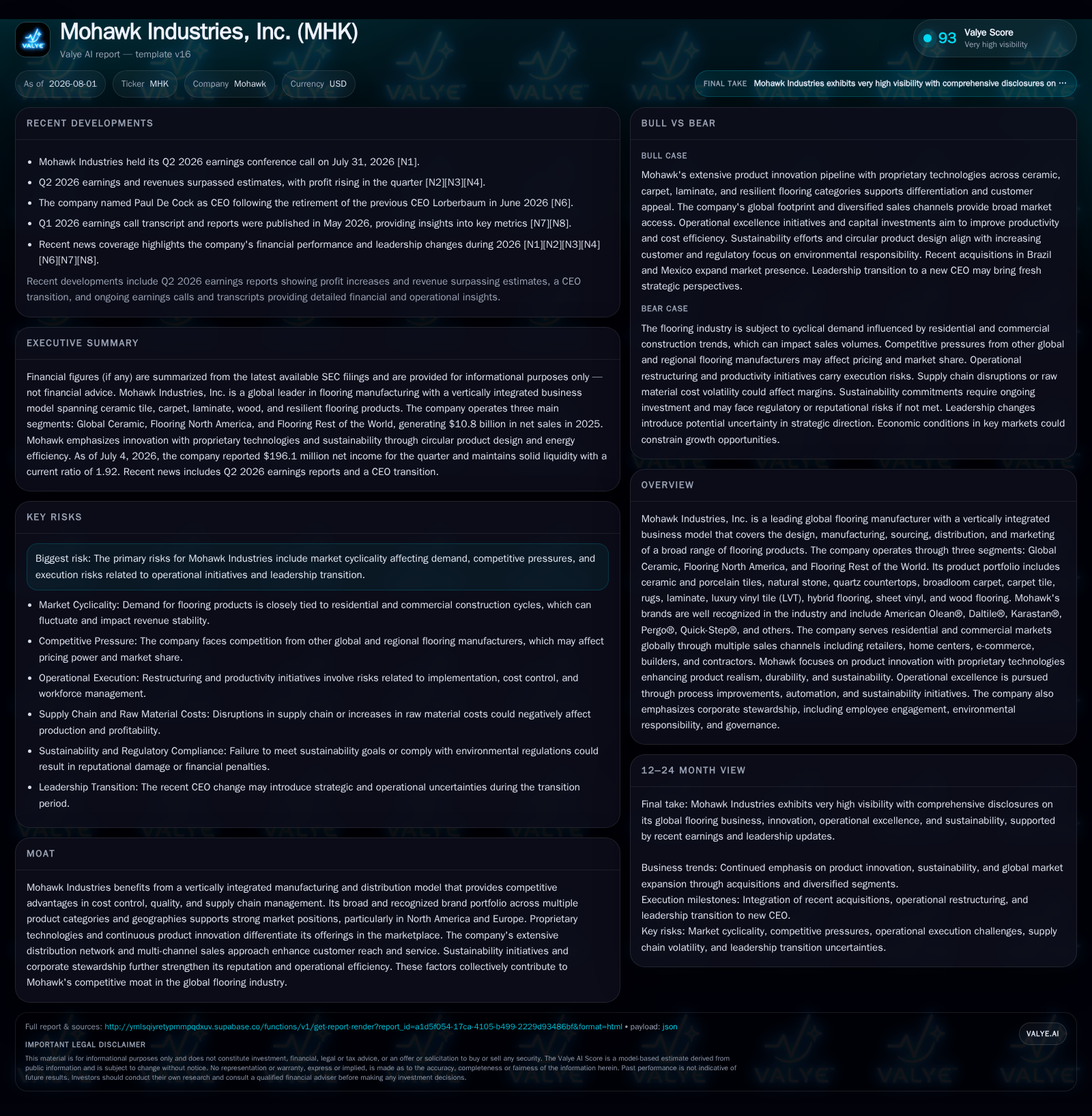
In its Q2 2026 earnings release, Mohawk Industries demonstrated operational resilience with revenues and earnings surpassing expectations despite a mixed macroeconomic backdrop affecting housing and remodeling activity. The company's vertically integrated production and distribution model underpins cost control and quality consistency across diverse product categories including ceramic tile, luxury vinyl tile, carpet, and wood flooring. Geographic diversification with balanced U.S. and international exposure further cushions demand cyclicality. Product innovation, notably in proprietary technologies such as SmartStrand®, coupled with an extensive multi-channel sales approach, bolsters Mohawk’s competitive positioning. Risks remain from macro sensitivity, pricing pressures related to imports, and execution of operational initiatives. The company’s solid liquidity profile supports strategic flexibility going forward.
Q2 Operating Performance Validates Strategic Positioning Amid Industry Cyclicality
Mohawk Industries reported second-quarter fiscal 2026 operating results that exceeded consensus estimates on both revenue and earnings measures despite ongoing headwinds in the housing market influenced by elevated interest rates. While residential remodeling demand has softened, the company showed encouraging volume stability in certain product categories supported by steady North American new construction activity. The reported average selling prices (ASPs) held firm in key segments indicating persistent pricing power which underscores Mohawk's effective cost management within its vertically integrated supply chain [S2][N2][N3]. Capacity utilization trends have benefited from deployment of recent capital investments aimed at boosting productivity while inventory turnover metrics suggest healthy demand visibility without undue buildup. Together these factors point to business model durability amid cyclical pressures that typically impact the flooring industry.
Business Model Insights: Integrated Manufacturing Fuels Diverse Product Offering & Channel Reach
Mohawk's business model leverages a highly integrated manufacturing-to-distribution value chain that spans raw material preparation through finished goods delivery across a broad product suite including ceramic tiles (porcelain slabs), natural stone surfaces, quartz countertops, broadloom carpet featuring proprietary SmartStrand® fiber technology, luxury vinyl tile (LVT), laminate flooring, hybrid flooring, sheet vinyl, and wood flooring [S1]. This vertical integration strategy enables tight control over costs, quality consistency, supply chain resilience, and rapid commercialization of innovations. For example, the Global Ceramic segment—accounting for roughly 40% of total annual revenue—manufactures diversified sizes and decorative trim pieces powered by proprietary glaze technologies to meet evolving consumer design preferences.
Multi-channel distribution amplifies reach with products marketed through retail outlets such as home centers (e.g., big box stores), specialty floor retailers, e-commerce platforms targeting DIY consumers, residential builders for new construction projects, and commercial contractors managing large-scale fit-outs [S1]. Mohawk’s brand portfolio includes recognized names such as American Olean®, Daltile®, Karastan®, Pergo®, Quick-Step®, providing stable customer retention due to brand equity across regions.
Competitive Positioning Reinforced Through Innovation and Geographic Mix
Relative to peers like Shaw Industries or Interface Incorporated—which also emphasize sustainability-driven innovation—Mohawk’s scale advantage and geographic diversification enhance its moat. Approximately 54% of revenues derive from the U.S., with the balance spread between Europe and other international markets contributing to a more balanced risk profile against regional economic cycles [S1]. Frequent new product introductions targeted at premium segments assist in maintaining differentiated positioning that justifies ASP premiums. The company's sustainability initiatives—such as using recycled materials in carpet fibers—align with growing customer preference for eco-friendly options which could support longer-term profitable growth [S14][S15].
Pricing pressures from imports remain a monitored challenge given global competitors potentially benefitting from state subsidies or lower input costs [S1][S13]. However Mohawk's combination of patented technology (e.g., in carpet fiber) plus vertical integration helps mitigate some external sourcing risks while elevating product performance benchmarks
Growth Levers: Innovation, Sustainability Demand, & Expansion Beyond North America
Industry growth typically hinges on residential/commercial new construction expansion alongside remodelling spending normalization. Mohawk strategically invests in high-value product innovation focused on materials like porcelain slabs which replicate natural stone aesthetics but deliver superior durability—targeting both commercial developers and upscale residential customers [S1]. Additionally expanding quartz countertop offerings meets rising demand for coordinated surface solutions.
The company is scaling e-commerce efforts alongside traditional channels to capture digitally influenced buying behavior shifts particularly among younger homeowners. Investments in production capacity tailored to fast-growing categories such as LVT are poised to fuel volume gains where Mohawk holds recognized market leadership positions [S1]. Sustainability commitments not only address regulatory expectations but also serve as brand differentiators enhancing loyalty among environmentally conscious buyers.
Risks on Watch: Macro Sensitivities, Pricing Pressures & Execution Dynamics
Mohawk operates in a sector that is inherently cyclical due to dependency on housing market health affected by interest rates, consumer confidence, and government infrastructure spending policies [S1]. Prolonged economic downturns or rising mortgage costs could significantly reduce floor covering demand causing margin compression through weaker volumes or forced discounting. Moreover fluctuating raw material commodity prices (such as resins for vinyl) directly impact costs requiring agile pricing strategies.
Trade tariffs have increased landed costs on some imported inputs affecting product cost profiles; this factor combined with aggressive global competition may limit price increases or erode market share if unaddressed. Execution risks related to ongoing plant productivity improvements or integration of acquired businesses must be managed closely to avoid operational disruption or dilution of profitability targets [S2][S13].
What’s Next: Market Signals and Execution Milestones to Track in Late 2026
Key near-term indicators include tracking order backlog development segmented by geography—particularly whether international markets regain momentum after recent softness—and monitoring ASP trajectories indicative of maintained pricing power versus competitive encroachment [N1][N4]. Segment margin expansion especially within high-growth LVT and ceramic categories will signal successful absorption of inflationary headwinds plus productivity enhancements.
Capacity utilization rates at recently enhanced facilities combined with inventory turnover levels will reveal alignment between supply chain agility and evolving demand patterns. Geographic sales mix shifts towards emerging markets or digital channels may offer early clues regarding structural growth opportunities beyond core mature regions.
Financial Profile Discussion: Capital Efficiency Supports Strategic Flexibility
As of the end of Q2 2026, Mohawk’s liquidity remained robust with approximately $850 million in cash and cash equivalents coupled with a current ratio near 1.92 reflecting solid short-term financial health supporting operational needs without dependence on incremental borrowing [F1][S2]
This analysis is based solely on publicly available filings and disclosures as of July 31, 2026. It does not constitute investment advice or research views but provides a detailed assessment grounded in latest company data within the building materials manufacturing sector specialized in flooring products.
Disclaimer: This is research-only, informational analysis and not investment advice. It may include AI-generated interpretation and general industry context. Always verify important details using primary sources.

Comments