
Cavco’s Integrated Finance Fuels Growth Despite Material and Labor Constraints
Cavco Industries leverages a vast production network and embedded financing services to grow amid supply challenges in manufactured housing.
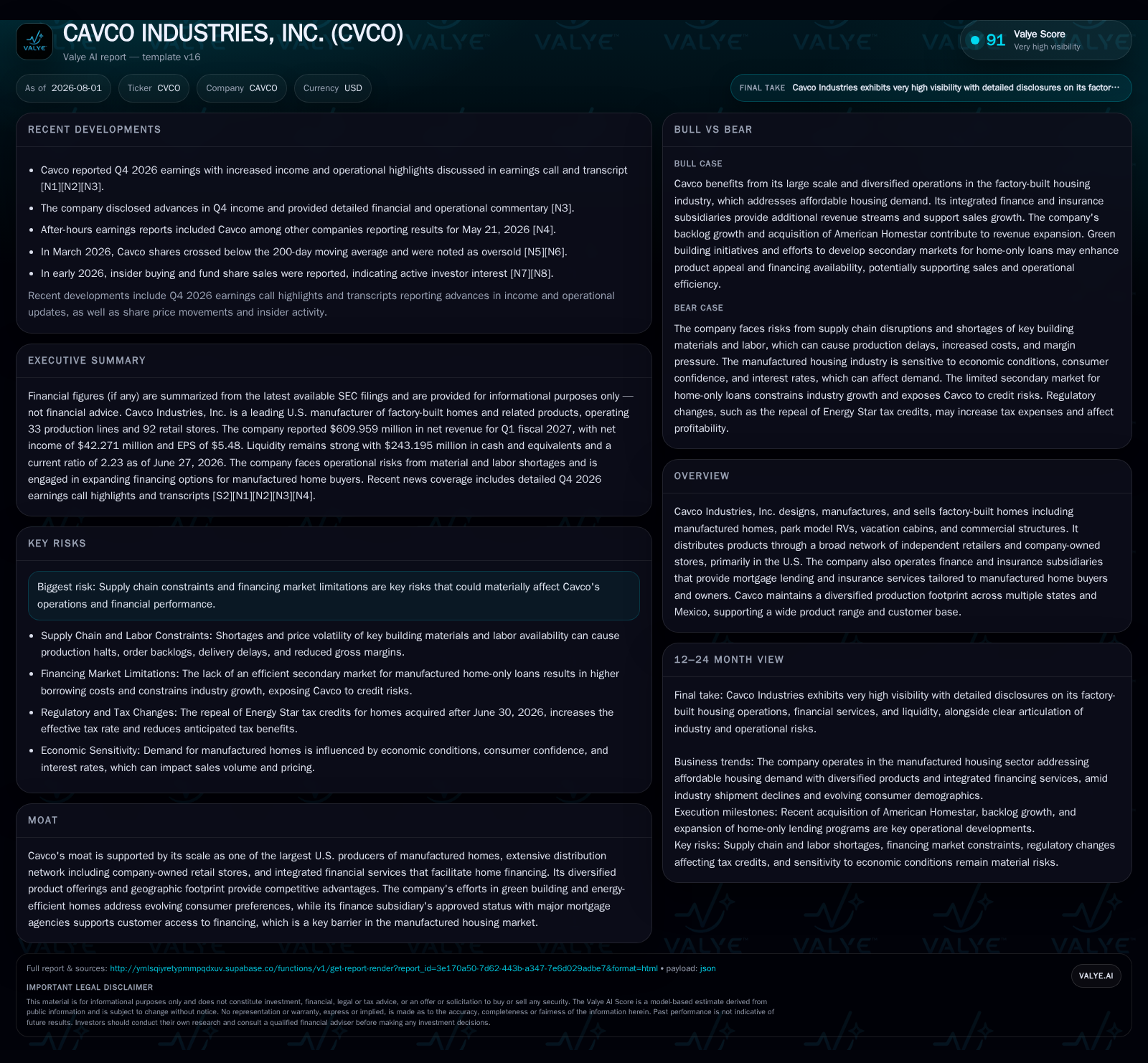
In its latest quarterly filing, Cavco Industries reports operating from 33 production lines across the U.S. and Mexico, navigating persistent raw material shortages and labor availability constraints. The company’s integrated mortgage lending and loan servicing subsidiary remains a key strategic moat by facilitating consumer financing in a traditionally constrained manufactured housing credit market. A diversified product mix spanning manufactured homes, park model RVs, vacation cabins, and commercial structures distributed through both independent and company-owned retail channels further bolsters Cavco’s competitive positioning. While growth is supported by ongoing secondary mortgage market efforts and green building trends, supply chain disruptions and credit market limitations temper near-term expansion prospects.
Production Capacity Expansion Meets Raw Material Constraints: Operational Realities From Q2 ’26
As of the end of Q2 fiscal 2026 (June 27), Cavco Industries operated an extensive network of 33 homebuilding production lines located throughout the United States—from Oregon to Florida—and including two international lines in Ojinaga, Mexico [S2]. This geographic diversification supports a broad product offering while mitigating regional risks such as labor shortages or supply disruptions. However, Cavco continues to face persistent constraints from shortages in critical building materials including wood products, gypsum wallboard, steel, windows, appliances, insulation, and petroleum-based products. These input scarcities have tangible operational impacts: extended order backlogs as delays compound; potential for delayed deliveries; and margin pressure due to material cost inflation outpacing price adjustments [S2].
Such supply bottlenecks underscore typical industry headwinds but are acute given the scale at which Cavco operates. While management attempts incremental pricing adjustments in response to cost increases, these often lag due to distributor contract structures and competitive pressures [S2]. The company's backlog—a metric reflecting committed yet not always firm orders—rose significantly to approximately $298 million at the end of Q2 from $195 million just three months prior. This signals strong latent demand but also raises caution since distributors may cancel orders without penalty until production begins. Effectively balancing workforce capacity with fluctuating demand remains an operational focus amid these volatile input conditions
Integrated Finance as a Strategic Lever in Overcoming Homebuyer Affordability Barriers
Cavco's business model uniquely integrates financial services supporting the purchase of its factory-built homes via its subsidiary CountryPlace Acceptance Corp., which holds approved seller/servicer status with Fannie Mae, Freddie Mac, and Ginnie Mae—the latter enabling issuance of GNMA mortgage-backed securities. This integration facilitates a more streamlined mortgage origination process for buyers of manufactured homes which traditionally suffer from limited financing availability compared to site-built housing markets [S1], [S2].
Loan originations for both consumer loans (homebuyers) and commercial loans (distributors/community developers) showed gradual increases compared to the prior year period indicating sustained lending activity supporting home sales. Moreover, loan servicing obligations tied to Ginnie Mae/Freddie/Fannie instruments expose Cavco to prepayment risks but also anchor recurring fee income streams.
This embedded financing capability functions as a significant barrier to entry for competitors lacking similar partnerships or secondary market access for manufactured home-only loans. Given that borrowing costs remain higher for manufactured home buyers due to fragmented secondary markets versus traditional residential mortgages, Cavco's role in fostering lending programs—including community-based initiatives—augments sales potential while dampening reliance on external lenders facing capital constraints [S1], [S24].
Diversified Product Mix and Distribution Channels Cement Market Position
Cavco’s revenue derives primarily from the design, manufacture, wholesale distribution, and retail sales of factory-built housing products encompassing manufactured homes (the largest segment), park model recreational vehicles (RVs), vacation cabins tailored for leisure use, as well as factory-built commercial structures for various ancillary applications [S1], [S2]. This product breadth mitigates reliance on any single sub-market segment thus softening cyclical sensitivity inherent in residential construction.
Distribution channels combine a network of independent retailers alongside company-owned stores strategically located near key markets. This dual channel approach strengthens customer access—critical in an industry marked by highly localized demand patterns—and enables better control over retail execution relative to peer producers who rely extensively on third-party distributors only. The scale benefits derived from this extensive retail footprint contribute materially toward brand awareness and operational efficiencies.
The industry's highly fragmented retail landscape outside Cavco’s footprint contrasts with its integrated approach that combines manufacturing scale with direct-to-consumer sales capabilities. Such integration improves lead times management amid supply chain variability while bolstering margin structure through reduced distribution layers.
Manufactured Housing Sector Dynamics Shape Competitive Landscape and Peer Benchmarks
Within the broader manufactured housing industry—a segment distinct from site-built residential construction—Cavco stands among leaders combining both sizeable manufacturing capacity across a geographically diverse facility base and significant finance capabilities via mortgage lending subsidiaries [S1]. This positioning allows it to better manage operating leverage inherent in fixed facility costs while championing proprietary loan products addressing industry-wide credit gaps.
Competitors generally cluster into standalone manufacturers focused on volume efficiency or regional players lacking full spectrum financing integration. Such peers face limitations translating order backlog picks into realized revenue without dedicated lending channels actively growing the secondary mortgage market for manufactured home loans.
Other players prioritize innovations around energy-efficient designs or green building practices; however Cavco’s previous investment in renewable energy-compatible envelope designs further strengthens its appeal given increasing consumer preferences for sustainable homes aligned with evolving regulatory standards.
Growth Catalysts: Financing Innovation, Geographic Reach, and Sustainable Homes Adoption
Future growth is expected to be driven by expansion within downstream financing markets solving traditional hang-ups on home-only loan affordability—a critical factor since manufactured homes typically benefit from lower sticker prices but suffer higher relative borrowing costs than site-built equivalents owing to liquidity constraints in secondary markets [S1]. Cavco's ongoing involvement in developing these markets through securitization efforts with GNMA/Freddie/Fannie programs offers levers for accelerating uptake among qualifying buyers
Geographic expansion both domestically—maintaining balanced coverage across multiple states—and internationally via Mexican assembly plants supports manufacturing agility correlating with shifting demand pockets while smoothing input sourcing across jurisdictions.
Additionally, increasing consumer adoption of energy-efficient homes—which reduce utility expenses—aligns well with Cavco’s investments in green building technology refinements enhancing product differentiation.
Operational Risks: Supply Chain Variability, Labor Shortages, and Financing Market Limits
Notwithstanding growth opportunities Cavco encounters substantial risks that could materially impact operating performance including:
- Raw materials volatility where sudden scarcity or cost spikes for wood products or steel can force production halts or margin compression;
- Labor availability challenges necessitating ongoing recruitment investment amid tight labor markets that risk constraining maximum achievable production output;
- Financing ecosystem inefficiencies where underdeveloped secondary mortgage market segments elevate borrowing costs limiting buyer pool expansion despite in-house lending programs;
- Regulatory uncertainties such as recent repeal of Energy Star tax credits effective July 2026 reducing federal incentives that had favored energy-efficient manufactured homes impacting product attractiveness temporarily until alternative subsidies potentially emerge [S16]
These factors contribute toward monitoring KPIs like cancellation rates pre-production start within backlog values—since order cancellations before production commence carry no penalty—which can signal emerging demand softness underlying apparent backlog strength.
What to Watch: Order Backlog Trends, Loan Portfolio Performance, and Regulatory Signals
Critical near-term indicators include tracking quarterly fluctuations in order backlog size adjusted for cancellations reflecting real firm demand; changes in loan origination volumes signaling credit market conditions impacting buyer financing availability; portfolio delinquency trends within loan servicing operations providing early warnings on credit quality shifts; plus regulatory developments particularly around federal incentives affecting energy-efficient housing tax credits or lending program eligibility standards.
Monitoring these markers will help gauge Cavco’s success in converting backlog into revenue under volatile supply conditions while assessing stability within its finance subsidiary’s asset quality securing sustainable earnings growth alongside manufacturing expansions.
Financial Profile Discussion: Liquidity Strength Amid Interest Income Compression
Financially, Cavco demonstrates robust liquidity supported by approximately $243 million in cash and equivalents against negligible total debt of about $338,000 as of the latest quarter-end, implying an effectively net cash position enabling operational flexibility—even amid capital-heavy manufacturing investments planned currently [F1], [S2]. The current ratio stood at 2.23 as of June 27, 2026, reflecting solid short-term balance sheet strength [F1].
This liquidity buffer supports resilience against cyclical downturns or supply chain disruptions permitting targeted capital allocation toward maintenance capex or acquisitions without compromising core operations.
Disclaimer: This analysis is based on publicly available company filings as cited; it does not constitute investment advice but aims at providing an informed industry-insider perspective on Cavco Industries’ operating environment and competitive positioning as reflected through recent disclosures.
Disclaimer: This is research-only, informational analysis and not investment advice. It may include AI-generated interpretation and general industry context. Always verify important details using primary sources.

Comments