
Universal Display Advances OLED Leadership Through Patent Strength and Royalty Growth
Q2 results underscore robust royalty revenue growth anchored in a strong patent portfolio amid fluctuating material sales tied to OLED panel production cycles.
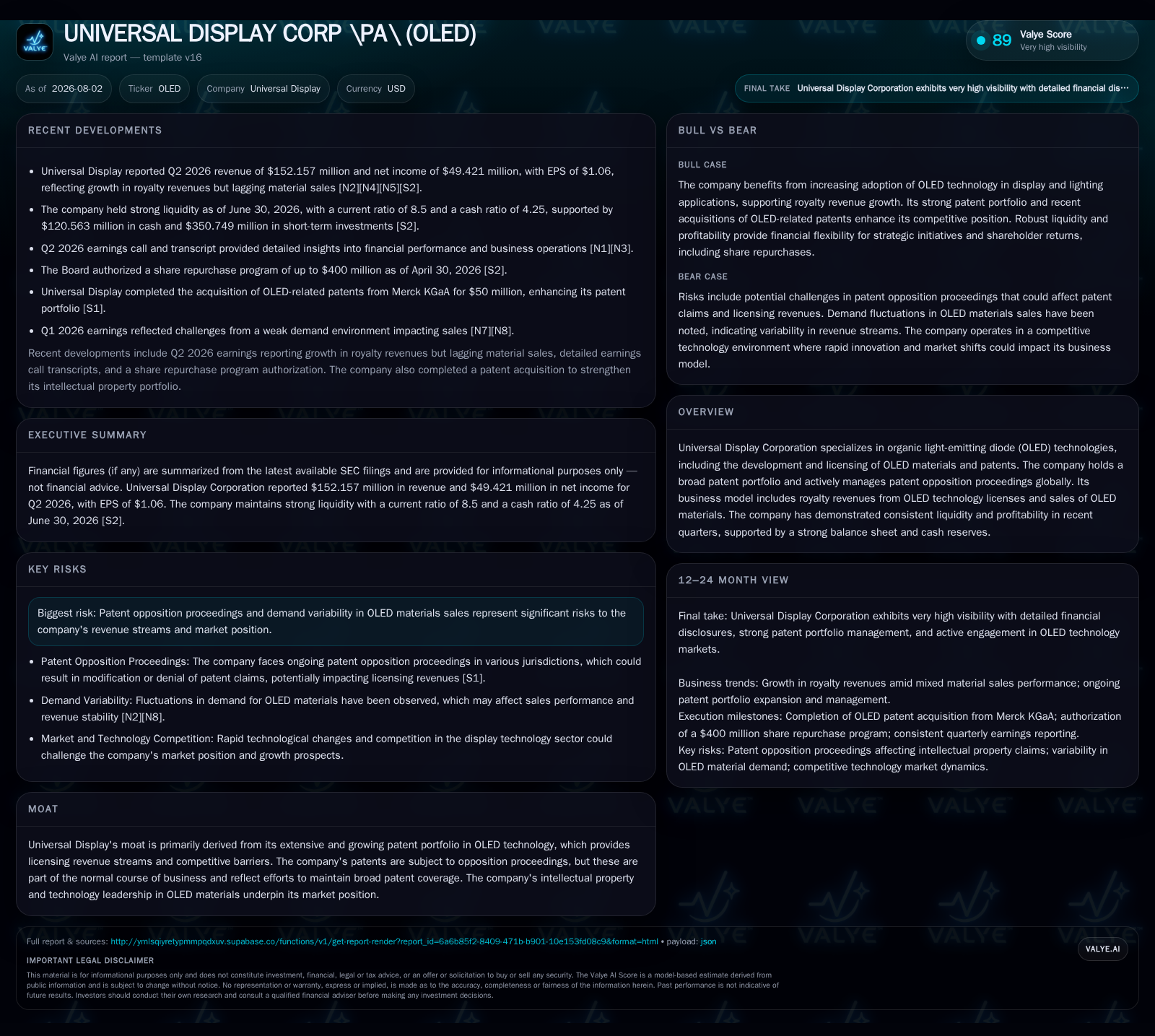
Universal Display Corp posted solid second-quarter results with royalty revenues outpacing material sales, reflecting continued expansion of its OLED technology licensing footprint. The company’s enduring moat rests on its extensive and actively managed patent portfolio that underpins recurring royalty streams linked to licensee panel production volumes. Meanwhile, material sales exhibited near-term variability owing to cyclical dynamics in OLED manufacturing and supply chain conditions. Sustained R&D investment supports innovation leadership and strengthens the company’s ability to defend against patent challenges globally. While patent opposition proceedings pose ongoing risks, they remain part of the normal IP lifecycle reflective of widespread adoption of OLED technologies.
Second Quarter Royalty Growth Underpinned by Patent Moat Expansion
Universal Display Corporation's Q2 2026 results highlighted a sharp contrast between royalty revenue growth and the more uneven performance of material sales. Royalty revenues expanded significantly as licensees continued ramping OLED panel production volumes, signaling robust technology adoption across smartphone, TV, and emerging display segments [S2][N2][N4]. This volume linkage is central to Universal Display’s recurring revenue profile: royalties are earned as a percentage of finished OLED panel output under long-term licensing agreements with major display manufacturers such as Samsung Display and LG Display — key partners who integrate Universal Display’s proprietary OLED materials under licensed patents [S1]. The company's patent portfolio acts as a gatekeeper here; it ensures that only licensees authorized through licensing agreements can utilize the patented technology for commercial panel fabrication.
This dynamic confers a degree of revenue visibility unusual for materials suppliers because royalty income scales predictably with licensee panel production. The steady rise in royalties thus reflects both expanding OEM adoption of OLED technology over alternative displays like LCD or emerging MicroLEDs, and Universal Display’s success in maintaining a broad patent coverage that deters unauthorized use [N3]. The sustainability of this moat relies heavily on rigorous intellectual property management including proactive defense via opposition proceedings where challengers question patent validity — an increasing but anticipated trend given the maturation of OLED tech [S1][S6].
Material Sales Reflect Cyclical Panel Production Amid Supply Chain Constraints
In contrast to royalty growth, direct sales of proprietary OLED materials exhibited more volatility in Q2. Material sales are inherently subject to fluctuations in customer procurement tied to manufacturing capacity plans, inventory cycles, and component sourcing conditions within the highly complex OLED value chain [S2][N2]. Customers primarily consist of panel manufacturers purchasing Universal Display's phosphorescent emitter materials which are critical components embedded in each OLED panel stack.
The observed lag in material sales relative to royalties suggests some softening or delay in panel factory throughput or batches produced during this quarter. Supply chain disruptions — a common theme across advanced manufacturing sectors — likely impacted customer ordering patterns transiently. Although this creates short-term top-line variability, it does not diminish longer-term demand as OLED penetration deepens into premium consumer electronics segments that prioritize higher efficiency and image quality displays [N1]. Gross margins on materials sales remain healthy due to the specialized nature of these inputs but exhibit less stability compared to royalty margins [S2].
Licensing Agreements Drive Recurring Revenues While Innovation Sustains Competitive Edge
Universal Display’s business model marries two complementary revenue streams: variable but recurring royalties tied to licensee panel output and direct product revenues from selling proprietary materials used in those panels [S1][S3]. This hybrid structure balances dependable cash flow from royalties against exposure to manufacturing cycle swings inherent in supplier contracts.
The company reported an increased number of active licensing agreements reflecting both renewals with existing licensees and incremental deals as new players adopt standard-essential OLED technologies [S3]. These multi-year contracts often incorporate technology transfer components enabling licensees’ efficient integration of Universal Display's materials into existing production lines while safeguarding intellectual property rights.
Continuous innovation through substantial R&D investment proves vital for keeping this business model vibrant. Advances in organic emissive compounds enhance panel efficiency, lifespan, brightness, and color precision — all critical for maintaining market preference for licensed technology versus competing alternatives [S1][S2]. The innovation pipeline also supports expansion into flexible displays and non-standard form factors which command premium pricing structures.
Patent Opposition Proceedings: Balancing Risk With Portfolio Breadth
The company recognizes that growing activism around patent oppositions is an inevitable aspect of maturing technology sectors [S1][S6]. Third parties frequently challenge issued patents claiming invalidity or technical deficiencies within jurisdictional limits. While such proceedings carry some degree of uncertainly regarding future enforceability or claim scope, Universal Display views these challenges as routine defensive engagements aimed at preserving maximal patent breadth possible.
Patents challenged remain presumed valid during ongoing administrative reviews until final adjudication. Given the scale and depth of Universal Display’s portfolio relative to competitors or new entrants, these oppositions do not currently undermine fundamental licensing revenue streams but could require careful navigation over time as markets evolve [S6]. Continual monitoring and swift legal response capability underpin their IP strategy.
Emerging OLED Applications Expand Growth Opportunities Despite Near-Term Volatility
Beyond conventional uses in smartphones and TVs, Universal Display is strategically positioned to benefit from rising OLED adoption in automotive displays, wearable devices, lighting solutions, and curved/flexible screens—a segment experiencing accelerating demand due to consumer expectations for high resolution combined with novel form factors [S1]. These applications create incremental royalty opportunities as new licensees engage around these use cases coupled with corresponding increases in proprietary material requirements.
Though still nascent compared with core smartphone/OLED TV markets, this diversification helps mitigate risks related to cyclical slowdowns in traditional segments. Persistent improvement in material properties like durability against environmental stressors further catalyzes OEM willingness to invest upstream licenses.
Risks from Market Concentration and Technology Shifts Remain Watchpoints
Significant reliance on a relatively small cohort of large OEM licensees exposes Universal Display to concentration risk should one or more reduce production or shift away from licensed technologies due to competitive pressures or strategic pivots [S1][S2][S6]. Additionally, disruptive innovations like MicroLED or advances in LCD efficiency pose latent threats if they gain meaningful adoption potentially diluting demand for OLED technologies.
Patent litigation outcomes represent another watchpoint; although opposition processes are routine defenses rather than adversarial court battles seeking damages claims, adverse findings could narrow claims’ scope diminishing licensing leverage overtime [S6]. Currency fluctuations impacting international licensing settlements add another layer of financial risk given globalized customer bases.
Development Pipeline and R&D Investments Reinforce Industry Positioning
Maintaining high R&D expenditures (measured relative to revenues) signals commitment to innovation leadership necessary for defending competitive moats based on intellectual property strength [S1][S2]. Innovations span novel emitter compounds enhancing quantum efficiency as well as tailored formulations optimized for various substrate types including flexible plastics enabling foldable displays.
This ongoing investment fortifies next-generation patent filings extending franchise longevity while creating incremental product differentiation allowing premium pricing power on material sales. It also supports proactive responses to emerging competitive threats through pipeline refreshment rather than dependency on legacy patents alone.
Financial Profile Discussion: Liquidity Strength Supports Ongoing Innovation
As of June 30, 2026, Universal Display maintained cash & equivalents exceeding $120 million complemented by $942 million in current assets against $111 million current liabilities yielding a robust current ratio above 8x—indicating strong liquidity conducive to steady operational funding including aggressive R&D investments without strain [F1]
Profitability metrics remain solid with operating income consistently ahead due largely to scalable royalty streams buffered from commodity-like material sales volatility. This financial flexibility supports ongoing technology acquisition initiatives (such as prior deals involving Merck KGaA patents) and share repurchases without compromising balance sheet stability [S5][F1]. Together, these factors underscore capacity for sustained innovation-driven competitive positioning amidst dynamic industry conditions.
This analysis synthesizes disclosed quarterly performance alongside broader industry understanding relevant to Universal Display's specialized role as an IP licensing leader supplying cutting-edge OLED technologies. While near-term cyclical fluctuations persist primarily within material sales linked closely to display manufacturing rhythms, the company's entrenched royalty base supported by wide-ranging patents continues offering predictable recurring revenues bolstered by ongoing innovation efforts. Monitoring patent opposition trajectories alongside emerging application market adoption will be crucial indicators shaping future operating momentum.
Disclaimer: This report is for informational purposes only; it does not constitute investment advice or research views concerning any securities mentioned herein.
Disclaimer: This is research-only, informational analysis and not investment advice. It may include AI-generated interpretation and general industry context. Always verify important details using primary sources.

Comments