
Contineum Advances PIPE-791 Phase 2 in IPF Amid Manufacturing and Clinical Risks
Latest quarterly update emphasizes PIPE-791’s clinical progress and supply chain dependencies, with PIPE-307 development contingent on partner Johnson & Johnson.
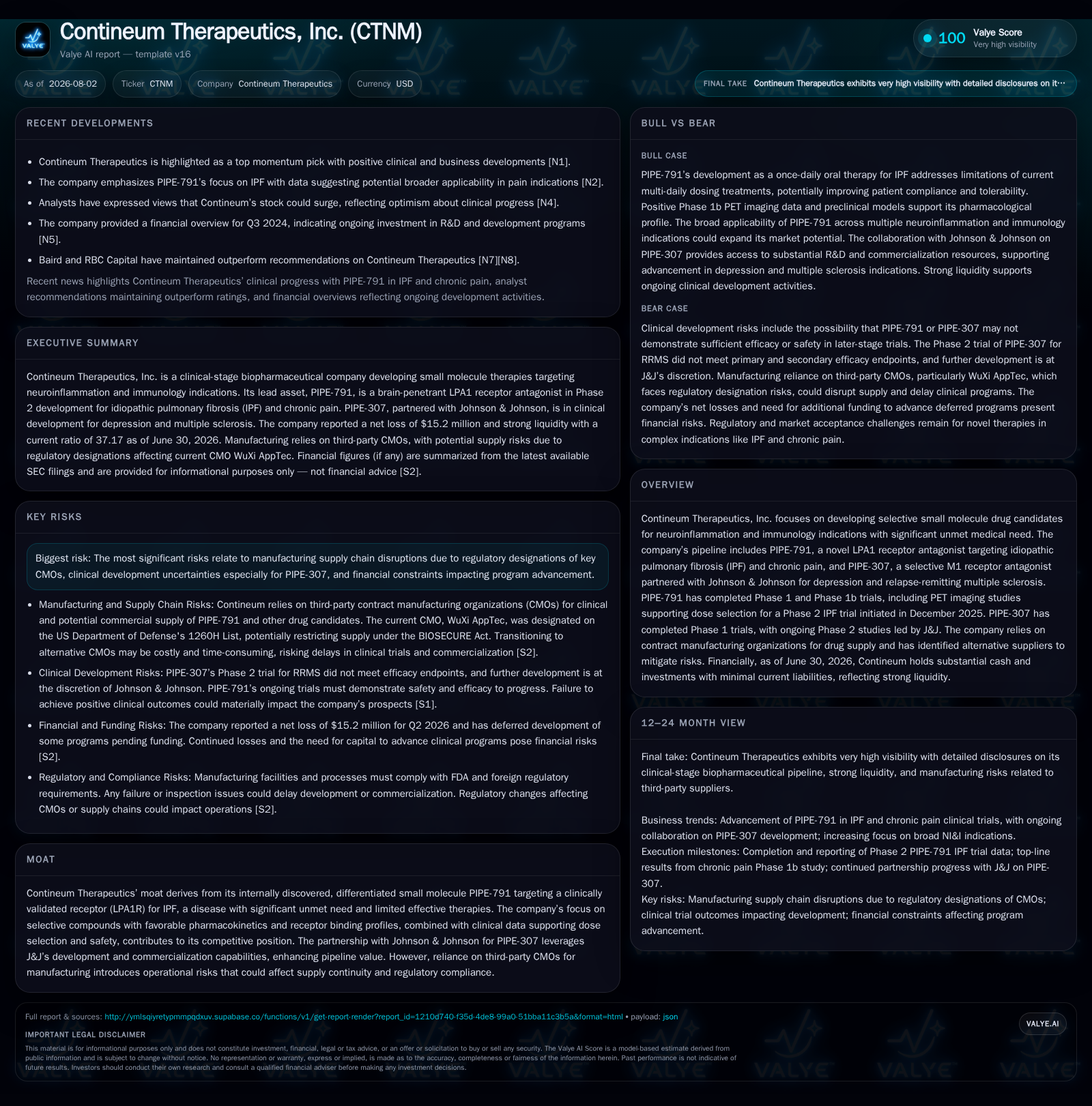
Contineum Therapeutics, a clinical-stage biotech focusing on neuroinflammation and immunology, recently initiated Phase 2 trials of PIPE-791 targeting idiopathic pulmonary fibrosis based on supportive Phase 1 data. Its pipeline also includes PIPE-307 for depression and multiple sclerosis under a partnership with Johnson & Johnson, which faces clinical setbacks in RRMS indications. The company's strategy leverages differentiated small molecule candidates but remains exposed to manufacturing supply risks due to reliance on contract manufacturers. Financially, Contineum maintains a strong liquidity position supporting ongoing operations.
Recent Operating Update: Advancing PIPE-791 and Manufacturing Risks
Contineum Therapeutics' latest quarterly filing dated July 30, 2026, confirms the initiation of a Phase 2 clinical trial for its lead wholly-owned asset, PIPE-791, targeting idiopathic pulmonary fibrosis (IPF). This progression follows the completion of Phase 1 and Phase 1b PET imaging studies that provided key pharmacokinetic (PK) and receptor occupancy (RO) data instrumental for dose selection in the ongoing trial [S2], [S1]. Notably, enrollment for this study commenced in December 2025, aiming to address a rising patient population with IPF where effective therapies remain limited.
Simultaneously, Contineum disclosed ongoing Phase 1b results from a trial assessing PIPE-791's safety and efficacy in chronic pain indications including chronic osteoarthritic pain (COAP) and chronic low back pain (CLBP), with topline data anticipated in Q2 2026 [S1]. This demonstrates management's effort to expand the drug candidate's indication breadth within neuroinflammatory pathways.
On the partnership front, PIPE-307—a selective muscarinic type 1 receptor antagonist licensed exclusively by Johnson & Johnson (J&J)—has experienced mixed outcomes. While two Phase 1 trials confirmed safety in healthy volunteers and J&J has initiated a Phase 2 monotherapy proof-of-concept trial for major depressive disorder (MDD), the analogous Phase 2 VISTA trial in relapse-remitting multiple sclerosis (RRMS) failed to meet primary or secondary efficacy endpoints despite acceptable tolerability [S1]. Consequently, future development hinges on J&J's discretion [S1].
Operationally, Contineum remains entirely dependent on third-party contract manufacturing organizations (CMOs) for supplying research-grade APIs and finished drug product under good manufacturing practice (cGMP) guidelines. WuXi AppTec serves as the primary CMO for PIPE-791’s clinical material production during strong regulatory compliance history; however, the company has flagged supply chain risk due to this reliance and identified alternative CMOs without securing binding contracts yet—highlighting potential disruption should transitions become necessary [S2]. Such manufacturing outsourcing aligns with sector norms but amplifies operational risk related to supply continuity.
Business Model: Differentiated Small Molecule Therapeutics Addressing Unmet NI&I Needs
Contineum operates predominantly in the early-to-mid pharmaceutical value chain stages—discovering and developing small molecule drug candidates targeting neuroinflammation and immunology (NI&I) indications with substantial unmet medical need. The company’s lead candidate PIPE-791 selectively antagonizes lysophosphatidic acid receptor type 1 (LPA1R), which is clinically validated in IPF pathophysiology. It distinguishes itself through favorable PK properties such as high bioavailability, brain penetration capability, low plasma protein binding, and prolonged receptor residence time—all factors that can improve dosing convenience and efficacy versus competing modalities [S1].
Revenue generation at this stage remains inherently limited to upfront licensing fees, milestone payments, and eventual royalties contingent on regulatory approvals. For instance, the exclusive worldwide license agreement with J&J for PIPE-307 brings upfront payments and performance milestones coupled with downstream royalties upon commercialization [S1]. Channel-wise, Contineum transfers responsibility for late-stage development, regulatory navigation, manufacturing scale-up, and marketing for partnered assets like PIPE-307 to established pharma players. This arrangement mitigates capital intensity but imposes strategic dependency.
Manufacturing is outsourced entirely without internal production capacities or facilities; API synthesis and final drug product formulation rely on partners compliant with cGMP standards. This reduces fixed cost burdens but adds complexity around supply chain coordination—a critical margin-related vector considering potential delays or quality-control setbacks arising at third-party sites [S1], [S2].
Industry Structure and Competitive Position
The biotechnology sector focusing on novel small molecule therapeutics targeting neuroinflammation overlaps heavily with pharmaceutical companies specializing in CNS disorders. Contineum’s competitive distinction lies in its selective targeting of validated receptors like LPA1R for IPF—a rare indication where treatment options are limited but disease burden is severe—and M1R for psychiatric and neurological diseases via partnership.
Within peers encompassing clinical-stage biotechs progressing small molecules through phase trials or pharma firms backing similar indications (e.g., Biogen's neurology franchise or Bristol Myers Squibb’s focus on fibrotic disorders), Contineum’s pipeline depth is narrower but enhanced by collaboration with J&J—facilitating risk hedging on pipeline execution. Its reliance on proven molecular mechanisms helps validate its scientific rationale compared to early discovery-stage players pursuing unproven targets.
Manufacturing outsourcing aligns closely with industry norms given prohibitively high fixed capital demands of production facilities built to cGMP standards; however, Contineum’s explicit acknowledgment of transition risks reveals operational fragility often observed in comparably sized biotech developers dependent on single CMOs without diversified agreements.
Growth Drivers
Key growth drivers hinge foremost upon successful clinical progression of PIPE-791 through pivotal phases culminating in regulatory approval [S1]. Early PET imaging studies showing dose-dependent receptor occupancy enhance confidence in translational prospects; positive Phase 2 efficacy data would materially increase asset valuation potential given IPF’s significant unmet need evidenced by ~130,000 patients in the US alone
For PIPE-307, prospective advancement depends heavily on J&J’s strategic decision-making post-efficacy failures in RRMS trials. Should ongoing MDD trials demonstrate benefit or indication expansion be pursued by J&J leveraging their commercialization capabilities, revenue contributions could substantially diversify Contineum’s future streams.
Operationally, mitigation of manufacturing risks via multiple CMO arrangements would underpin continuous clinical supply chains essential to maintaining developmental momentum—determinant both commercially and regulatorily. Additionally, expansion into other NI&I indications leveraging these differentiated small molecules offers promising long-term pathway diversification.
Risks and Watchpoints
Manufacturing risks stand out prominently as the company lacks internal production control—any disruption at WuXi AppTec or inability to contract secondary suppliers promptly may delay critical clinical milestones or commercial launch timelines post approval [S2]. Transition complexities can lead to expensive revalidation processes that compress margins.
Clinical development uncertainties remain profound especially for PIPE-307 where recent efficacy setbacks place decision burden squarely on J&J’s commercial assessors; failure to reinitiate Phase 3 development or license expansion curtails upside substantially [S1].
Financial constraints typical of early-stage biotech arise from negative operating income trends extending into recent years; sustaining R&D funding until successful readouts necessitates ongoing capital acquisition or milestone revenues tied closely to pipeline success or partner payments [F1], [S3]. Additionally, intellectual property strength around selective receptor antagonists must withstand competitor innovation assaults over time.
What to Watch Next
Topline readouts expected mid-year from the Phase 1b chronic pain trial involving PIPE-791 will indicate whether new indications beyond IPF can justify expanded development capital allocation. Further progress updates from J&J regarding pipelines under license should be monitored closely for any shifts in Phase 2/3 investment or potential out-license transactions.
Supply chain updates detailing contracting progress with backup CMOs would signal reduced operational risk exposure impacting valuation multiples sensitive to manufacturing continuity.
Regulatory milestones related to IND filings or engagement frequency will also serve as barometers of timeline adherence relative to peer biotech asset windows given typical industry attrition rates at late phases.
Financial Profile Discussion
Contineum holds a solid liquidity position reflecting $14.7 million in cash and equivalents alongside substantial current assets totaling roughly $242.6 million as of June 30, 2026 [F1]. These figures underpin a remarkably strong current ratio exceeding 37x due principally to minimal current liabilities near $6.5 million—indicating excellent short-term financial flexibility supporting sustained R&D investment through upcoming clinical milestones without imminent refinancing pressures [F1].
The partnership revenue profile remains primarily milestone-based absent product sales; thus cash runway extension strategies will depend on achieving upcoming clinical readouts that trigger earned payments from licensing partners like J&J as well as external financing opportunities aligned with biotech market appetite at those inflection points.
Disclaimer: This analysis is based solely on publicly available information from SEC filings dated up to July 30, 2026 ([S1], [S2], [S3]) supplemented by companyfacts financial data ([F1]). It does not constitute investment advice nor forecasts precise future outcomes but reflects an objective synthesis grounded in biotech sector norms and company disclosures.
Disclaimer: This is research-only, informational analysis and not investment advice. It may include AI-generated interpretation and general industry context. Always verify important details using primary sources.

Comments