
Farmland Partners Advances Rental Income and Sustainability Amid Sector Challenges
FPI’s Q2 2026 update shows stable rental revenue with growth in renewable energy leases, alongside ongoing farmland portfolio management.
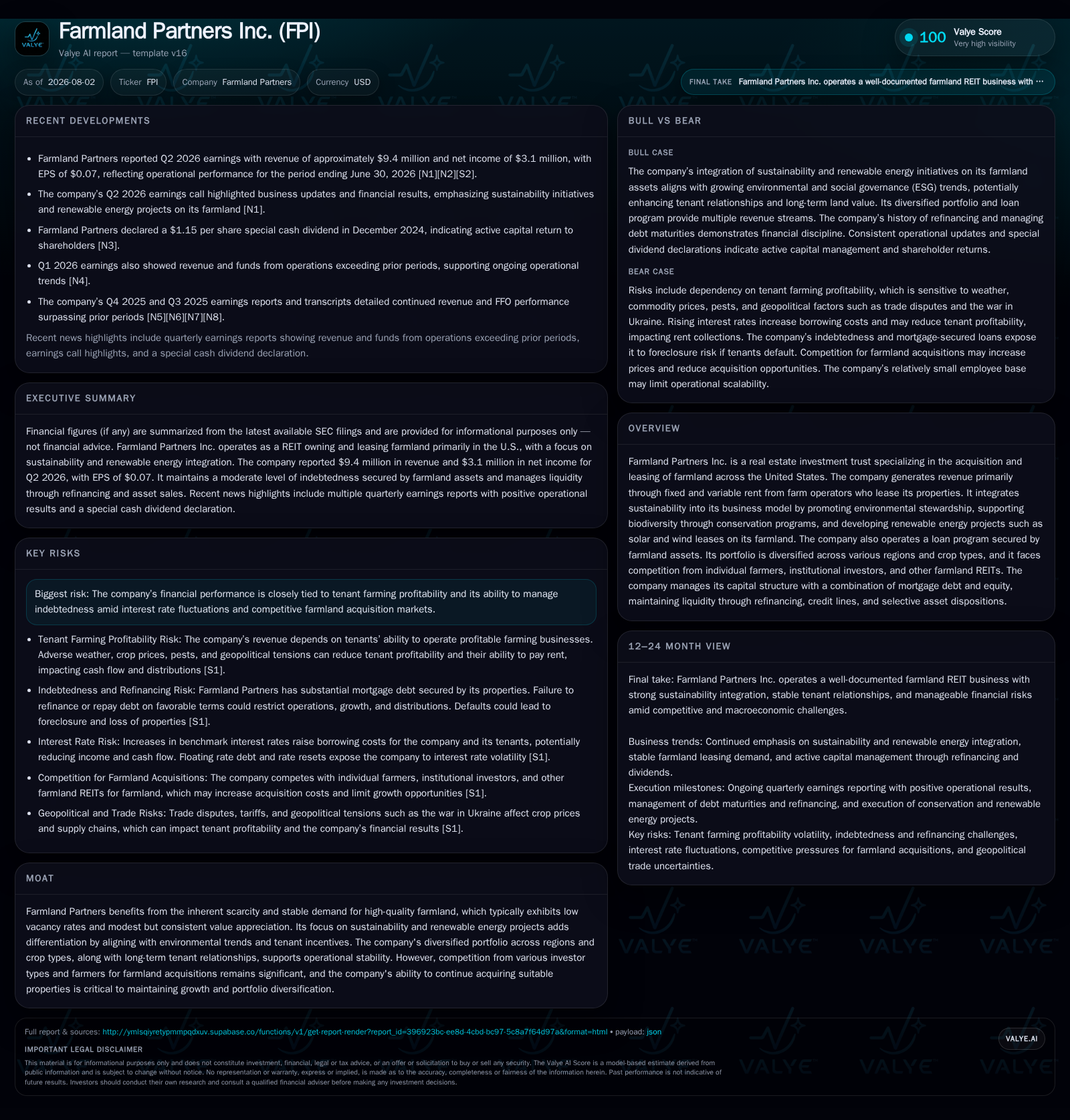
Farmland Partners Inc. (FPI) reinforced operating stability in Q2 2026 driven by recurring fixed and variable rent from its diversified farmland portfolio across the U.S. The company’s integration of sustainability through renewable energy projects and conservation initiatives adds a strategic layer to its income streams, differentiating it within the farmland REIT sector. While competition for acreage acquisition remains an ongoing challenge, FPI’s capital management approach—balancing mortgage debt and equity—supports its operational resiliency amid rising interest rates and farmland value fluctuations.
Recent Operating Update: Q2 2026 Highlights
Notably, FPI’s continuation of leasing acreage for renewable solar energy projects expanded their income diversification strategy, an increasingly integral component of their business model [S1]. The company's acreage under solar leases supports approximately 207 MW of renewable capacity as of December 31, 2025, a segment expected to grow with new projects leveraging owned farms' solar potential [S1]. Combined with biodiversity commitments via USDA Conservation Reserve Program enrollments, these sustainability initiatives strengthen tenant incentives and align land stewardship with broader environmental goals.
Business Model Analysis
Farmland Partners operates as a specialized real estate investment trust targeting acquisition and leasing of productive U.S. farmland. It monetizes assets primarily through lease agreements with tenant farmers who cultivate crops; revenue mechanics combine fixed minimum rents plus variable components often linked to commodity prices or yield outcomes [S1]. This structure generates recurring rental income backed by long-term lease agreements that typically feature low vacancy rates due to the fundamental scarcity and essential nature of farmland.
Beyond tenant rents, FPI supplements cash flows through ancillary operations such as solar and wind renewable energy leases and a loan program secured by farmland assets. These loans carry first or second lien mortgages on land or farm equipment, diversifying risk while deepening ties to the farming community [S19]. The company’s loan portfolio balance stood at approximately $44.6 million at year-end 2025 [S19], reflecting active engagement in financing agricultural operations.
Operationally, key drivers include total acres owned (currently diversified across regions), leased acres utilization rates near full capacity, average rental rates per acre which can rise with commodity pricing environments, tenant occupancy and lease renewal rates [S14][S20]. Additional variables such as operating expenses per acre impact margin outcomes. The firm actively manages these levers to optimize net operating income (NOI) and funds from operations (FFO), which provide industry-standard performance metrics for REITs
Industry Structure and Competitive Position
Within the farmland REIT landscape—comprised of players like Gladstone Land Corporation along with institutional agricultural funds and individual farmer ownership—FPI distinguishes itself through blended revenue streams inclusive of sustainability-linked projects. The competitive environment reflects intense contestation for high-quality farmland driven by increasing scarcity due to urban expansion removing prime arable lands [S1]. Individual farmers are most aggressive buyers, supported by institutional investors who compete on scale and capital availability.
FPI’s geographic portfolio diversity reduces concentration risks inherent in agricultural cycles and regional weather variability. Additionally, crop variety diversification cushions the company against commodity-specific downturns. Its focus on incorporating renewable energy leases not only taps new investor interest related to ESG but also provides tenants additional revenue incentives, enhancing lease renewal likelihood.
Growth Drivers
Long-term structural growth is underpinned by global trends: rising population elevates food demand; increasing GDP per capita especially in emerging markets shifts diets towards higher-quality foods requiring more arable inputs; biofuel markets also sustain demand for crops like corn and soybeans [S1]. Farmland value appreciation historically tracks these dynamics, compounded by limited expansions in cropland supply.
Renewable energy integration offers a complementary growth vector as farms offer natural sites for solar and wind installs without hindering core agricultural use. Environmental programs such as USDA’s Conservation Reserve Program further support sustainable land use while promoting biodiversity—a growing consideration among tenants and investors alike [S1]. Strategically selective acquisitions continue where accretive opportunities arise despite competition, aided by FPI’s capital access.
Risks, Constraints, and Watchpoints
The competitive environment for property acquisitions can drive up purchase prices limiting new portfolio additions essential for long-term growth. Regulatory changes affecting land use or environmental compliance could impose additional costs or restrict certain activities on owned farmland.
Increased impairment charges recorded in recent periods indicate some valuation pressures on select West Coast properties, warranting scrutiny on asset quality evolution [S13]. Legal expense upticks largely stem from current litigation matters but remain controlled relative to operating expenses [S13]. Capital allocation choices between share repurchases, acquisitions or asset dispositions also present trade-offs affecting shareholder value.
What to Watch Next
Expansion pace of renewable energy leases will provide insights into the scalability of this emerging revenue line. Likewise, further asset disposition announcements or accretive property acquisitions will reveal management's tactical balance between optimizing portfolio composition versus preserving capital flexibility.
Monitoring adjusted Funds From Operations (AFFO) per share trends will help assess operational cash flow sustainability after adjusting for non-recurring costs such as stock-based compensation or acquisition-related expenses [S14][S26]. Lastly, any changes in risk disclosures or litigation outcomes may impact financial flexibility.
Financial Profile Discussion
Increased impairments (approximately $17.8 million booked in 2025) slightly pressure net income but do not materially impair liquidity given offsetting gains on asset sales totaling $10.5 million during property dispositions [S12][S13]
Distributions comply with REIT regulatory requirements necessitating most taxable income distribution annually limiting internal cash retention yet providing shareholder returns reflective of operational earnings [S21]. Share repurchase programs have proceeded cautiously reflecting management’s balancing act between returning capital versus conserving funding room for portfolio opportunities.
Overall financial health hinges on maintaining debt covenants compliance amid interest expense reductions seen year-over-year due to lower outstanding balances—the ability to service debt without stress signals prudent capital management amid macroeconomic headwinds [S13][S19]
Disclaimer
This analysis is based strictly on filed documents and publicly available information as of August 2026 without forecasting or investment advice. It aims solely to provide detailed operational and industry context concerning Farmland Partners Inc.’s business model performance within its sector environment.
Disclaimer: This is research-only, informational analysis and not investment advice. It may include AI-generated interpretation and general industry context. Always verify important details using primary sources.

Comments