
METTLER TOLEDO Q2 2026 Highlights Margin Expansion and Industrial Growth Despite Geopolitical Risks
Strong segment profit growth in industrial products and tariff refunds buoy METTLER TOLEDO’s operating performance amid global uncertainties.
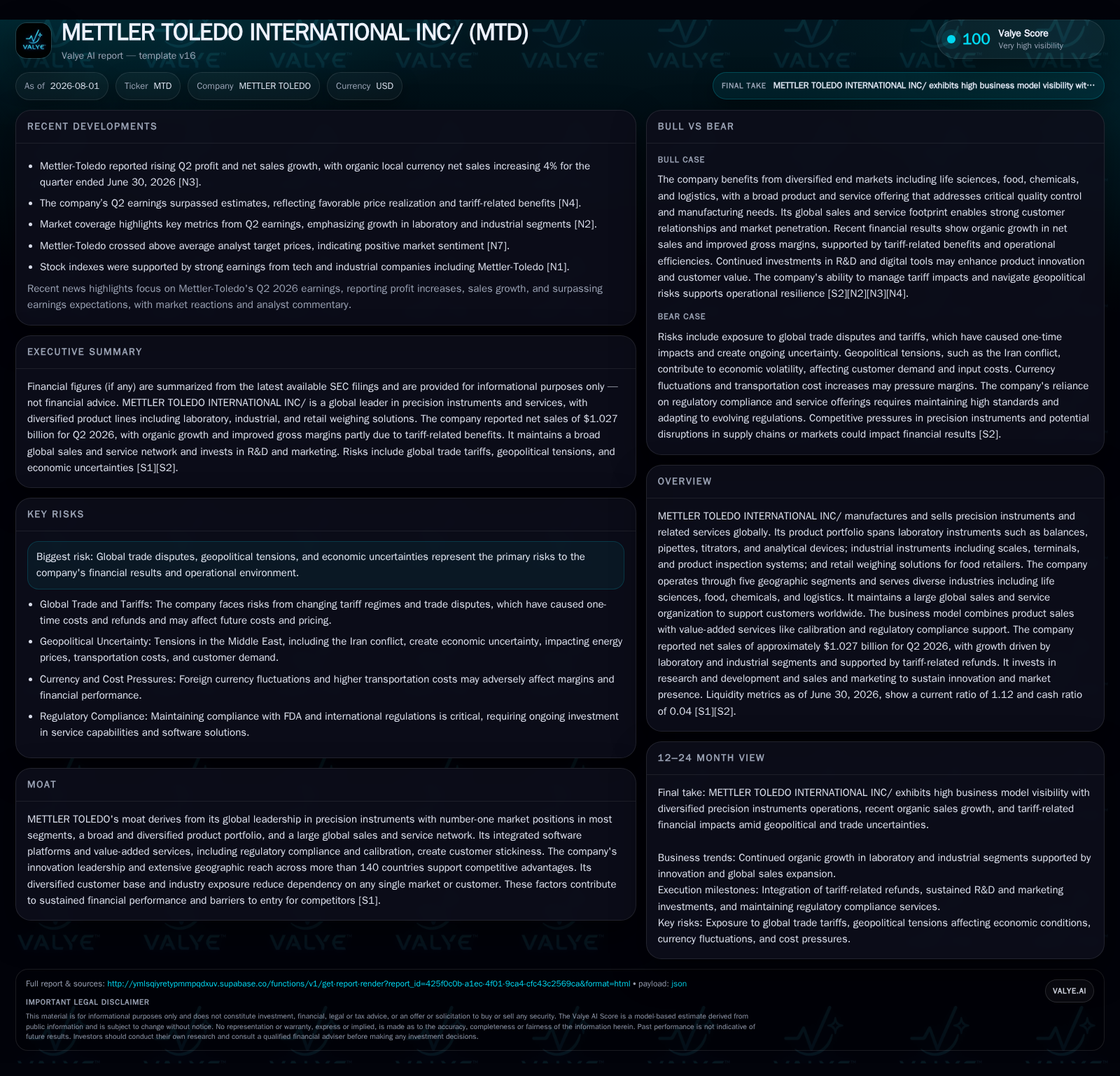
METTLER TOLEDO INTERNATIONAL INC reported net sales of $1.027 billion in Q2 2026, driven by robust demand in industrial instruments and laboratory segments alongside favorable tariff-related refund impacts. The company achieved segment profit increases supported by margin expansion initiatives despite unfavorable foreign currency translation. Its diversified geographic exposure and integrated sales-service model reinforce its competitive moat amid ongoing geopolitical and trade tensions. Capital expenditures rose slightly, focused on automation and facility enhancements, including a government-backed program in China. Risks remain from economic cycles, tariffs, and regional conflicts, but innovation leadership and recurring service revenues undergird stability.
Recent Operating Update
A distinctive feature impacting cost structure this quarter was a one-time tariff-related refund benefit of $52.4 million from the U.S. government linked to invalidated tariffs under the International Emergency Economic Powers Act (IEEPA). While this credit reduced cost of sales significantly, approximately $27.8 million of related customer refunds offset some net sales revenue—a reflection of the company's pass-through policy towards end customers ([S2]). This mechanism illustrates how global trade policy unpredictability can introduce volatility into operating results but is largely transitory.
Capital investments totaled $45.2 million for the first half of 2026 compared to $41.1 million in same period last year as Mettler-Toledo continues its push towards enhanced production automation and facility modernization—especially under an agreement secured with the government of Xuhui district in China aimed at expanding automated capacity and improving logistics infrastructure ([S2]).
Business Model Overview
Mettler-Toledo operates as a global leader in precision instruments spanning laboratory equipment such as balances capable of measuring microgram weights to large-scale industrial scales; pipetting solutions widely used in life science labs; titrators; along with advanced analytical instruments like moisture analyzers and spectrophotometers ([S1]). These hardware offerings are augmented by embedded software platforms like LabX that streamline data management and compliance documentation.
The company monetizes primarily through direct sales to institutional customers such as pharmaceutical companies, biotech firms, food producers, chemical manufacturers, academic research labs, transportation/logistics firms, metals processors, electronics manufacturers, and food retailers. Products at the higher end of technological complexity are sold mostly via a global direct sales force which enables tailored application support and upselling of associated calibration services—a recurring revenue source critical for long-term customer retention.
Less complex instruments reach customers through indirect channels including distributors that broaden market access especially in emerging regions ([S1]). The hybrid customer acquisition strategy balances scale with technical consultative selling.
Beyond initial equipment sales, Mettler-Toledo derives valuable income streams from calibration services mandated by regulatory agencies across healthcare, food safety, environmental testing sectors; instrument maintenance contracts; software licenses; consumables such as pipette tips; as well as upgrades tied to replacement cycles ([S1]). This diversifies revenue sources reducing dependence on capital spending cycles.
Industry Structure & Competitive Positioning
The precision instruments and analytical equipment industry is marked by high technical entry barriers created through demanding product accuracy requirements, proprietary measurement technologies, stringent regulatory compliance standards across markets like pharmaceuticals and food safety, plus extensive global after-sales service networks ().
Mettler-Toledo holds leading market positions globally propelled by a broad product portfolio encompassing both laboratory-grade balances with ultra-fine sensitivity to industrial weighing scales integrated into manufacturing automation lines ([S1]). Its embedded software platforms differentiate offerings by enabling automated workflow control and regulatory audit trails—key factors valued by heavily regulated end-users.
Geographically diversified operations spanning North & South America (42% sales), Europe (29%), and Asia/rest (~29%) distribute risk exposure while offering growth avenues particularly via expanding middle-class-driven manufacturing hubs in Asia ([S1]).
Peer competitors typically include other laboratory instrument manufacturers with more narrow product sets or weaker service footprints versus Mettler-Toledo’s integrated end-to-end solutions that foster customer stickiness through binding calibration contracts and embedded analytics software modules.
Growth Drivers
Organic growth is spurred primarily by rising demand in life sciences/pharmaceuticals where precise measurement underpins R&D efficiency and regulatory approval processes; this is complemented by increasing quality control requirements across food production/safety realms as consumers demand transparency ().
The company benefits from adoption trends toward digitization/automation within manufacturing enabled by integration of weighing systems with process analytics sensors—facilitating continuous monitoring for compliance (). Replacement cycles accelerated by aging installed bases push ongoing instrument upgrades.
Emerging markets provide incremental demand uplift due to rising industrial activity coupled with enhanced adherence to global regulatory norms fostering uptake of value-added calibration/maintenance services (). The recent agreement with Xuhui authorities to expand automated capacity exemplifies strategic positioning to capture China’s burgeoning instrumentation market more efficiently ([S2]).
Lastly, service revenues linked to consumables (pipette tips primarily) generate stable recurring income streams contributing increasingly higher shares of total revenue which supports margin stability even during capital expenditure downturns.
Risks & Constraints
Macro risks include economic slowdowns predominantly in developed countries that may cause capital expenditure deferrals impacting new instrument purchases ([S1]). Trade tensions—such as U.S.-China relations—pose risks through tariffs or supply chain disruptions which could temporarily inflate costs or delay deliveries despite mitigation efforts evidenced by tariff refund claims settled this year ([S2]).
Currency exchange volatility stemming from multinational operations complicates financial consistency given borrowings denominated in multiple currencies ([S7,S11]). Heightened political conflicts like the recent escalation involving Iran potentially disrupt logistics routes raising operational expenses or causing regional demand softness ([S24]).
Technological risk involves staying ahead amid rapid innovation cycles; failure to continue investing adequately in R&D could erode competitive advantage given peers also focus heavily on software integration alongside hardware excellence (,[S22]). Regulatory changes could also increase operational costs related to compliance programs.
Customer concentration risks are moderated through broad diversified end-markets yet heavy weighting toward developed countries implies some dependency on mature economies' purchasing patterns remains relevant ([S1],). Capacity constraints are minimal currently but future scalability depends on successful implementation of automation projects.
What To Watch Next
Key indicators include organic net sales growth rates across major geographies excluding acquisitions or one-time tariff adjustments—particularly in emerging Asian markets where double-digit local currency growth could signal sustained traction ([S18],[S22]). Monitoring gross margin trends will reflect pricing power balanced against input cost inflation or foreign exchange effects.
Progress and incremental capital expenditure updates relating to automation efforts—especially under the Chinese government program—will reveal efficiency gains potential and capacity build-out timelines ([S2]).
Innovation pipeline updates centered on software platform enhancements that improve workflow automation or compliance analytics would further affirm differentiation strategies.
Renewal rates of calibration contracts underpinning recurring service revenues additionally serve as early signals for future cash flow stability.
Finally, management's commentary on macroeconomic outlooks concerning trade policy uncertainties or geopolitical events will remain crucial context for near-term guidance revisions if any are issued.
Financial Profile Discussion
As of June 30, 2026, Mettler-Toledo held approximately $51.4 million in cash and cash equivalents against total debt near $2.04 billion resulting in a net debt position around $1.99 billion with a current ratio of about 1.12 indicating adequate short-term liquidity to cover current liabilities ([F1],[S2]). The company maintains significant undrawn borrowing capacity exceeding half a billion dollars under its revolving credit agreements providing financial flexibility for opportunistic acquisitions or capital investments ([S2]).
The firm’s capital expenditure run-rate increased modestly with a strategic tilt toward investments aiding production automation technologies reflecting a forward-looking capex allocation focused on long-term efficiency rather than mere maintenance capex ([S2]). Share repurchase activity continues at several hundred million dollars annually indicating confidence in free cash flow generation fueled partly by growing adjusted operating profits excluding non-recurring tariff benefits that distort comparability temporarily ([S3],[S2],[F1]).
Overall profitability margins improved sharply this quarter reaching gross margin north of 63% compared to sub-60% intervals previously attributed partially to cost containment initiatives offsetting headwinds from inflationary pressures on raw materials [S22]
This combination underscores Mettler-Toledo’s ability to convert innovation leadership into measurable financial outcomes while managing balance sheet prudently amid macroeconomic uncertainties.
This analysis is based exclusively on publicly available SEC filings and corroborated news sources without any forecast or investment research view provided herein.
Disclaimer: This is research-only, informational analysis and not investment advice. It may include AI-generated interpretation and general industry context. Always verify important details using primary sources.

Comments