
Universal Insurance Holdings Sharpens Underwriting Discipline and Strengthens Capital Amid Florida Market Dynamics
UVE’s Q2 2026 results signal improved underwriting performance, premium growth through dual distribution, and robust capital resilience in a challenging coastal insurance landscape.
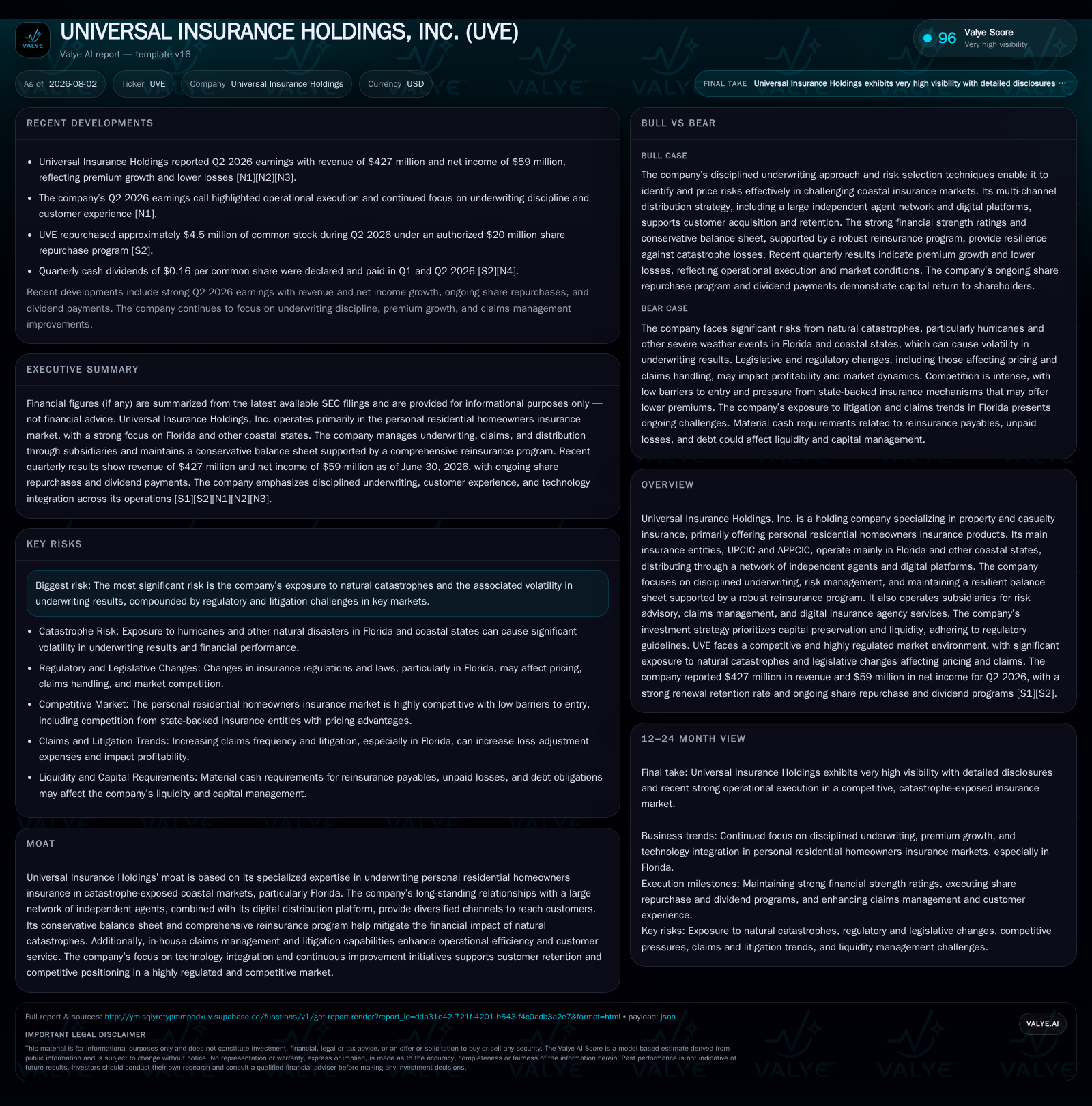
Universal Insurance Holdings released strong Q2 2026 financials, reflecting enhanced underwriting discipline marked by a lower combined ratio driven by reduced catastrophe losses. The company’s diversified distribution channels, combining independent agents with its digital platform Clovered.com, support steady premium growth amid regulatory pressures. Its comprehensive reinsurance program continues to provide crucial earnings stability against volatile natural catastrophe exposure in Florida and neighboring states. With solid liquidity and conservative leverage, UVE is positioned to maintain underwriting profitability and shareholder returns in a highly regulated market.
Q2 Results Show Tangible Underwriting Improvement Bolstered by Lower Catastrophe Losses
Universal Insurance Holdings’ latest quarterly filing reveals meaningful progress in underwriting performance in the second quarter of 2026. The company reported a marked improvement in its combined ratio, driven predominantly by a reduction in catastrophe-related losses compared to prior periods [S2]. In property and casualty insurance—especially focused on personal residential homeowners lines in catastrophe-prone coastal markets like Florida—the combined ratio is a critical barometer of underwriting discipline. A lower combined ratio signals better control over claims (loss ratio) and operating expenses (expense ratio).
This improved underwriting result suggests that UVE’s risk selection and loss mitigation programs are effectively countering the inherent volatility brought by severe weather events. Given that natural catastrophes represent one of the largest sources of unpredictability for insurers operating in Florida, this development indicates an operational environment where UVE’s balance sheet is less strained during periods without major storms. The durability of such improvement will depend on whether catastrophe frequency remains moderate or if favorable loss experience reflects transient weather conditions [S2]. Continued monitoring of catastrophe loss frequency remains essential for confirmation.
Dual Distribution Strategy Enhances Premium Growth and Customer Reach
UVE’s business model capitalizes on a dual-channel distribution strategy. The bulk of premium volume flows through an extensive appointed independent agent network specializing in personal residential homeowners insurance across Florida and other coastal states [S1]. Complementing this traditional channel is UVE’s proprietary digital agency platform, Clovered.com, which partners with nearly four dozen carrier relationships offering multi-line insurance products
The combination yields several strategic advantages: independent agents provide deep local market knowledge, trusted customer relationships, and retention stability; meanwhile, the digital channel opens access to tech-savvy consumers seeking direct online policy purchases, broadening market reach while potentially lowering policy acquisition costs over time [S1]. During Q2 2026, premium growth persisted despite volatile market conditions as these two channels together enhanced policy count and broad-based customer engagement [S2].
This hybrid approach also creates resilience against shifting consumer preferences or disruptions affecting any single channel. It positions UVE comparably among peers such as HCI Group that similarly blend agent networks with digital capabilities to drive sustainable growth in high-catastrophe coastal markets.
Reinsurance as a Pillar for Earnings Stability in a Volatile Florida Market
A foundational element supporting UVE’s underwriting profits is its comprehensive reinsurance program designed to transfer material catastrophe risks off the balance sheet [S1][S2]. The company maintains multi-year contracts with reinsurers providing layered coverage above specified attachment points.
This strategy protects capital adequacy by capping potential loss severity from hurricanes or other disasters common in Florida’s insurance landscape [S1][S10]. Such reinsurance arrangements also facilitate more stable operating results across underwriting cycles by smoothing net loss experiences that could otherwise cause severe profit swings. Regulators closely scrutinize capital to surplus ratios under NAIC Risk-Based Capital requirements; well-structured reinsurance supports compliance with these standards and maintains operational licensing
The effectiveness of this approach depends heavily on reinsurer credit quality and contract terms.
Regulatory Environment Heightens Pricing Discipline and Reserve Vigilance
Operating primarily within Florida—a state notorious for regulatory complexity impacting homeowners insurance—UVE faces intense scrutiny influencing pricing flexibility and claims management practices [S1]. Legislative mandates often constrain premium increases or impose requirements that elevate claim adjustment costs.
Consequently, UVE adopts rigorous pricing discipline calibrated to absorb regulatory-driven cost pressures while preserving underwriting profit potential [S1][S2]. Reserve adequacy also becomes paramount given litigation risks associated with disputed claims or expanded coverage interpretations common in this segment
The quarterly filings underscore elevated vigilance on reserving practices to reflect changing legal landscapes. Such conservatism mitigates unexpected reserve development risking future earnings shocks but can dampen near-term profitability metrics.
Digital Agency Clovered.com Expands Strategic Footprint Alongside Independent Agents
Clovered.com emerges as a growing pillar within UVE’s distribution ecosystem offering an integrated digital experience for consumer policy purchases alongside a wide array of carrier options [S1]. This platform not only increases customer convenience but also drives operational efficiencies by reducing manual processing steps apparent in traditional agency interactions.
Its multi-carrier structure allows cross-selling opportunities among allied lines beyond homeowners coverage, diversifying revenue sources [S1]. Early investment in technology infrastructure suggests potential for scalability benefits without proportionate expense growth enhancing overall expense ratio trends if customer acquisition volumes rise
This digital channel's relative contribution remains secondary but important for future growth acceleration especially as consumer habits evolve toward online insurance shopping environments comparable to emerging industry peers.
Growth Catalysts Center on Geographic Expansion and Technology Investment
Near-term growth prospects hinge on carefully targeted geographic diversification into additional states where healthy independent agency networks exist or regulatory environments permit constructive pricing increments [S1]. Such expansions leverage existing distribution relationships minimizing upfront costs versus greenfield development.
Simultaneously, enhancements to underwriting models supported by advanced data analytics enable more precise risk segmentation facilitating profitable premium rate setting aligned with evolving market conditions [S1]. Broader product line introductions including allied coverages further augment cross-sell capacity enhancing customer lifetime value.
Together these factors align with broader industry trajectories observed among specialty regional insurers refining portfolios toward technology-enabled underwriting efficiency gains coupled with measured geographic footprints balancing risk concentration versus scale economics.
Risks Stem from Natural Catastrophes and Legislative Shifts Impacting Profitability
Natural catastrophe exposure remains the foremost risk given the inherently unpredictable severity of hurricane seasons impacting Florida-based personal homeowners insurers like UVE [S1][S2]. Losses exceeding reinsurance attachment points could strain capital reserves causing adverse earnings impacts.
Additionally, persistent changes to state regulations affecting allowable rates or enforcement intensity around claims create ongoing margin pressure elevating expense ratios or provoking greater reserve uncertainty [S1][S2]. Legal challenges related to claim disputes exacerbate this dynamic further increasing operational costs.
Market competition also pressures pricing power necessitating continual innovation balanced with prudent underwriting safeguards ensuring sustainability.
"On Deck": Monitoring Reserve Development, Pricing Trends, and Regulatory Developments Ahead of Next Quarter
Key indicators to watch going forward include patterns in reserve development signaling adequacy or need for adjustments which impact profitability metrics directly [S2]. Renewal premium pricing momentum across existing book portfolios reflects whether regulatory contexts remain supportive of margin maintenance or indicate compression.
Legal or rule-making developments announced during upcoming quarters could materially affect expense bases or claims cost assumptions requiring swift management responses visible in guidance updates or quarterly commentary [N1][N3]. These inputs will critically inform whether current underwriting gains prove sustainable amidst an uncertain macro backdrop.
Financial Profile Discussion: Strong Liquidity, Conservative Leverage Supporting Strategic Flexibility
As of June 30, 2026, UVE held approximately $532 million in cash and equivalents against total debt near $100 million resulting in net negative net debt—signaling ample liquidity headroom [F1]. This robust cash position underpins operational agility managing reinsurance obligations due within forthcoming periods estimated well below available liquidity levels per filings [S2].[F1]
Management continues authorized share repurchase activity funded by cash generated from operations demonstrating confidence in long-term capital deployment efficacy while preserving regulatory compliance buffers [S11]. Additionally, forthcoming maturity of senior unsecured notes late 2026 may lead to refinancing strategies balancing cost of capital optimization alongside maintaining conservative leverage consistent with NAIC RBC standards.
This financial posture affords UVE resilience amidst cyclical weather volatility allowing strategic investments into distribution expansion and technological initiatives without undue capital constraints.
This analysis integrates the latest disclosed operational results for Universal Insurance Holdings alongside annual context emphasizing the company's proactive risk management focus within the complex Florida homeowners insurance landscape. Underwriting discipline improvements paired with diverse distribution channels and a robust reinsurance framework serve as key differentiation pillars navigating evolving market dynamics. Nonetheless, exposure to escalating natural catastrophe events coupled with regulatory flux necessitates close tracking of reserve adequacy trends and margin-sensitive variables moving forward.
Disclaimer: This is research-only, informational analysis and not investment advice. It may include AI-generated interpretation and general industry context. Always verify important details using primary sources.

Comments