
State Street Strengthens Fixed-Income Capital and Advances Fee Growth Amid Market Volatility
Latest quarter shows resilience in fee revenue and strategic capital issuance amidst evolving regulatory and competitive pressures.
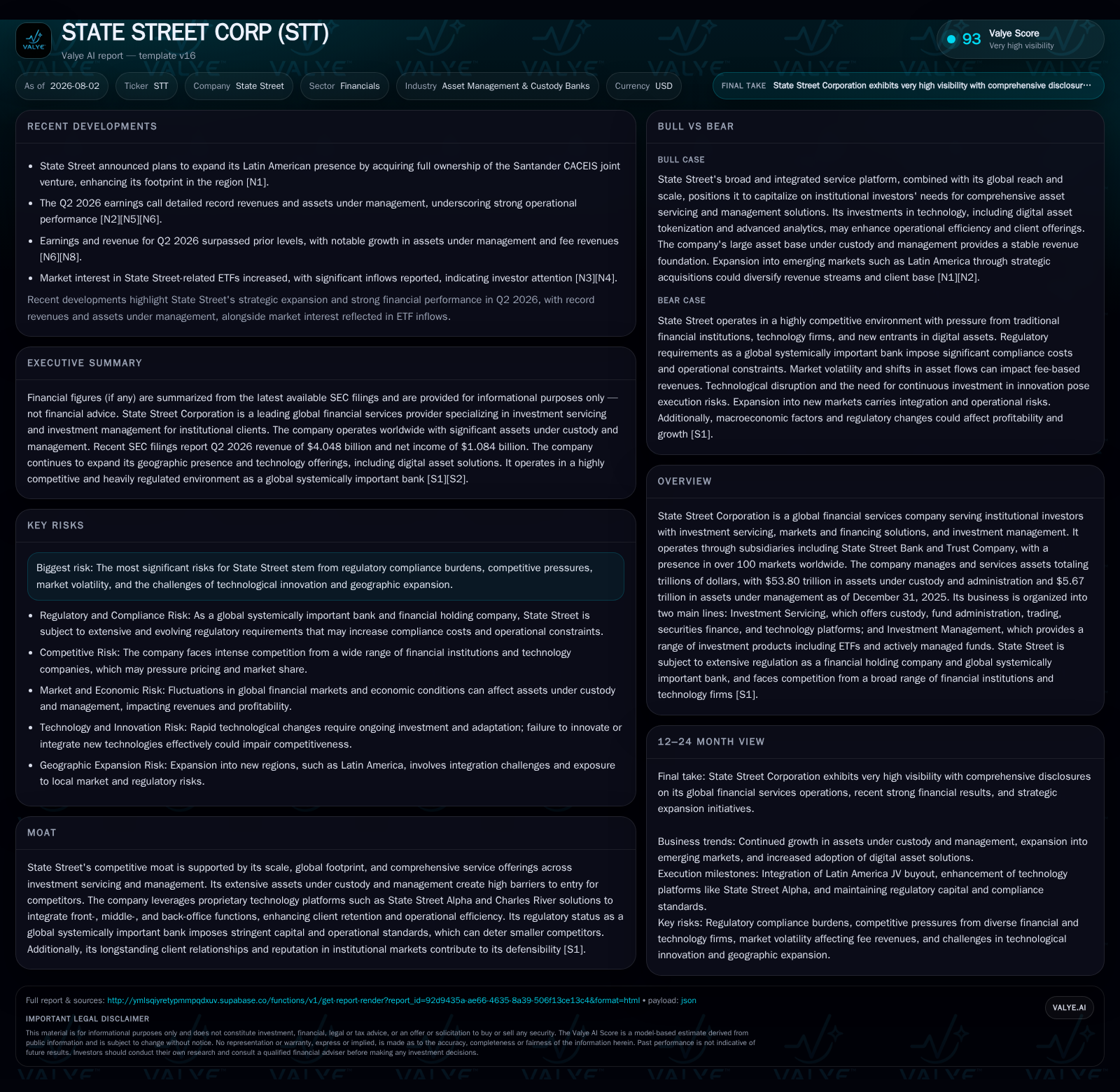
State Street Corporation reported solid second-quarter 2026 results highlighted by rising assets under custody and administration (AUC/A) and assets under management (AUM), supporting fee income growth. The company raised $1.25 billion in senior notes enhancing its capital base to navigate heightened regulatory requirements as a global systemically important bank. State Street’s scale, proprietary technology platforms, and global footprint continue to underpin its competitive moat, though ongoing pricing pressures and regulatory costs remain key challenges. Monitoring fee revenue per AUC/A and operational efficiency will be critical to assess margin sustainability going forward.
Recent Operating Update: Q2 2026 Highlights
In its latest quarterly filing ending June 30, 2026, State Street Corporation demonstrated resilience driven by strong assets under custody and administration (AUC/A) reaching $53.80 trillion as of December 31, 2025, alongside $5.67 trillion in assets under management (AUM) [S2][S1]. These sizeable asset bases continue to fuel fee revenues primarily in the Investment Servicing business line which encompasses custody, fund administration, securities finance, trading solutions, and tech platforms. The company reported total consolidated revenue growth aligned with AUC/A expansion despite macroeconomic volatility affecting transaction flows.
Additionally, on July 23, 2026, State Street Bank and Trust Company issued $750 million in senior notes due 2029 at a fixed rate of 4.701% plus $500 million senior notes due 2034 at a fixed rate of 5.217%, enhancing its regulatory capital position in response to stringent global systemic bank requirements [S3]. This sizeable debt issuance reflects management’s proactive approach to maintaining capital adequacy amidst evolving regulatory landscapes that impose heightened buffers such as the Stress Capital Buffer (SCB) replacing fixed conservation buffers under Basel III for G-SIBs [S1][S15].
Business Model: Fee-Based Institutional Servicing and Investment Management
State Street operates through two principal lines: Investment Servicing and Investment Management [S1]. The Investment Servicing segment is the cornerstone of its earnings profile delivering services critical for institutional investors—pension funds, insurance firms, asset managers—to securely hold assets (custody), administer funds including NAV calculations (fund administration), facilitate securities lending and financing activities crucial for market liquidity, plus advanced technology platforms that streamline client front-to-back office functions.
Revenue mechanics hinge on fees tied to the scale of assets serviced (AUC/A), transaction volumes processed daily across global markets, securities lending spreads earned from collateral reinvestment programs, plus subscription-style or usage fees for proprietary platforms such as State Street Alpha which integrates portfolio construction through execution with middle/back-office operations. This diversified revenue base tends toward high visibility but is subject to pressure from competitive pricing dynamics.
The complementary Investment Management line generates income by managing client portfolios via ETFs and actively managed funds. This segment benefits from the secular shift toward passive investing (ETF growth) yet contends with intense industry competition squeezing management fees to compressed levels industry-wide. Notably, this unit helps diversify revenues beyond pure servicing but requires continual innovation to maintain client engagement.
Industry Structure and Competitive Positioning
The institutional financial services space is dominated by a handful of large custodians and asset managers each leveraging significant global scale combined with robust technology infrastructure. Peers include BNY Mellon—another giant custodian known for comprehensive global asset servicing—and Northern Trust that combines wealth management with institutional custody services. On the investment management front BlackRock dominates ETFs globally.
State Street’s broad geographic reach spanning over 100 markets worldwide couples with its proprietary platforms like State Street Alpha and Charles River investment solutions confers a differentiated service offering integrating complex workflows across multiple asset classes. These technological investments create switching costs for clients while also delivering operational efficiencies that other competitors without similar scale or platform depth find difficult to replicate [S1].
However, price competition manifests strongly in both servicing fees per AUC/A as well as asset management fees. Continued consolidation in financial services introduces downward pricing pressures threatening margin expansion—a persistent challenge noted by management [S1]. Regulatory compliance demands also exacerbate cost structures especially for systemically important financial institutions subject to enhanced capital rules.
Growth Drivers Supporting Long-Term Trajectory
Substantial industry tailwinds underpin State Street’s growth prospects. First is the consistent upward trajectory in global institutional assets driven by pension funding needs in aging populations, sovereign wealth allocations from emerging markets growth phases, insurance sector reserves expansion, all boosting total investible dollars requiring custody and servicing solutions.
Second is increasing outsourcing of administrative functions by asset owners seeking specialization benefits — accelerating demand for custody banks capable of handling complex asset classes including alternatives.
Thirdly passive investment vehicles’ growth fuels investment management AUM gains; ETFs not only expand market share but also drive ancillary servicing volumes through associated transaction processing.
Fourth is the adoption of advanced financial technology platforms facilitating integrated portfolio management offers operational scalability improving client retention in competitive environments.
Finally geographic diversification into Latin America—evidenced by recent strategic moves including CACEIS joint venture buyout expanding local presence—reflects capturing emerging markets penetration potential [N7].
Risks and Watchpoints Affecting Operating Performance
Regulatory complexity remains perhaps the most salient risk factor facing State Street given its designation as a global systemically important bank (G-SIB). Compliance costs have settled at elevated levels reflecting ongoing investments in personnel, cyber controls, audit processes among others; these factors place pressure on operating margins despite revenue growth efforts [S1][S4][S5]
Moreover technological disruption from fintech entrants or niche service providers could challenge incumbents if they out-innovate on seamless API integration or deliver lower-cost alternatives eroding traditional fee pools.
Market volatility directly influences transactional volumes impacting short-term revenue variability especially within securities finance activities which rely on stable valuation frameworks.
Legal proceedings linked to fiduciary duties or regulatory inquiries carry reputational risks that may divert senior management focus or induce costly settlements—as has occurred historically—but are hard to quantify in advance [S4][S6][S22].
Client retention dynamics necessitate ongoing service excellence particularly given competitors sometimes balance acting as counterparties or larger banking clients who may seek preferential terms creating nuanced conflicts requiring safeguards.
Capital requirement adjustments—such as potential rises in G-SIB surcharge—could compel further capital raisings potentially dilutive or constrain growth initiatives until absorbed sustainably over time [S15][S16].
What to Watch Next: KPIs and Milestones Ahead
Key volume indicators to track include continued AUC/A growth signaling maintenance or expansion of core custodian relationships as well as net flows in investment management products highlighting client acquisition or retention success.
Fee revenue per unit of AUC/A or AUM will reveal pricing power trends amid competitive pressure.
Operating expense control versus revenues gauges margin sustainability given elevated compliance spending.
Adoption rates for proprietary technology platforms provide insight into future recurring revenue streams beyond traditional custody fees.
Execution milestones around digital asset servicing initiatives may signal positioning ahead of fintech disruptions transforming post-trade ecosystems.
Liquidity coverage ratios (LCR) disclosures alongside stress capital buffer (SCB) adherence will indicate balance sheet strength appropriate for regulatory expectations sustaining investor confidence.
Debt refinancing activity patterns following the recent senior note issuance will reflect capital cost optimization strategies integral to funding flexible growth without undue leverage risk [S3][S2][S7]
Financial Profile Discussion
As of December 31, 2025, State Street reported consolidated total revenue of approximately $13.94 billion with net income near $2.95 billion reflecting solid profitability supported by scale-driven fee yields across diversified segments [F1][S2]. Despite being a G-SIB subject to stringent Basel III related buffers including a current surcharge around 1%, the firm maintains robust Common Equity Tier 1 ratios reinforced through recent public debt issuances aggregating $1.25 billion aimed at shoring up longer-dated funding pools mitigating refinancing risks [S3][S15].
Net interest income contributes materially alongside fee income given large deposit bases especially operating deposits treated favorably under regulatory liquidity ratios—the LCR requirements dictate meticulous matching of high-quality liquid assets ensuring short-term resilience; State Street has complied consistently thus far reporting metrics above mandated thresholds [S2][S7]
Provisioning for credit losses remains prudent with exposure assessments focused on leveraged loan portfolios where credit risk is higher relative to commercial real estate loans collateralized but sensitive to economic downturns—a watchpoint given admitted allowances climbed moderately over recent years reflecting cautious underwriting posture [S10][S22].
Operating expenses incorporate sustained investments for compliance programs plus continued repositioning charges related to strategic realignments within technology transformation programs aiming at long-term cost competitiveness while preserving client service quality standards [S2][N1].
Overall leverage remains manageable with a total long-term debt figure consistent with maintaining committed liquidity lines reducing refinancing friction points—a critical factor given evolving capital regime demands under stress scenarios overseen by U.S. regulators including Federal Reserve supervisory exercises [F1][S20]
In summary State Street's financial position shows disciplined capital stewardship balancing shareholder return objectives against rigorous regulatory demands that tend towards costly compliance ecosystems characteristic amongst peer G-SIBs such as JPMorgan Chase or BNY Mellon who operate under similar stress buffer stipulations though differ in product breadth focus areas. This nuanced mix prompts constant recalibration between risk appetite calibrated growth investments versus conservative earnings preservation policies typical at top-tier custodianship firms.
Disclaimer
This analysis is provided solely for informational purposes without any research view regarding buying or selling securities. It is based exclusively on publicly available information sourced from SEC filings dated through July 30, 2026; company disclosures; industry benchmarks; peer comparisons; and investigative evaluation consistent with buy-side analytical standards but does not account for undisclosed material facts or events occurring after noted filings.
Disclaimer: This is research-only, informational analysis and not investment advice. It may include AI-generated interpretation and general industry context. Always verify important details using primary sources.

Comments