
LSB Industries Advances Carbon Capture Amidst Volatile Natural Gas Costs and Geopolitical Risks
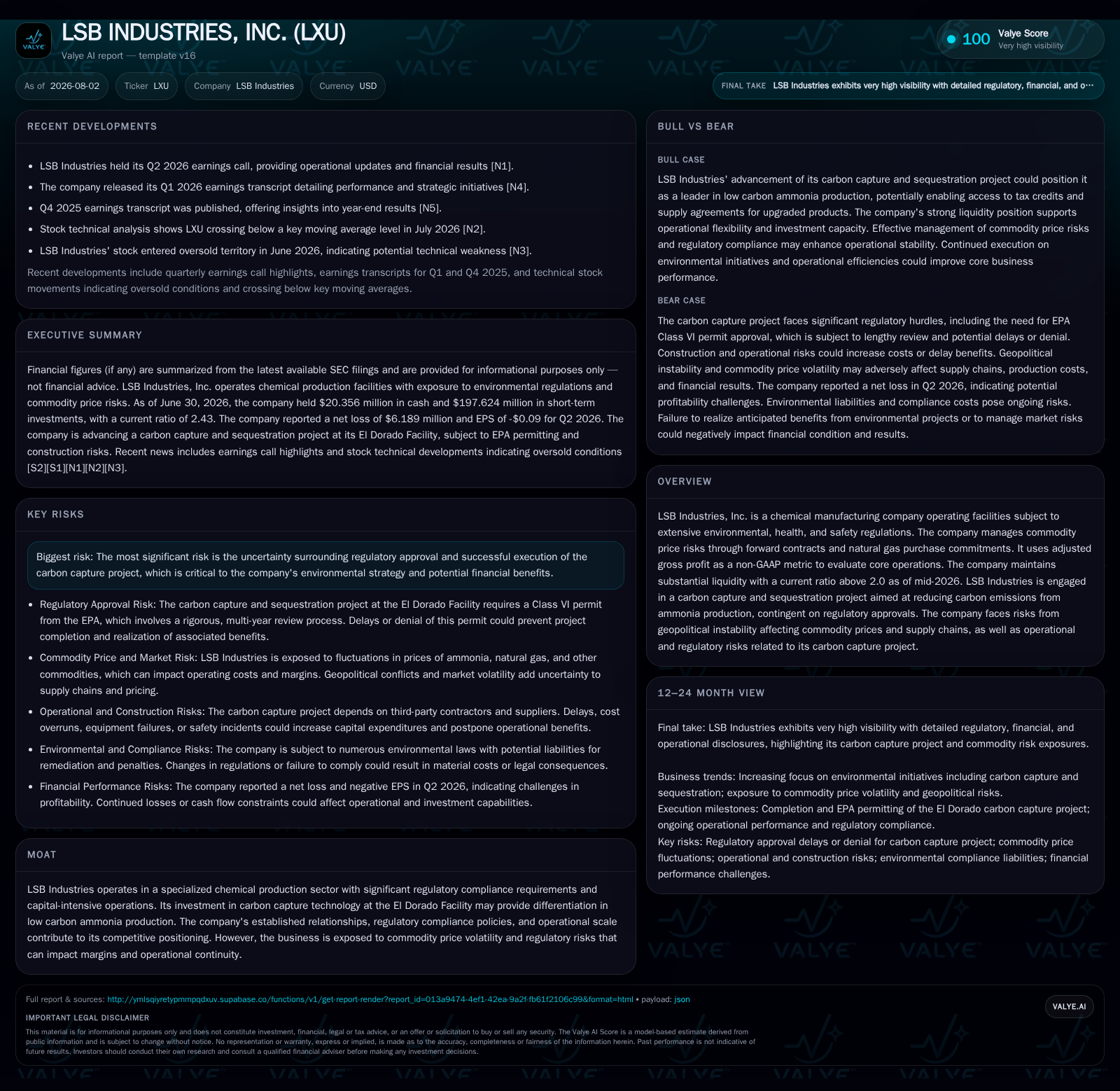
The Q2 2026 update highlights LSB Industries’ operational resilience in managing natural gas price volatility and geopolitical uncertainties while progressing its El Dorado carbon capture project, positioning the company within an evolving regulatory landscape.
LSB Industries navigates ongoing challenges from fluctuating natural gas feedstock costs exacerbated by geopolitical tensions impacting supply chains and commodity markets. The company’s use of hedging strategies and forward contracts supports margin stability, reflected in steady adjusted gross profit despite external pressures. Its strategic investment in carbon capture technology at the El Dorado Facility signals a shift toward sustainable chemical manufacturing amid stringent environmental regulations. However, legacy environmental compliance issues and regulatory risks persist, requiring continued capital allocation. Financially, LSB maintains solid short-term liquidity but carries significant indebtedness typical for capital-intensive chemical producers.
Q2 Operating Update Highlights Resilience Amid Commodity Volatility
In its quarterly report ending June 30, 2026, LSB Industries detailed the sustained impact of volatile natural gas prices—the primary feedstock for its ammonia production—compounded by geopolitical tensions affecting energy supplies and fertilizer markets [S2]. Elevated input costs challenged margin stability; however, the company maintained uninterrupted operations throughout the quarter, evidencing operational resilience. Persistent geopolitical risks, including conflicts that threaten global energy transit routes, remain significant factors influencing supply reliability and pricing power [S2], [N1]. This environment necessitates active raw material cost management amid fluctuating market conditions.
Adjusted Gross Profit Provides Clarity on Core Operational Performance
LSB employs adjusted gross profit—a non-GAAP metric excluding depreciation, amortization, and turnaround-related expenses from cost of sales—to better reflect ongoing production efficiency [S1]. The latest disclosures indicate that despite spot price fluctuations in natural gas, adjusted gross profit margins remained relatively stable during Q2 2026. This suggests effective management of production throughput and input costs through contractual procurement arrangements [S2]. Given the capital-intensive nature of chemical manufacturing where maintenance activities can distort short-term profitability, this metric is critical for assessing underlying operational health.
Hedging Strategies Mitigate Natural Gas Price Exposure
The company utilizes forward contracts and volume purchase commitments to hedge against natural gas price volatility [S1], [S2]. These instruments lock in prices for portions of anticipated consumption—often qualifying as normal purchases under accounting standards—thereby reducing spot market risk. For example, early 2026 contracts covered approximately 0.2 million MMBtus at weighted average fixed prices near $4.39/MMBtu [S24]. Such measures buffer margins from abrupt energy market swings driven by regulatory changes or demand surges within sectors like AI data centers.
Strategic Carbon Capture Project at El Dorado Signals Environmental Commitment
A pivotal strategic initiative is LSB’s carbon capture and sequestration (CCS) project at its El Dorado Facility aimed at lowering emissions from ammonia production [S1], [N1], [S3]. Pending key permits from Arkansas environmental regulators and successful demonstration of technology scalability, this project represents a forward-looking effort to align with increasingly stringent environmental standards. If realized, CCS could provide competitive differentiation through sustainability credentials and potential future incentives tied to decarbonization.
Regulatory Compliance Risks Persist Amid Environmental Challenges
Despite progress on innovation fronts, LSB continues to face regulatory scrutiny related to historic wastewater discharge violations at El Dorado [S1]. The Arkansas Department of Environmental Quality (ADEQ) mandates ongoing semi-annual monitoring under a Corrective Action Order (CAO), supported by Notices of Violation issued as recently as August 2023 [S1]. These enforcement actions impose direct costs for remediation, legal contingencies (approximately $0.7 million accrued as of year-end 2025), and necessary capital expenditures for equipment upgrades or operational adjustments to maintain permit compliance [S22]. Such legacy issues highlight enduring capital demands in operating mature chemical facilities within tight regulatory frameworks.
Capacity Utilization Influenced by Planned Turnarounds Impact Margins
LSB’s four manufacturing sites undergo periodic planned turnarounds—essential maintenance periods that temporarily reduce production capacity [S1], [S2]. These events affect capacity utilization rates—a key operational metric—as downtime decreases available output tonnage. The company’s adjusted gross profit calculation excludes turnaround expenses to isolate core production performance from these cyclical disruptions [S24]. Operating leverage effects are significant; higher utilization improves fixed cost absorption thereby expanding margins when full-scale operations resume.
Geopolitical Instability Continues to Affect Fertilizer Markets
The company identifies geopolitical conflicts such as Russia's invasion of Ukraine and Middle East tensions as principal contributors to heightened volatility across energy inputs and fertilizer product markets [S2]. Disruptions in critical shipping routes like the Strait of Hormuz increase transportation risk premiums while influencing global commodity pricing benchmarks indirectly affecting U.S.-based ammonia producers. This instability introduces seasonal uncertainty in demand-supply balances that complicate contract negotiations, pricing power with agricultural customers, and inventory management.
Forward Outlook: Regulatory Milestones and Market Monitoring Key for Growth
Upcoming focus areas include securing final regulatory approvals for the El Dorado CCS project anticipated within the next year [S3], alongside demonstrating that emissions reduction efforts do not impair operational throughput. Concurrently, post-turnaround market pricing dynamics will be closely monitored to evaluate hedging strategy effectiveness amid evolving commodity environments. Tracking natural gas futures relative to contracted prices will remain essential for managing feedstock cost risks heading into 2027.
Financial Profile Discussion: Strong Liquidity Balanced Against Elevated Debt Levels
As of June 30, 2026, LSB held approximately $20 million in cash equivalents with current assets totaling about $345 million against current liabilities near $142 million—yielding a robust current ratio of roughly 2.43 indicative of solid short-term liquidity [F1], [S2]. However, total debt outstanding stands at approximately $441 million with net debt (debt less cash) exceeding $420 million [F1]. This leverage aligns with industry norms given the capital intensity of specialty chemical manufacturing but constrains financial flexibility compared to peers with lower debt profiles or larger revolving credit facilities. Sustained free cash flow generation remains critical to meet interest obligations amid uncertain commodity price cycles.
LSB Industries operates within a complex commodity chemical landscape where natural gas feedstock volatility requires disciplined hedging complemented by operational scale efficiencies. Its strategic pivot toward carbon capture technology positions it competitively amid tightening environmental regulations demanding innovation beyond compliance toward sustainable operations. Nonetheless, legacy environmental liabilities pose ongoing risks requiring vigilant capital management alongside growth investments. Geopolitical uncertainties further complicate fertilizer market dynamics downstream from ammonia production. Financial metrics reflect typical sector trade-offs between liquidity strength and leverage constraints inherent in capital-intensive operations necessitating prudent balance sheet stewardship alongside technological advancement.
Disclaimer: This analysis is based solely on publicly available filings through July 30, 2026, supplemented by recent news disclosures up to August 2026. It does not constitute investment advice or research views regarding securities discussed herein.
Disclaimer: This is research-only, informational analysis and not investment advice. It may include AI-generated interpretation and general industry context. Always verify important details using primary sources.

Comments