
SPS Commerce Strengthens SaaS Recurring Revenue Amid Strategic Leadership Changes
Q2 2026 results reveal stable liquidity and earnings amid a CFO transition, underscoring SPS Commerce’s SaaS model resilience and execution risks.
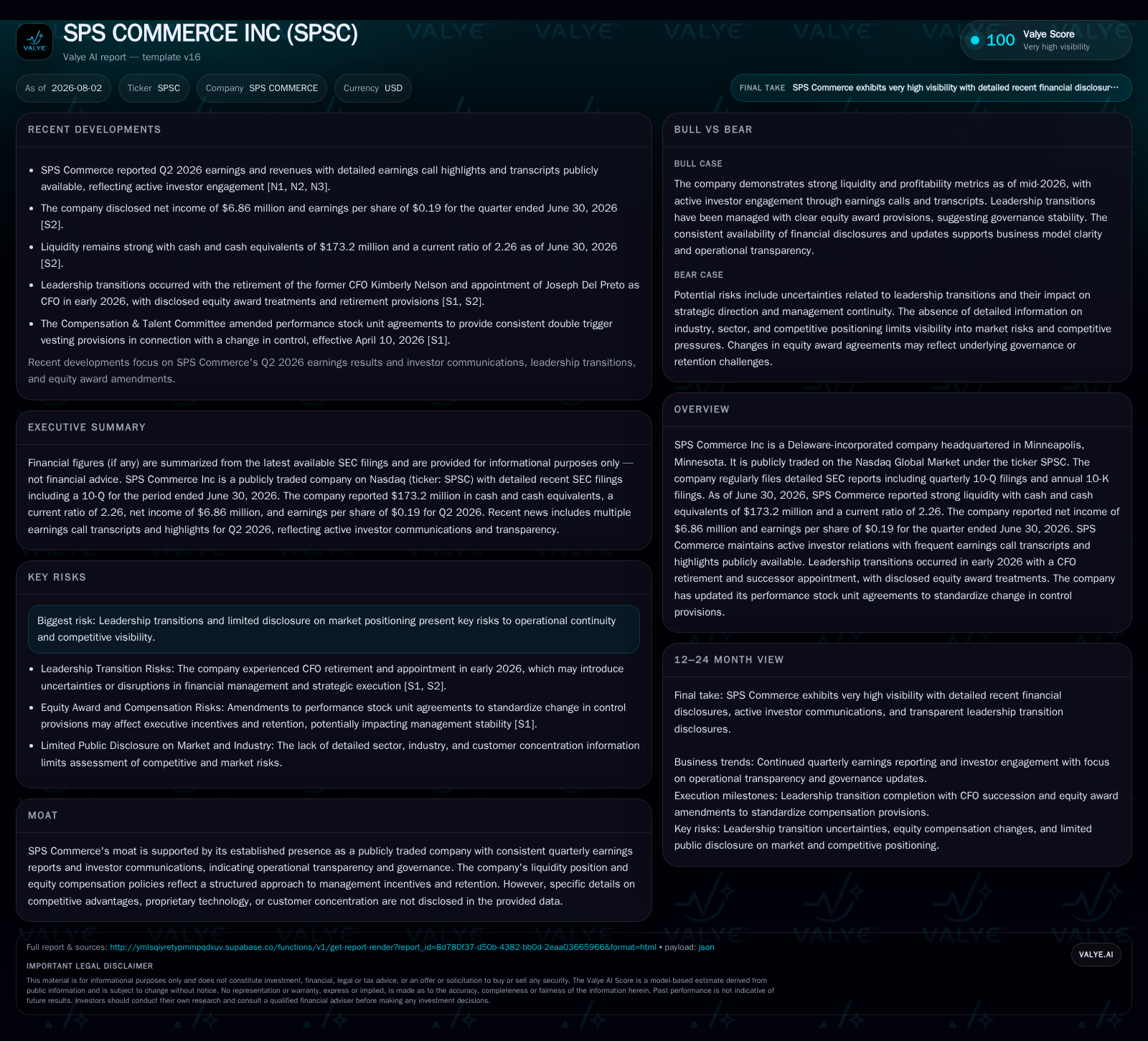
SPS Commerce reported Q2 2026 earnings that surpassed expectations with net income of $6.86 million and strong liquidity evidenced by $173.2 million cash and a current ratio of 2.26. The company’s subscription-based SaaS platform continues to demonstrate durability through steady recurring revenue streams supported by multi-tenant cloud architecture and integration-focused professional services. However, leadership transitions at the executive level introduce operational continuity risks that warrant monitoring. Peer benchmarking against SaaS incumbents like Shopify and Salesforce highlights SPS Commerce’s growth potential through platform scalability and customer retention metrics, especially net dollar retention rates and reduced churn. Vigilance on ARR expansion, margin trends, and renewal rates will be key upcoming milestones.
Q2 Operational Highlights Signal Resilient Recurring Revenue Model
In its latest quarterly filing dated July 30, 2026, SPS Commerce reported net income of $6.86 million (EPS $0.19) for Q2 2026 that beat consensus expectations [S2],[N3],[F1]. This affirms the company’s ability to sustain operational momentum in a macro environment where IT spending has shown caution. Importantly, liquidity remains strong with cash and cash equivalents totaling $173.2 million alongside a current ratio of 2.26 as of the quarter end [F1], underscoring a solid financial foundation to support continued investments in platform innovation and sales capacity without reliance on external capital markets in the near term.
These financial markers reflect SPS Commerce’s durability as a SaaS vendor embedding itself into complex B2B commerce networks where supply chain automation drives essential transaction processing. While macroeconomic softness may impose some pressure on discretionary IT budgets broadly, SPS’s recurring subscription revenue streams demonstrate resilience; this is typical in well-positioned supply chain SaaS platforms due to their stickiness and critical integration into retail and logistics workflows.
Subscription Platform Dynamics: Strengths in Scaling & Customer Retention
As detailed in the company’s latest annual filing ([S1]), SPS Commerce operates a multi-tenant cloud platform delivering software as a service with a primary focus on supply chain automation solutions that connect retailers, suppliers, distributors, logistics providers, and marketplaces. This architecture enables scalable deployment to thousands of customers without the need for on-premises installations.
Revenue is predominantly subscription-based licensing fees charged to customers for access to the platform's data exchange networks enhanced by professional services such as implementation support and API integration consulting. The usage-based pricing component is less emphasized but offers flexibility for growing accounts.
From an operational perspective, net dollar retention rate (measuring expansion revenue from existing customers minus churn) is paramount to driving lifetime value and overall ARR growth sustainability. The company’s investments in robust integration APIs increase switching costs for customers by embedding workflows deeply into their back-office systems, making churn management more effective compared to less integrated SaaS offerings.
Professional services act both as an upfront onboarding enabler and ongoing upsell vector—critical levers in managing customer acquisition cost (CAC) efficiency amidst competitive SaaS dynamics where large incumbents exert downward price pressure.
Leadership Transitions Pose Both Risks and Renewal Opportunities
The first half of 2026 saw significant executive turnover with the retirement of the CFO Kimberly Nelson and appointment of Joseph Del Preto as her successor [S3],[S24]. Accompanying this change was an update to performance stock unit agreements explicitly standardizing change-in-control provisions designed to align incentives during the transition period.
While well-managed from an equity compensation governance standpoint, such leadership changes introduce inherent risk around strategic continuity at a pivotal time when sustaining ARR growth requires tight execution across sales operations, product development prioritization, and customer success functions.
The company has highlighted intentions to retain other key senior management members through tailored equity incentives signaling awareness of retention risks during this inflection [S3]. Confirmation of a smooth transition would come from stable or improving sales efficiency metrics alongside consistent renewal rates in coming quarters.
Competitive SaaS Ecosystem: Peers Provide Context for Growth Prospects
Within the software-as-a-service ecosystem focusing on supply chain data exchanges, SPS Commerce aligns with specialized platform providers distinguished by deep vertical domain expertise rather than broad horizontal coverage. Shopify represents a notable peer benchmark given its embedding into e-commerce merchant ecosystems with strong network effects facilitating seamless third-party integrations.
Salesforce.com offers a parallel case study showing how subscription SaaS platforms can scale customer acquisition while managing churn effectively through comprehensive CRM functionality—underscoring the importance of cross-channel renewal efforts which SPS also pursues via its professional services model.
Workday exemplifies another comparable enterprise SaaS case managing operational continuity amid leadership transitions—and provides insights into governance practices that can mitigate executive turnover impacts on long-term growth trajectories.
These benchmarks highlight that sustaining high gross margins above typical software levels (often exceeding 70%) paired with disciplined ARR expansion underpins durable shareholder value in this sector.
Growth Catalysts: Integration Enhancements and Market Expansion Paths
Future growth vectors stem from broadening integration capabilities through API enhancements which facilitate faster onboarding for new customers and deeper engagement within existing accounts driving incremental usage-based billing possibilities.
Simultaneously, accelerating demand across industries for digital transformation of supply chains—partly driven by increasing complexity in omnichannel retailing—provides substantial addressable market expansion.
Cross-selling opportunities pervade given SPS Commerce's position connecting diverse trading partners; thus revenue leveraging existing contracts through added modules or premium service tiers is an ongoing focus area underpinning net dollar retention improvements.
This roadmap aligns with broader SaaS trends emphasizing scalability afforded by multi-tenant cloud platforms offering continuous feature deployment without disruption—a key advantage over legacy on-premise competitors eventually phasing out.
Risks to Monitor: Churn Risks, Execution Amid Management Changes
Item 1A risk disclosures emphasize customer churn impact on recurring revenue stability as a material vulnerability given market competition from larger cloud incumbents possessing broader ecosystems [S2],[S19]. Although not specifically flagged as imminent threats for SPS Commerce alone, vigilance here is critical since elevated churn can erode lifetime value rapidly affecting bookings visibility.
Data privacy regulations impacting cross-border supply chain data exchanges further complicate compliance burdens with potential service interruptions or increased operating costs if overlooked. Such regulatory evolution typifies modern SaaS operational hazards requiring proactive risk management embedding cybersecurity resilience into platform development cycles.
Leadership transitions compound these execution risks by potentially disrupting sales momentum or slowing product innovation cycles during key platform enhancement phases [S3]. Effective succession will be validated by stable personnel retention figures in related departments together with continuous improvement indicators such as enhanced renewal rates or billing expansions.
Upcoming Milestones: Monitoring ARR Expansion and Margins
Earnings calls surrounding the recent Q2 release have underscored management’s focus on tracking ARR growth rate trajectory quarterly alongside maintaining gross margin percentages indicative of operating leverage gains achievable through cloud infrastructure scalability combined with optimized cost structures [N1],[N2].
Renewal rates post-leadership transition will be particularly insightful since they directly relate to customer satisfaction levels underpinning retention economics central to long-term valuation sustainability in subscription models.
Additional KPIs include sales efficiency metrics measuring new bookings relative to sales spend which reflects effectiveness amid evolving go-to-market initiatives after executive team reshuffling.
Financial Profile Discussion: Strong Liquidity Supports Growth Investments
As of June 30, 2026, SPS Commerce held cash & equivalents totaling $173.2 million along with current assets at $330.4 million versus current liabilities at $146.3 million yielding a healthy current ratio of 2.26—all confirming ample short-term liquidity buffers that enable ongoing R&D investments alongside targeted sales force expansion without immediate capital raising pressures [F1]
This fiscal sturdiness is crucial since it provides runway amidst shifting leadership dynamics while allowing management discretion over strategic positioning including potential opportunistic acquisitions or expanding professional services footprints enhancing overall monetization mix.
In essence, the company’s financial positioning complements its subscription-based business economics characterized by recurring revenue stability bolstered through platform scalability.
Disclaimer: This is research-only, informational analysis and not investment advice. It may include AI-generated interpretation and general industry context. Always verify important details using primary sources.

Comments