
Bausch Health Advances Diversified Portfolio and Revenue Growth Despite Debt Burden
Bausch Health reports solid growth in branded pharmaceuticals and medical devices, balanced against significant leverage and regulatory headwinds.
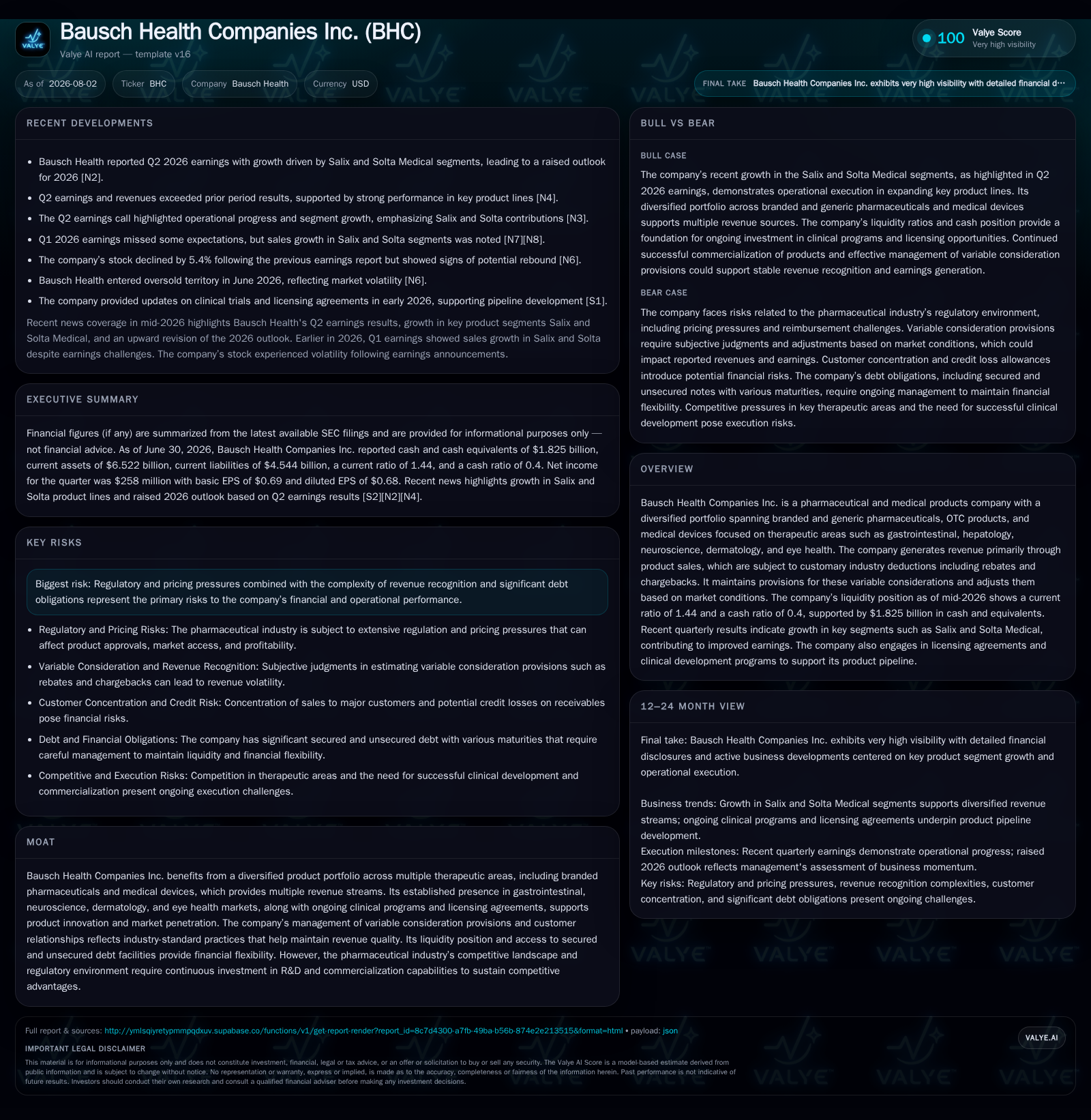
In Q2 2026, Bausch Health demonstrated operational resilience with revenue gains driven by its Salix pharmaceutical segment and Solta Medical aesthetic devices. The company manages a complex business model across multiple therapeutic areas including gastrointestinal, neuroscience, dermatology, and eye health. While diversified revenue streams mitigate competitive pressures, Bausch's financial health is constrained by substantial debt. Continued focus on clinical development, licensing partnerships, and effective revenue recognition amid regulatory pricing pressures will be critical to sustaining growth and cash flow.
Recent Operating Update
Management emphasized that they actively monitor variable consideration provisions tied to rebates, chargebacks, distribution fees, and other industry-standard deductions that affect net revenue recognition. These estimates are periodically revised to reflect shifting market conditions and trade inventory levels to ensure accurate reporting of product sales [S2]. This ongoing adjustment process highlights the complexity of pharmaceutical revenue recognition amid evolving payer landscapes.
Business Model and Strategic Position
Bausch Health operates a multifaceted business model combining branded pharmaceuticals, generic drugs, over-the-counter (OTC) products, and medical devices. Its portfolio spans several therapeutic categories including gastrointestinal (Salix), hepatology, neuroscience, dermatology, and eye health under the Bausch + Lomb brand [S1].
Revenue is predominantly generated through direct product sales to wholesalers, distributors, pharmacies, healthcare providers, and various healthcare payers [S1]. The model includes customary contract terms allowing rebates and price adjustments that impact gross-to-net calculations. Licensing agreements further supplement income streams with milestone payments and royalties recognized as earned under applicable accounting standards
The company’s ability to commercialize both pharmaceutical products and medical device technologies differentiates it from peers focused solely on one product type. For example, the Solta Medical segment enhances revenue diversity by selling technologically advanced aesthetic devices through controlled distribution channels globally [S1]. This diversification also cushions Bausch against patent cliffs typical in branded pharmaceuticals.
Industry Structure and Competitive Position
Pharmaceuticals and medical products form a highly regulated industry requiring sustained R&D investment for pipeline progression coupled with robust commercialization capabilities to achieve market access. Bausch’s strategic footprint across mid-to-late stages of drug development integrates manufacturing scale with marketing reach.
Peers include large diversified pharma conglomerates such as Pfizer or Johnson & Johnson who also balance branded drugs with device businesses. At the generic drug level, competitors like Teva offer lower-margin volume-driven models while device manufacturers like Medtronic focus largely on hardware innovation versus pharma’s complex formulations.
Bausch’s established presence in several therapeutic areas provides a foundation for recurring revenues supported by patent protections or limited competition in select markets. However, it faces typical industry headwinds involving generic competition risks post-patent expiration alongside pricing pressures intensified by healthcare reform policies aimed at reducing drug costs.
Growth Drivers
Multiple growth levers exist for Bausch Health anchored on product launches, lifecycle management initiatives for existing portfolio brands (notably in gastrointestinal and eye health specialties), and geographic expansion efforts.
A material recent strategic move was the acquisition of Wuhan Shibo Zhenmei Technology Co., Ltd., granting full control over Solta Medical aesthetic device distribution in China—a rapidly growing market—bolstering top-line momentum for this segment [S1].
Additionally, ongoing clinical development programs targeting innovation across neuroscience and dermatology reinforce the medium-term pipeline potential. Maintaining high R&D intensity ensures a steady stream of new formulations or device enhancements subject to eventual regulatory approval [S1]
Licensing agreements act as supplementary growth drivers providing non-dilutive funding sources through milestone payments linked to pipeline achievements or commercialization thresholds reached by partners.
Demographic factors such as aging populations globally underpin increased demand for treatments spanning eye health to gastrointestinal disorders. Moreover, aesthetic device adoption is climbing amid consumer-driven healthcare trends enhancing Solta Medical’s market opportunity.
Risks and Growth Constraints
Despite operational advances, Bausch contends with several layered risks typical of pharmas with significant debt burdens:
- The company carried approximately $20.239 billion in total debt offset somewhat by $1.825 billion cash equivalents at quarter-end June 30, 2026—yielding a net debt position around $18.4 billion—and a current ratio of 1.44 indicating adequate near-term liquidity but ongoing leverage concerns [F1][S2].
- Pricing pressure from legislation such as the Inflation Reduction Act (IRA) introduces negotiated Medicare prices expected to take effect around 2027 affecting flagship branded drugs like Xifaxan which contribute materially to Salix segment revenues [S7].
- Complexities in revenue recognition due to extensive rebate programs mandate continuous provision adjustments to avoid material misstatements; unexpected shifts in payer behavior could impair future reported margins [S2][S7].
- Regulatory risks remain material given long approval cycles for new products or reformulations; failure or delay could hamper pipeline replenishment critical for sustaining growth.
- Market access challenges linked to reimbursement negotiations may limit effective commercialization especially outside the U.S., where pricing controls are often stricter.
- The necessity for ongoing capital allocation toward R&D competes with debt servicing requirements potentially restricting financial flexibility for opportunistic acquisitions or marketing investments.
What To Watch Next
Key near-term milestones include progress updates from clinical trials particularly within neurosciences or dermatology pipelines that could unlock future regulatory filings or partnering opportunities. Monitoring advancement at Solta Medical post-China acquisition will clarify capacity for sustained device sales acceleration.
Financially, watch how management navigates evolving rebate estimates and adjusts provisions which are crucial indicators of underlying demand sustainability versus inventory channel shifts. Additionally, capital markets attention will focus on debt refinancing progress or deleveraging efforts given the elevated gross leverage ratio.
Pricing environment evolution influenced by IRA implementation timeline along with CMS drug price negotiations will significantly impact net realized prices on key products starting late 2026 onward.
Commercial execution effectiveness across geographic expansions remains critical; tracking International RX segment revenues alongside U.S.-based operations will help decipher global market penetration success.
Financial Profile Discussion
Bausch Health’s balance sheet displays substantial leverage typical of companies with prior acquisition-fueled growth strategies but tempered by respectable liquidity metrics: cash balances stood at approximately $1.825 billion with current assets exceeding current liabilities at a ratio of 1.44 as of June 30, 2026 providing manageable short-term coverage [F1][S2]. Operating cash flow generation suggests improving conversion capacity backed by incremental top-line expansion from core segments; however net losses moderated by non-cash impairments included significant goodwill write-downs reflecting portfolio repricing exercises during recent years [S2]. Ongoing capex spending supports manufacturing capabilities essential for supply continuity while acquisition-related outlays remain modest following prior major deals such as China distribution assumption for Solta Medical.
Gross margins benefit from mix improvements associated with higher-value branded products combined with medical device sales which typically command premium pricing compared to commoditized generics segments thereby supporting overall profitability potential despite heavy SG&A costs related to commercial infrastructure maintenance [S2][S1]. Rigorous cost management alongside selective pipeline prioritization enhances adjusted earnings before interest depreciation taxes amortization (EBITDA) performance even amid external macro uncertainties.
This analysis incorporates recent SEC disclosures as well as market commentary without offering investment advice or price targets. It focuses on fundamental business characteristics augmented with industry-standard key performance indicators relevant to evaluating pharmaceutical and medical products companies.
Disclaimer: This is research-only, informational analysis and not investment advice. It may include AI-generated interpretation and general industry context. Always verify important details using primary sources.

Comments