
Columbus McKinnon Streamlines Portfolio and Faces Profitability Challenges in Q1 2027
Recent divestitures and capital moves reshape Columbus McKinnon's industrial hardware focus while operating losses persist.
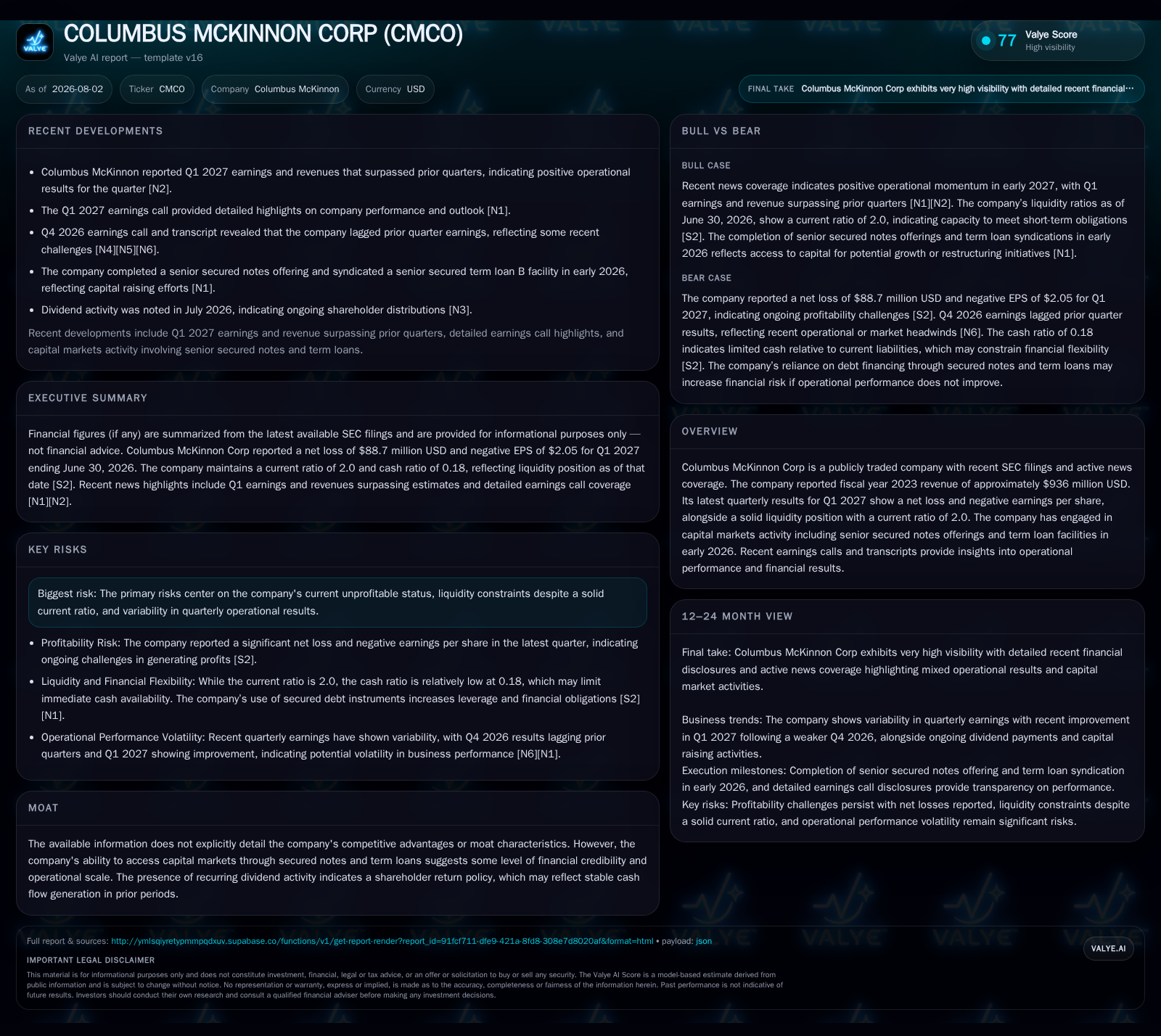
Columbus McKinnon Corporation reported Q1 2027 results reflecting ongoing net losses despite a stable liquidity position with a current ratio of 2.0, highlighting persistent profitability challenges. The company completed the divestiture of its U.S. power chain hoist and chain manufacturing operations earlier in 2026, receiving $210 million cash proceeds with additional earnout potential, signaling a strategic portfolio narrowing. Concurrently, leadership changes in the finance function aim to bolster operational oversight. Demand dynamics remain tied to industrial and construction sectors where product reliability and service support are critical competitive dimensions.
Recent Operating Update: Q1 2027 Financials Reflect Strategic Shift and Profitability Pressure
These financial outcomes coincide with recent strategic portfolio moves aimed at streamlining operations. Most notably, the company divested its U.S. power chain hoist business — excluding Little Mule® products — as well as related chain manufacturing assets early in calendar year 2026 for upfront cash proceeds of $210 million plus potential earnout payments totaling an additional $25 million subject to future sales performance during fiscal years 2027 and 2028 [S5][S12]. This divestiture reflects a decisive step towards sharpening focus on core product lines while monetizing less aligned businesses.
Business Model Overview: Product Sales Complemented by Aftermarket Services
Columbus McKinnon's revenue primarily derives from designing, manufacturing, and selling mechanical lifting products such as hoists—especially power chain hoists—and related material handling equipment primarily targeting industrial customers including manufacturers, construction firms, and logistics operators. Alongside initial equipment sales, the company generates recurring revenue streams through aftermarket parts distribution and service contracts that enhance revenue stability and margin profiles [S1][S4]. This hybrid monetization model leverages long product lifecycles typical in heavy industrial settings wherein customers require reliable load control solutions certified under stringent safety standards.
The company's distribution channels combine direct sales teams with dealer networks facilitating broad market penetration across various geographies. Custom engineered solutions also represent a portion of offerings tailored to specific customer requirements, potentially commanding premium pricing but necessitating longer development cycles and specialized capacity utilization. Key operating metrics influencing top-line growth include order backlog size indicating near-term shipment demand, average selling prices per unit reflective of product mix and inflation passthrough, production capacity utilization rates affecting throughput efficiency, along with aftermarket service revenue which tends to have higher margins than original equipment sales.
Industry Structure and Competitive Positioning
Operating within the industrial hardware and material handling sector situates Columbus McKinnon amongst diverse peers such as Dover Corporation or Enerpac Tool Group who similarly blend finished goods manufacturing with robust aftermarket support services. Industry competition often pivots on engineering innovation cycles that reduce product introduction timeframes while maintaining compliance with evolving safety standards that influence customer buying decisions heavily due to liability concerns.
Supply chain resilience also constitutes a critical competitive factor given global component dependencies; disruptions can delay production schedules impacting shipment volumes and customer satisfaction metrics like on-time delivery rates. Moreover, customer contract durations and warranty claims experience affect retention rates; extended contracts offer revenue visibility whereas elevated warranty issues can erode margins.
Columbus McKinnon's recent portfolio reshaping through selective divestitures aims to consolidate competitive strengths in differentiated lifting devices while optimizing capital allocation focused on growth segments such as aftermarket services and custom engineered products [S5][S18]. Geographically expanding presence via acquisitions like Kito Crosby broadens footprint beyond legacy North American markets enhancing diversification against regional economic cycles [S18].
Growth Drivers
Several structural factors underpin industry demand growth prospects for companies like Columbus McKinnon:
- Infrastructure spending acceleration, especially driven by government programs targeting modernization projects requiring upgrading or replacement of industrial lifting equipment.
- Industrial automation trends pushing mechanization increases lift equipment sophistication necessitating technologically advanced products.
- Replacement demand motivated by aging installed bases presents stable refresh cycles sustaining aftermarket activity.
- Emerging market expansion enabling access to new customer segments undergoing manufacturing sector development.
- Aftermarket parts & services growth, providing higher margin uplift relative to base equipment sales given recurring nature.
- Technological advancements improving product safety and operational efficiency supporting premium pricing opportunities.
- Regulatory mandates enforcing equipment upgrade cycles reinforce steady demand environments.
Monitoring order backlog levels alongside new product introduction cycle times offers insight into how effectively Columbus McKinnon capitalizes on these growth vectors internally.
Key Risks and Watchpoints
Despite strategic initiatives, several risks remain prominent:
- Cyclical end-market exposure ties performance closely to fluctuations in construction and industrial output sensitive to macroeconomic shocks.
- Raw material price volatility, including steel inputs vital for manufacturing hoists, could pressure gross margins absent effective cost pass-through mechanisms.
- Supply chain disruptions from geopolitical or logistical interruptions threaten timely component sourcing impacting capacity utilization rates.
- Technological obsolescence risk requires maintaining continuous innovation investment lest competitor offerings surpass existing product capabilities.
- Regulatory compliance complexity intensifies costs related to certification adherence or liability management frameworks.
- Customer concentration risks may cause volatility if major accounts reduce orders or switch vendors without contractual lock-ins.
- Competitive pressure from low-cost manufacturers could erode pricing power if not countered by clear differentiation through quality or service networks.
- Warranty claim rates require tight control as excessive claims inflate aftersales expenses impairing profitability.
- Capital intensity inherent to fixed asset investments limits flexibility during economic downturns if demand softens dramatically.
Staying alert to shifts in backlog trends or margin compression signals will be crucial for gauging emerging constraint impacts or financial stress onset signs.
What to Watch Next
Key monitoring points include:
- Quarterly updates on order backlog fluctuations indicating demand momentum or weakening.
- Progress against earnout-related performance targets linked to the divested business sales threshold provides partial visibility on divestiture financial benefits realization.
- Trajectory of operating income improvements or sustained losses clarifying management’s ability to drive profitability post-divestiture amidst ongoing cost pressures.
- Outcomes from leadership transition effects following July 2026 CFO changeover assessing continuity in financial stewardship.
- Evolution of aftermarket service revenues as proportion of total sales elucidating success in margin stabilization strategies.
- Any disclosure on new product launches or capacity adjustments impacting competitive standing or cost structures.
Financial Profile Discussion
As of June 30, 2026, Columbus McKinnon exhibited a healthy liquidity position highlighted by cash & equivalents approximating $98 million coupled with total current assets over $1.12 billion against current liabilities near $562 million yielding a current ratio of about 2 [F1]. These figures affirm adequacy of working capital buffers within a quarter-end frame despite trailing losses reported through March 31, 2026 [F1][S2]. Total debt stood around $463 million at March 31, 2023, reflecting moderate leverage relative to scale; however, contemporaneous leverage ratios could have shifted post-divestiture transactions though no newer debt disclosures appeared within latest filings [F1].
Overall, Columbus McKinnon’s financial position implies manageable short-term obligations coverage; however sustained unprofitability underscores the importance of structural adjustments—whether via portfolio optimization or operational efficiencies—to restore consistent positive free cash flow generation needed for deleveraging over time.
Disclaimer: This is research-only, informational analysis and not investment advice. It may include AI-generated interpretation and general industry context. Always verify important details using primary sources.

Comments